Contents / Inhaltsverzeichnis
- Introduction / Einführung
- CV
- Featured Works / Ausgewählte Arbeiten
- First Photograph, Munich 1972
- Thalia, London 1983
- A. R. Penck, Nuremberg 1994
- Emil Schumacher, Hagen 1995
- Louise Bourgeois, New York 1996
- Andreas Slominski, Hamburg 1999
- Balthus, Rossinière, Switzerland 2000
- Jeff Koons, Berlin 2000
- Beck, Hamburg 2000
- Michel Majerus, Berlin 2000
- Sir Anthony Hopkins, Berlin 2001
- Richard Ford, Berlin 2002
- Okwui Enwezor, Kassel 2002
- Lars von Trier, Copenhagen 2003
- Tom Hanks, Berlin 2004
- Claus Peymann, Berlin 2004
- Cate Blanchett, Berlin 2005
- Richard Serra, Siegen 2005
- Self-portrait, Vienna 2005
- Count Ferdinando Brachetti Peretti, Rome 2006
- Otto von Habsburg, Pöcking 2006
- Children in the Garden of Princess Mafalda of Hesse, Rome 2006
- Katrin Bellinger, LHR-MST 2006
- Luc Tuymans, Berlin 2006
- Benazir Bhutto, Dubai 2006
- Max Raabe and Marilyn Manson, Berlin 2006
- Hans Neuenfels, Berlin 2006
- Wolfgang Schäuble, Berlin 2007
- Mia Farrow, Berlin 2007
- Knut, Berlin 2007
- Richard Baron Cohen, Berlin 2007
- Thomas Harlan, Berchtesgadener Land 2007
- Oliver Pocher, Berlin 2007
- Joschka Fischer, Berlin 2007
- Sandra Hüller, Berlin 2008
- Simon de Pury, Berlin 2008
- Roberto Cavalli, Florence 2008
- Philipp Demandt, Greifswald 2008
- Angela Merkel, Berlin 2009
- Nicole Hackert, Jonathan Meese, Gunny Gudmunsdottir, Marc Brandenburg, and Bruno Brunett, Berlin 2009
- Joachim Gauck, Berlin 2010
- Philip Topolovac, Berlin 2010
- Thomas de Maizière, Berlin 2010
- Umberto Eco’s Bed, Mailand 2011
- Pope Benedict XVI., Erfurt 2011
- Günther Uecker, Düsseldorf 2011
- Ronald de Bloeme, Berlin 2011
- Bernhard von Barewisch, Groß Pankow 2011
- Hereditary Prince Maximilian and Hereditary Princess Marissa zu Bentheim-Tecklenburg with Their Children, Rheda 2012
- Cameron Carpenter and his Personal Trainer, Berlin 2012
- Yoko Ono, Berlin 2012
- Tacita Dean, Berlin 2012
- Madeleine Albright, Berlin 2013
- Maria Furtwängler and Ursula von der Leyen, Berlin 2013
- Thomas Oppermann and Alexander Dobrindt, Berlin 2013
- Dieter Hallervorden, Berlin 2013
- Ursula von der Leyen, Berlin 2014
- Idris Elba, Berlin 2014
- Adrian Ghenie, Berlin 2014
- Otto Piene, 2014
- Marcel Reich-Ranicki and Andrew Alexander Ranicki, Frankfurt am Main 2014
- Der Jungbrunnen, Berlin 2015
- Don’t be afraid of the truth, 2015
- Hoischen / Mark – “Christian Louboutin”, 2017
- Bucovina Monasteries, Romania 2017
- Jonathan Meese, Berlin 2017
- Kristen Stewart, Hamburg 2017
- Madonna, Berlin 2017
- Ursina Lardi, Berlin 2018
- Georg Friedrich Prince of Prussia, Hohenzollern Castle, Bisingen 2018
- Alicja Kwade, Berlin 2010, 2014 & 2019
- Christiane Paul, Berlin 2019
- Isa Melsheimer, Vaduz 2019
- Neue Nationalgalerie, Berlin 2020–2021
- Isa Melsheimer, Berlin 2021
- Hoischen / Mark – “untitled”, 2020
- Oliver Mark Studio, Berlin 2010–2022
- Isa Melsheimer / Oliver Mark – “Georg”, Berlin 2022
- Thomas Scheibitz / Oliver Mark – “Umbertide I and II”, Berlin 2022
- Sheikh Rashid bin Khalifa Al Khalifa, Bahrain 2022
- Klaus Mertens SJ, Berlin 2023
- Richard Roberts, Berlin 2023
- Joachim Lenz, Ventotene 2024
- Michael Kunze, Ventotene 2024
- Sean Scully, London 2024
- Julie Delpy, Berlin 2005/2025
- Isa Melsheimer, Basque Country 2025
- Alicja Kwade, Vatican City 2026
Introduction
by Felicitas Hönicke

Oliver Mark was one of the first people I met in Berlin in 2015. Time has passed since then. His perspective on time and transience—his unique way of capturing moments—is what I now aim to describe here, in November 2024 in Berlin and in April 2026.
Shortly after we met, he photographed me for the first time. Why do I mention this? Because I want to share how it felt—and I believe that many of his portrait subjects experience something similar, at least when they see the final image—provided their own vanity doesn’t get in the way. That can happen, because Mark has an intense, curious, and provocative way of seeing and photographing.
During a shoot, it’s often challenging to maintain a steady flow of conversation, as he seems to think with his eyes while photographing. Then, suddenly, he’ll deliver a witty remark or an insightful comment that pulls him back from the distance of the lens into the present moment—often, it´s in these instances that the most striking image is taken. Mark has a respectful and sensitive way of dealing with his environment and any tensions, yet he occasionally provokes intentionally to reveal something about his subject. The result is not mere exposure (at least most of the time), but rather he uncovers strength and a moment of self-assertion, which he captures.
The other day, he said to me: “Everything has its time.” This short yet profound statement reflects his appreciative view of transience and his ability to continuously question it in his images. I’d like to enrich some of these images with Oliver Mark’s memories of the stories behind their creation.
Dear readers, grab a glass of ›ORANGE‹ Riesling 2022 (Weingut Melsheimer), put on your favorite playlist (Mark’s tip: Radio FIP, FR)—let’s take it one step at a time.
Einführung
von Felicitas Hönicke
Oliver Mark war eine der ersten Personen, die ich 2015 in Berlin kennengelernt habe. Seitdem ist Zeit vergangen. Seine Einstellung zu Zeit und Vergänglichkeit – seine Art, Momente festzuhalten, beschreibe ich hier jetzt, im Berliner November 2024 und im Aril 2026.
Kurz nach unserem Kennenlernen fotografierte er mich zum ersten Mal. Warum ich das erwähne? Weil ich erzählen möchte, wie ich mich dabei gefühlt habe – und glaube, dass viele der Porträtierten Ähnliches empfinden, spätestens wenn sie das fertige Bild sehen – sofern ihnen nicht die eigene Eitelkeit dazwischenkommt. Das kann passieren, denn Mark hat eine eindringliche, interessierte und provokante Art zu sehen und zu fotografieren.
Während der Aufnahmen ist es oft schwer, in einen gleichmäßigen Gesprächsfluss zu finden, da er beim Fotografieren geradezu mit den Augen denkt. Und dann, ganz plötzlich, bringt er einen pointierten Witz oder einen Kommentar, der ihn aus der Distanz der Linse wieder direkt in die Situation holt – meist sind das die Momente, in denen das Bild entsteht. Mark hat eine respektvolle und feinsinnige Art, mit seiner Umgebung und Spannungen umzugehen – doch hin und wieder provoziert er bewusst, um sein Gegenüber zu enthüllen. Dabei entsteht keine bloße Nacktheit (zumindest meistens), sondern er bringt Stärke und einen Moment der Selbstbehauptung zum Vorschein, den er festhält.
Neulich sagte er zu mir: “Alles hat seine Zeit.” Diese kurze, aber wahre Aussage drückt seine wertschätzende Haltung zu Vergänglichkeit und seine Fähigkeit aus, sie in seinen Bildern immer wieder zu hinterfragen. Einige dieser Bilder möchte ich mit den Erinnerungen von Oliver Mark zu ihren Entstehungsgeschichten anreichern.
Liebe Lesende, greifen Sie sich ein Glas ›ORANGE‹ Riesling 2022 (Weingut Melsheimer), legen Sie Ihre Lieblingsplaylist auf (Marks Tipp: Radio FIP, FR) – wir gehen der Reihe nach.
CV
Oliver Mark, born in 1963, lives and works in Berlin. After completing his training as a photographer, he began his career at the Burda photo studios in Offenburg and has been working as a freelance photographer since 1992. He attended seminars by Prof. Katharina Sieverding (Visual Culture) as a guest student at the Berlin University of the Arts and taught photography at Hannover University of Applied Sciences and Arts from 2012 to 2014.
Mark’s work has been published in numerous outlets, including Architectural Digest, Rolling Stone, Die Zeit, Les Inrockuptibles, Vogue, Der Spiegel, Capital, Süddeutsche Zeitung Magazin, Stern, Cosmopolitan, Playboy, Time, Vanity Fair, ICON Magazin, Madame, National Geographic, Zeit Magazin, Manager Magazin, Elle, GQ – Gentlemen’s Quarterly, The New York Times, Geo und The Wall Street Journal.
His exhibition and publication projects have been presented internationally, including in Germany, Austria, Italy, Liechtenstein, Russia, Romania, England, Ireland, Scotland, France, Bulgaria, and China. Highlights include a solo exhibition in 2017 at the Picture Gallery of the Academy of Fine Arts in Vienna and at the Natural History Museum in Vienna, as well as two group exhibitions at the National Portrait Gallery in London. In 2024, he was featured at the Kunsthalle Würth in Schwäbisch Hall with an exhibition of artist portraits. At Paris Photo 2024, early and recent works were showcased at the ºCLAIRbyKahn Gallery alongside pieces by Sigalit Landau, Erich Hartmann, Eikoh Hosoe, and Chien-Chi Chang.
CV
Oliver Mark, geboren 1963, lebt und arbeitet in Berlin. Nach seiner Ausbildung zum Fotografen begann er seine Karriere in den Burda Fotostudios in Offenburg und ist seit 1992 als selbstständiger Fotograf tätig. Er besuchte als Gaststudent die Seminare von Prof. Katharina Sieverding (Visual Culture) an der Universität der Künste Berlin und lehrte von 2012 bis 2014 Fotografie an der Fachhochschule Hannover.
Marks Arbeiten wurden in zahlreichen Publikationen veröffentlicht, darunter Architectural Digest, Rolling Stone, Die Zeit, Les Inrockuptibles, Vogue, Der Spiegel, Capital, Süddeutsche Zeitung Magazin, Stern, Cosmopolitan, Playboy, Time, Vanity Fair, ICON Magazin, Madame, National Geographic, Zeit Magazin, Manager Magazin, Elle, GQ – Gentlemen’s Quarterly, The New York Times, Geo und The Wall Street Journal.
Seine Ausstellungs- und Publikationsprojekte sind international zu sehen, unter anderem in Deutschland, Österreich, Italien, Liechtenstein, Russland, Rumänien, England, Irland, Schottland, Frankreich, Bulgarien und China. Zu den Höhepunkten zählen eine Einzelausstellung 2017 in der Gemäldegalerie der Akademie der bildenden Künste Wien und im Naturhistorischen Museum Wien sowie zwei Gruppenausstellungen in der National Portrait Gallery London. 2024 war er in der Kunsthalle Würth in Schwäbisch Hall mit einer Ausstellung zu Künstlerporträts vertreten. Auf der Paris Photo 2024 wurden neben Sigalit Landau, Erich Hartmann, Eikoh Hosoe und Chien-Chi Chang frühe und neuere Arbeiten in der ºCLAIRbyKahn Gallery gezeigt.
Featured Works / Ausgewählte Arbeiten
First Photograph, Munich 1972

At the age of nine, Mark won first prize in an art competition organized by the Westdeutsche Zeitung: a trip to the 1972 Olympic Games in Munich. On this occasion, his father gifted him his first camera. He took several pictures that felt entirely different from the ones he had seen in magazines until then. His enthusiasm was sparked—and here we see a glossy silver gelatin print of one of his earliest photographs.

Mit neun Jahren gewann Mark bei einem Malwettbewerb der Westdeutschen Zeitung den ersten Preis: Eine Reise zu den Olympischen Spielen 1972 in München. Zu diesem Anlass schenkte ihm sein Vater eine Sucherkamera. Er machte einige Bilder, die ganz anders wirkten als die in den Zeitschriften, die er bis dahin kannte. Seine Begeisterung entstand – hier zu sehen ist ein glänzender Silbergelatineabzug einer seiner ersten Fotografien.
Thalia, London 1983

With a 35mm camera, a Yashica FR1 with a 50mm lens, Mark took his first portrait. It depicts his then-girlfriend Thalia, whom he met during a world trip. The work is wonderfully composed, combining spontaneity with the minimalism of the hostel environment. The chair where Mark had been sitting moments earlier was pushed back, and the table reflected light into the courtyard with its brick wall and potted plant.
Mit einer Yashica FR1 und einem 50mm Objektiv machte er sein erstes Porträt: Es zeigt seine damaligen Freundin Thalia, die er auf einer Weltreise kennenlernte. Die Arbeit ist in ihrer Spontanität und auch Sparsamkeit der Hostel-Umgebung wunderbar komponiert. Der Stuhl, auf dem Mark noch vor kurzem saß, wurde kurz nach hinten geschoben, und der Tisch reflektierte im Hinterhof mit Ziegelmauer und Topfpflanze das Licht.
A. R. Penck, Nuremberg 1994

Mark’s first artist portrait was taken with a Hasselblad 500 C/M and an 80mm 2.8 CF*T Carl Zeiss Planar lens, featuring A.R. Penck. His interest in art stemmed from his parents, who had a small collection themselves. The photograph was taken at the Maritim Hotel in Nuremberg, using a self-made backdrop and set lighting for the first time.
Sein erstes Künstlerporträt entstand mit einer Hasselblad 500 C/M, 80 mm 2.8 CF*T Carl Zeiss Planar von A.R. Penck – das Interesse für Kunst stammte von seinen Eltern, die selbst eine kleine Sammlung hatten. Das Bild hat er im Maritim Hotel in Nürnberg gemacht und dafür zum ersten Mal einen selbstgebauten Hintergrund und ein gesetztes Blitzlicht verwendet.
Emil Schumacher, Hagen 1995
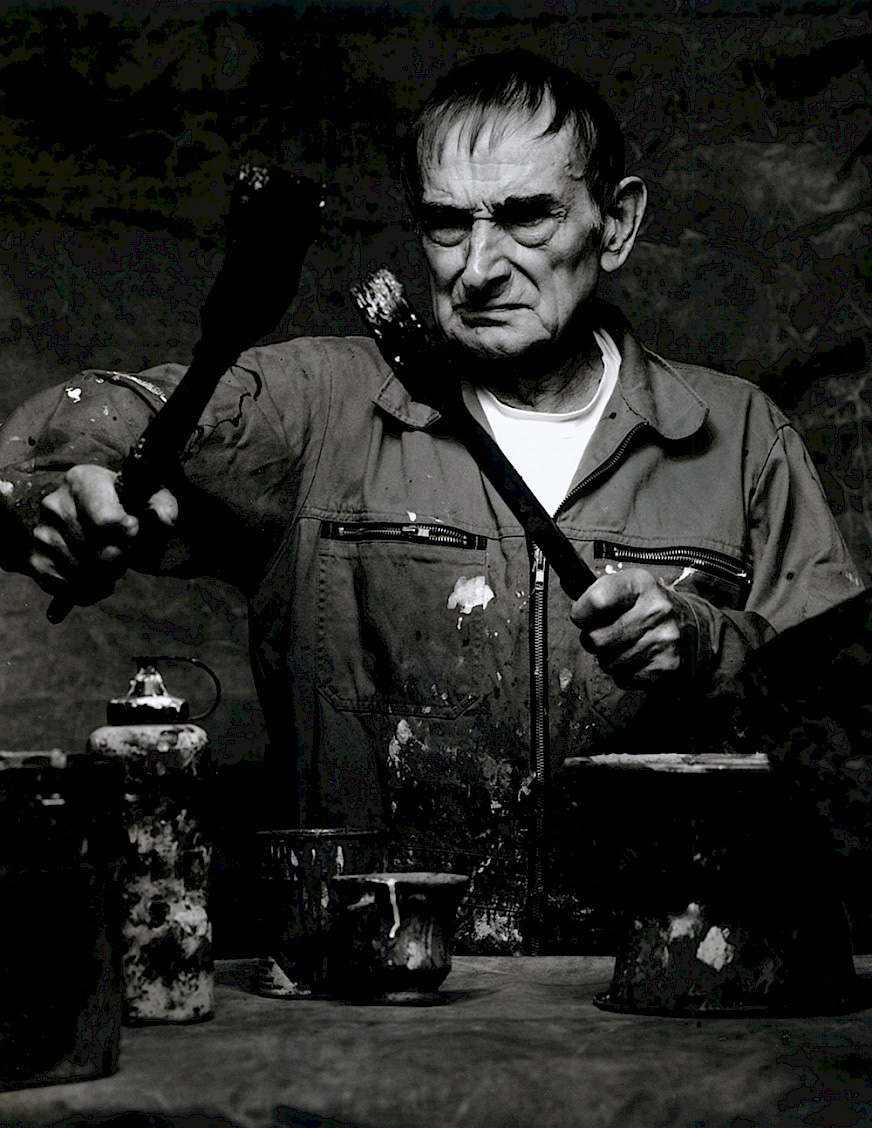
In this portrait of Schumacher, one of Mark’s early works, figuration and staging initially dominate. Dressed in overalls and holding two brushes like drumsticks, Schumacher stands by a table with bottles of paint and two small pots. At this time, Mark was still heavily influenced by Irving Penn, which is evident in his choice of backdrop. The lighting was created using a 2400-watt-second Balcar power pack and a 60cm translucent umbrella positioned about 1.5 meters above Schumacher’s head. While this setup provided dramatic effects, it was unconventional for classic portraiture, as the light didn’t illuminate the eyes much. Mark deliberately utilized this effect to create a dramatic atmosphere. The photo was taken in Schumacher’s studio in Hagen, a complex of townhouses that combined living and working spaces. After the portrait session, Schumacher showed Mark his swimming pool, where he swam daily to stay fit.
In diesem Porträt von Schumacher dominieren zunächst Figuration und Inszenierung. Wie ein Schlagzeuger steht Schumacher hier mit zwei Pinseln in den Händen, in einem Overall gekleidet, an einem Tisch. Auf dem Tisch befinden sich einige Flaschen Farbe und zwei kleine Töpfe. Zu dieser Zeit war Mark noch stark von Irving Penn beeinflusst, was sich deutlich an der Wahl des Hintergrunds erkennen lässt. Das Licht wurde mit einem 2400-WS-Balcar-Powerpack und einem 60 cm Ø großen Durchlichtschirm erzeugt, der zentral etwa 1,5 Meter über Schumachers Kopfhöhe positioniert wurde. Für ein klassisches Porträt war das Licht jedoch zu hoch angesetzt, wodurch die Augen kaum noch Licht einfingen. Genau diesen Effekt hat Mark bewusst genutzt, um eine dramatische Wirkung zu erzeugen. Die Fotografie entstand in Schumachers Atelier in Hagen, einem Komplex aus mehreren Reihenhäusern, in dem Wohnung und Atelier miteinander verbunden waren. Nach Abschluss der Porträtsitzung zeigte Schumacher Mark sein Schwimmbad im Reihenhaus, in dem er täglich seine Bahnen zog, um sich fit zu halten.
Louise Bourgeois, New York 1996
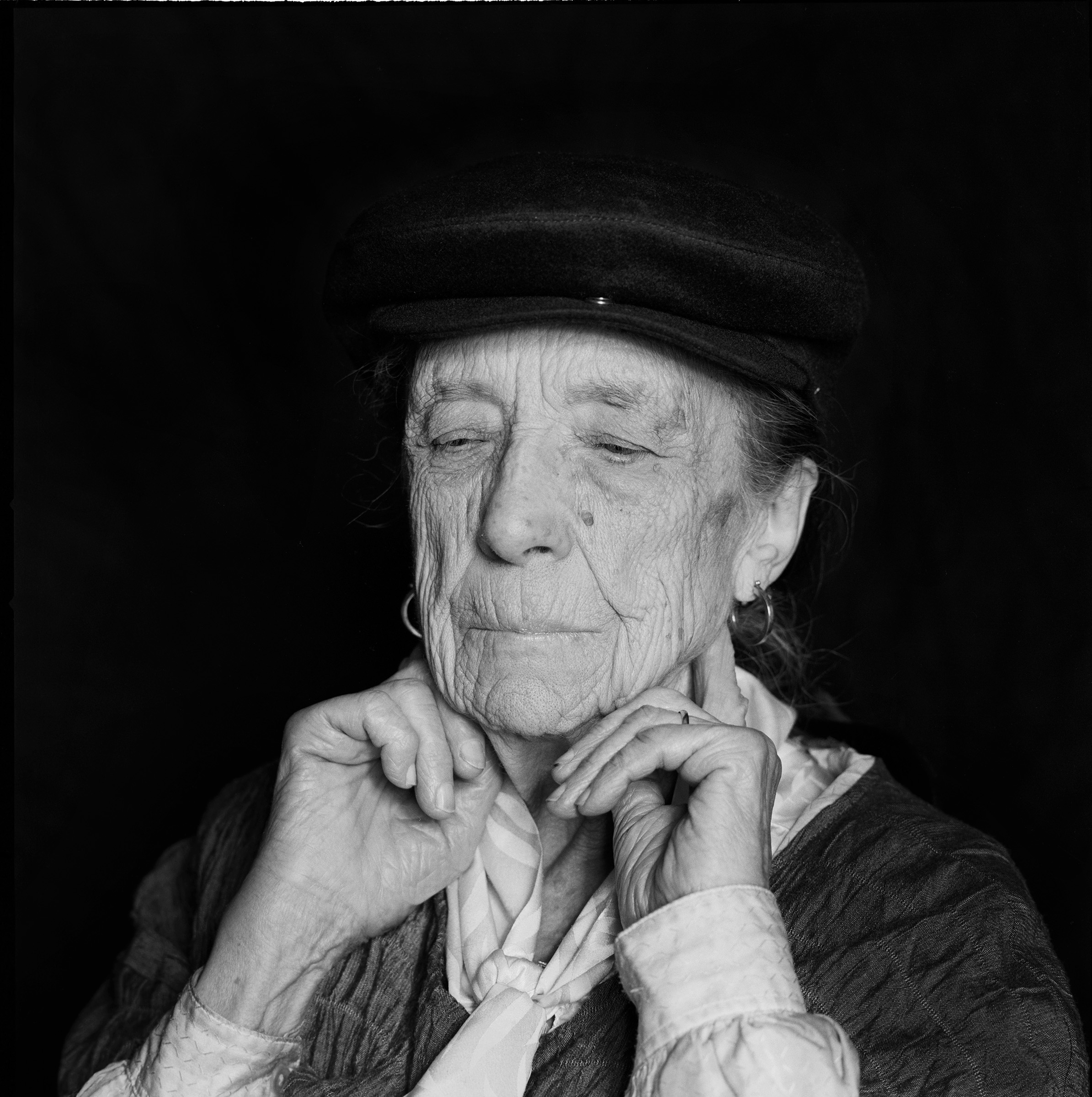
Mark was in the U.S. working as a fashion photographer on 5–6‑week assignments, with teams rotating every two weeks due to exhaustion. He used this break from commercial work for portrait sessions. Through letters and faxes, Mark arranged a shoot with Louise Bourgeois via her assistant, Jerry. Mark captured three rolls of 12 images each with his Hasselblad. Once developed, he sat with Bourgeois at a small kitchen table, reviewing contact sheets and negatives. She held scissors and systematically cut up anything she didn’t like. With each cut, Mark’s confidence dwindled until she asked for his opinion. He pointed to two favorites, which she allowed him to keep. In the end, Mark left with a handful of images and a catalog from her exhibition at the Deichtorhallen Hamburg, signed with her first name and adorned with a small drawing.
Eigentlich war Mark in den USA als Modefotograf in 5–6‑wöchigen Aufträgen tätig – alle zwei Wochen wechselte das Team aufgrund von Erschöpfung. Diese Kunstpause nutzte Mark für Porträts. Via Brief und Fax hat er mit Jerry, dem Assistenten von Bourgeois, einen Fototermin ausgemacht. Von der Künstlerin Louise Bourgeois hat Mark drei Filme à 12 Bilder mit einer Hasselblad aufgenommen. Nachdem sie entwickelt waren, saß er mit Bourgeois an einem kleinen Küchentisch. Vor ihnen lagen Kontaktbögen und Negative. Sie hatte eine Schere in der Hand und zerschnitt nach und nach alles, was ihr nicht gefiel. Oliver wurde mit jedem Schnitt etwas kleiner, bis sie ihn nach seiner Meinung fragte – er zeigte auf zwei seiner Favoriten, die er dann auch behalten durfte. Am Ende hatte er eine Handvoll Bilder und einen, von ihr mit ihrem Vornamen signierten und einer kleinen Zeichnung versehenen Katalog ihrer damaligen Ausstellung in den Deichtorhallen Hamburg.

Jenny Holzer, Leipzig 1996
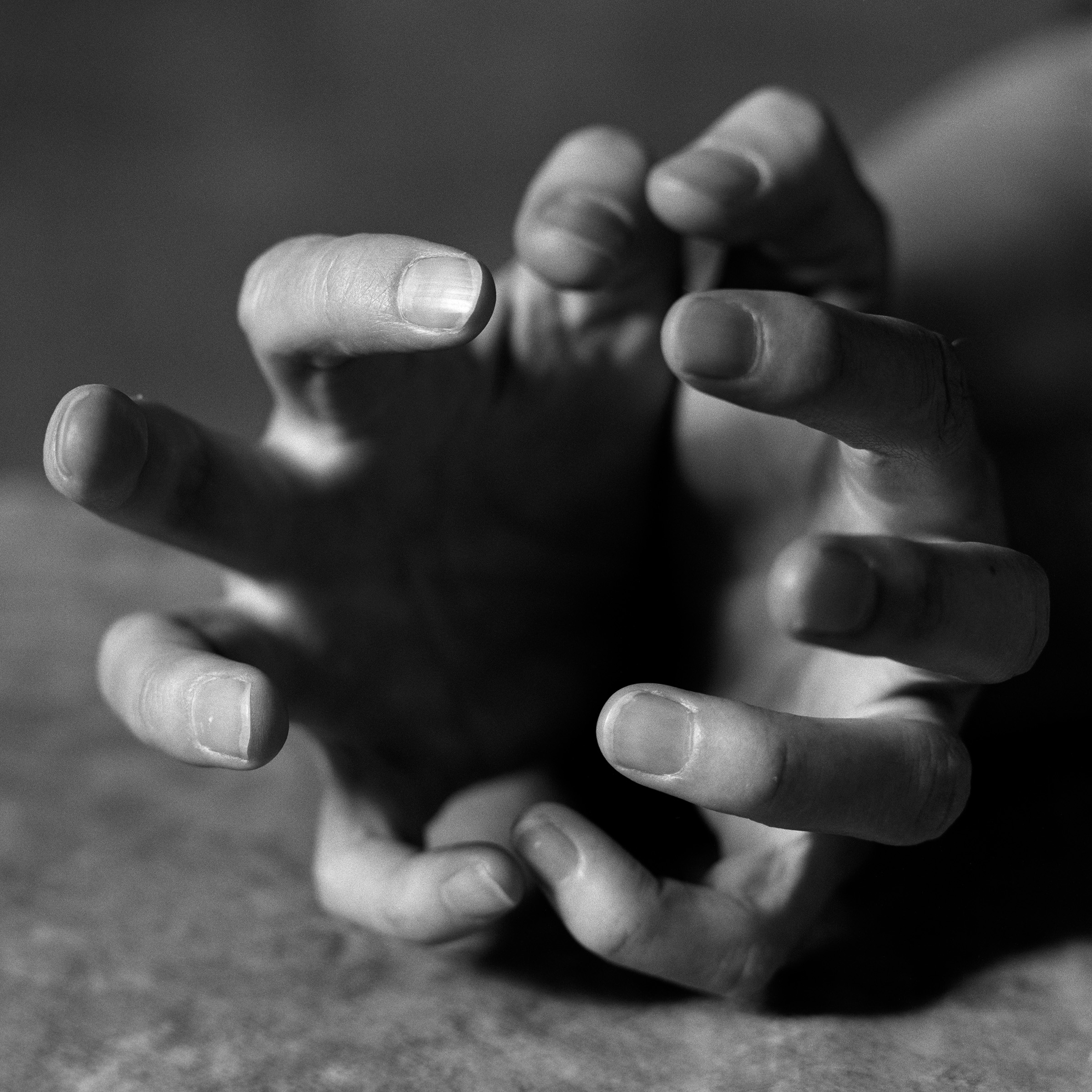
“IN A DREAM YOU SAW A WAY TO SURVIVE AND YOU WERE FULL OF JOY” – this quote by artist Jenny Holzer hangs above my desk as a postcard. Her hands, photographed here by Mark, oscillate between a stretching and reaching gesture and a protective curving. For me, this symbolizes Holzer’s work: a longing and yet also a protection – a negotiation with the current state of affairs and hope.
„IN A DREAM YOU SAW A WAY TO SURVIVE AND YOU WERE FULL OF JOY“ – dieses Zitat der Künstlerin Jenny Holzer hängt bei mir als Postkarte über dem Schreibtisch. Ihre Hände, die Mark hier fotografiert hat, changieren zwischen einem streckenden und reckenden Gestus und einem schützenden Krümmen. Für mich eine Versinnbildlichung von Holzers Arbeit: ein Sehnen und dennoch auch ein Schützen – eine Verhandlung mit dem Ist-Zustand und Hoffnung.
Andreas Slominski, Hamburg 1999

In 1999, Mark photographed the artist Andreas Slominski in Hamburg. Mark’s concept was to connect with Slominski’s work by driving through speed traps together. Slominski was famous as a “trap setter,” transforming animal traps into art objects designed to capture not animals but the viewer’s attention. Together, Mark and Slominski exceeded the speed limit twice. Unfortunately, neither the traffic fines nor the resulting photographs ever reached Mark.
1999 porträtierte Mark den Künstler Andreas Slominski in Hamburg. Marks Idee war es, mit ihm durch Radarfallen zu fahren, um so eine Verbindung zu Slominski Werk herzustellen. Berühmt wurde er als »Fallensteller«, der Tierfallen zu Kunstobjekten umfunktionierte, um nicht Tiere, sondern sein Publikum festzuhalten. Insgesamt hat Mark die zulässige Höchstgeschwindigkeit zusammen mit Andreas Slominski zweimal überschritten. Leider hat Oliver Mark die Bußgeldbescheide inklusive Aufnahmen nie erhalten.
Balthus, Rossinière, Switzerland 2000
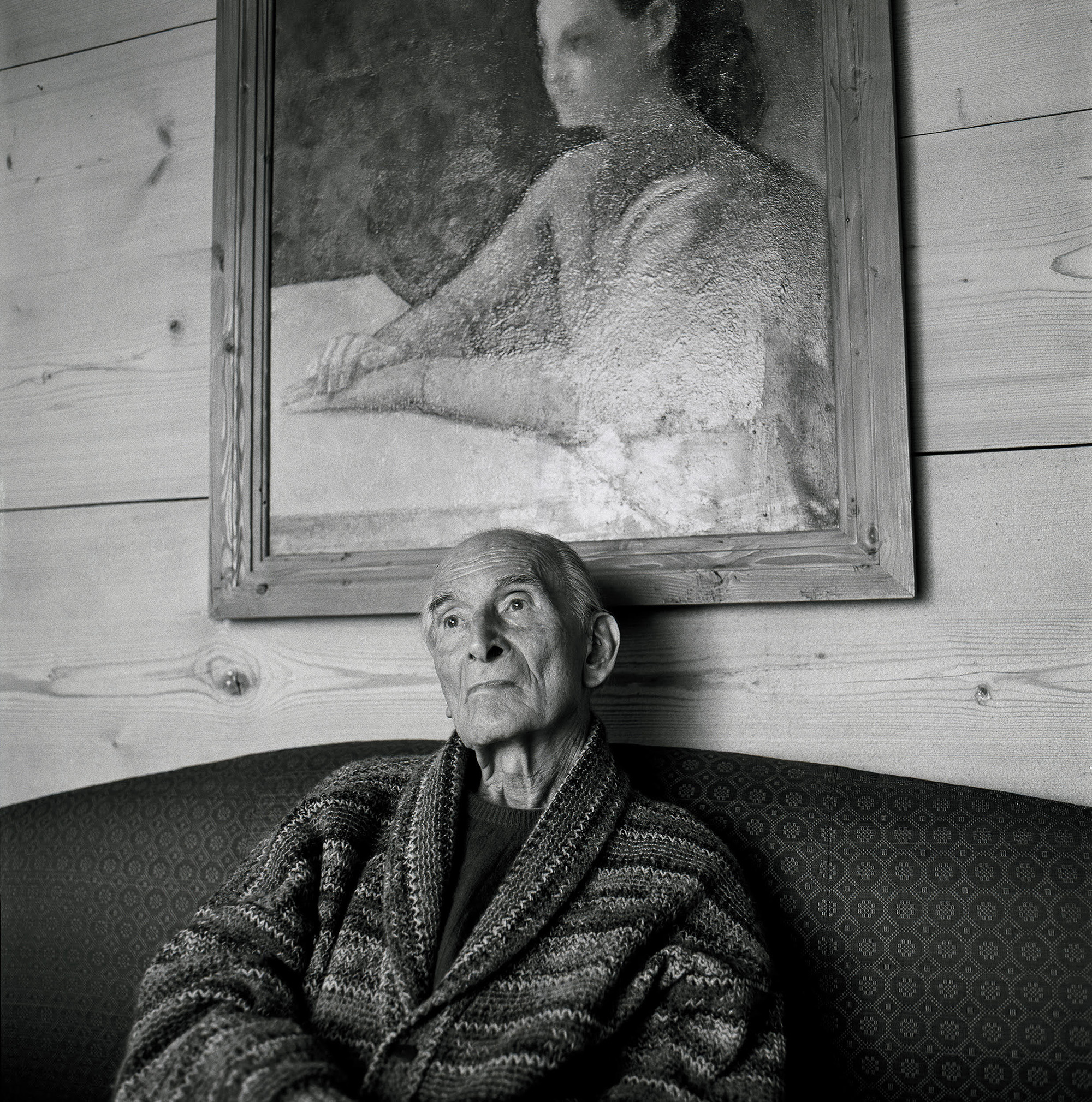
Balthus (*29.02.1908, Paris, France – †18.02.2001, Rossinière, Switzerland) sits in front of his painting Colette de Profil (1954, oil on canvas, 92.5 x 73.5 cm). The framing of the portrait includes only half-figures—those of the painting and of Balthus himself. His head serves as a connecting element between his body, the space, and the frame, as well as the flatness of the painting. These portraits of Balthus were taken on October 1, 2000, at the Grand Chalet, the largest wooden house in Switzerland. They are likely the last portraits taken of him before his death. In addition to the half-figure shots, Mark created a series of close-ups and a portrait featuring Balthus with his son Stanislas Kłossowski de Rola. As with many of his sessions, Mark began by taking a Polaroid for a lighting test. One Polaroid from this session shows Balthus with his wife Setsuko and Stanislas looking at a Struwwelpeter book.


Balthus (*29.02.1908, Paris, Frankreich – †18.02.2001, Rossinière, Schweiz) sitzt vor seinem Gemälde Colette de Profil (1954 Öl auf Leinwand, 92,5 x 73,5 cm). Im Bildausschnitt sind ausschließlich Halbfiguren zu sehen – die des Gemäldes und die von Balthus selbst. Sein Kopf wirkt wie ein verbindendes Element zwischen seinem Körper, dem Raum sowie dem Rahmen und der Flächigkeit der Malerei. Diese Porträts von Balthus entstanden am 1. Oktober 2000 im Grand Chalet, dem größten Holzhaus der Schweiz. Vermutlich waren es die letzten Porträts, die vor seinem Tod aufgenommen wurden. Neben der Halbfigur entstand auch eine Reihe von Close-ups sowie ein Porträt mit seinem Sohn Stanislas Kłossowski de Rola. Mark begann die Porträtsitzung – wie bei vielen – mit einer Polaroidaufnahme, um einen Lichttest durchzuführen. Von diesem Lichttest existiert ein einziges Polaroid, auf dem Balthus zusammen mit seiner Frau Setsuko und Stanislas Kłossowski de Rola ein Buch über Struwwelpeter anschaut.
Jeff Koons, Berlin 2000
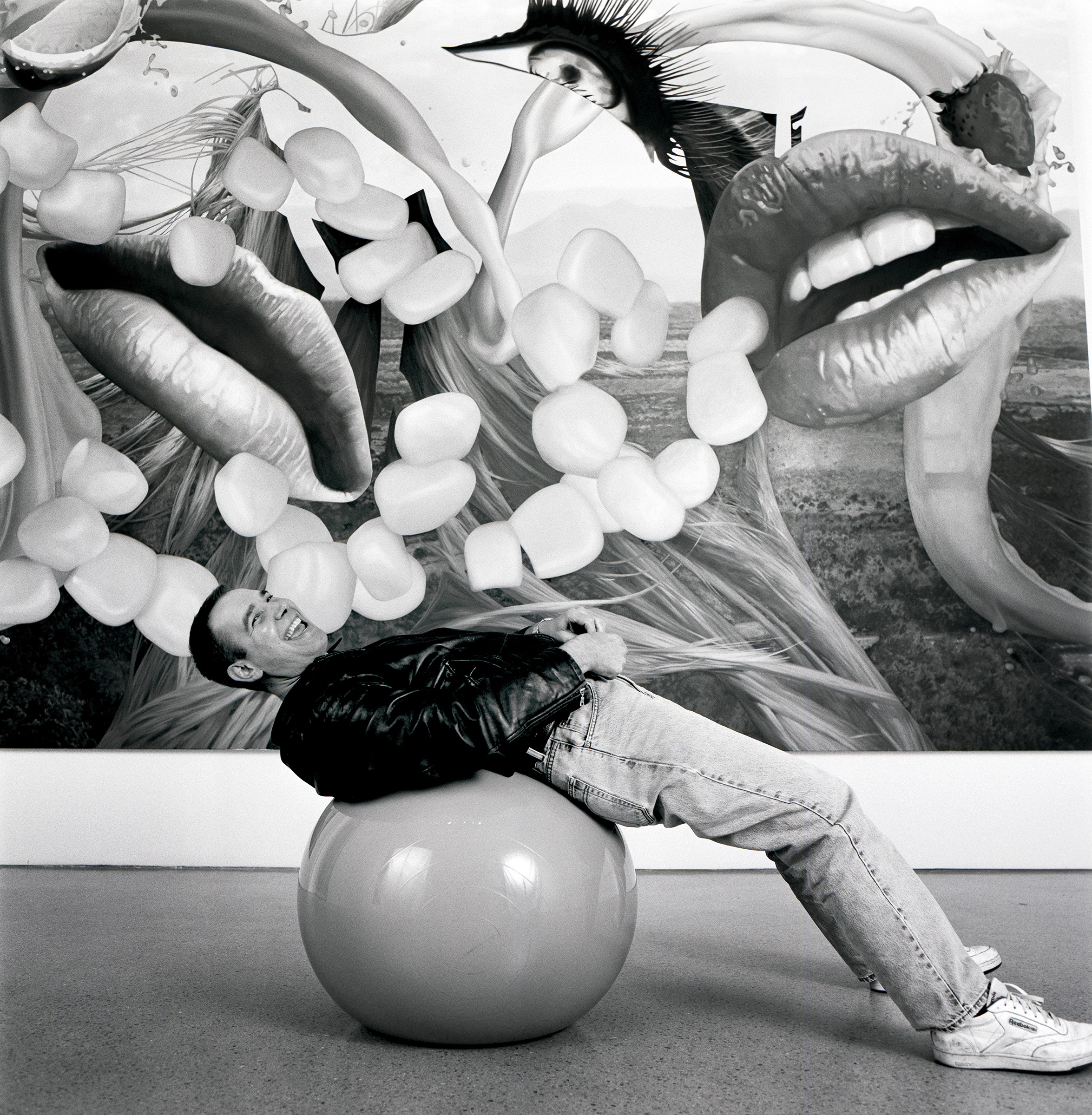
How does a rubber ball end up in the Deutsche Guggenheim? When Mark photographs Koons, of course. Mark brought this prop to create a connection between Koons’ work and the building. After a few stiff shots (“Koons sat on the ball as if he were on a tram”), Mark suggested Koons lie on his back. Koons hesitated, as his mother was present, but eventually laughed and complied. The resulting portrait is, in my opinion, incredibly cohesive. It depicts Koons in front of his work Lips (2000, oil on canvas, 304.8 x 427.7 cm)—playful!
Wie kommt ein Gummiball in das Deutsche Guggenheim? Wenn Mark ein Porträt von Koons macht. Mark hatte dieses Utensil mitgebracht, um eine Beziehung zwischen der Arbeit von Koons und dem Gebäude zu erstellen. Nach einigen starren Aufnahmen („Koons saß auf dem Ball wie in einer Straßenbahn“) schlug Mark vor, dass Koons sich doch mal auf den Rücken legen solle. Koons zögerte, seine Mutter war anwesend, ließ sich dann aber doch lachend auf den Vorschlag ein. Es entstand folgendes, wie ich finde, unglaublich stimmiges Porträt. Koons vor seinem Werk Lips (2000, Öl auf Leinwand, 304,8 x 427,7 cm) – playful!
Beck, Hamburg 2000
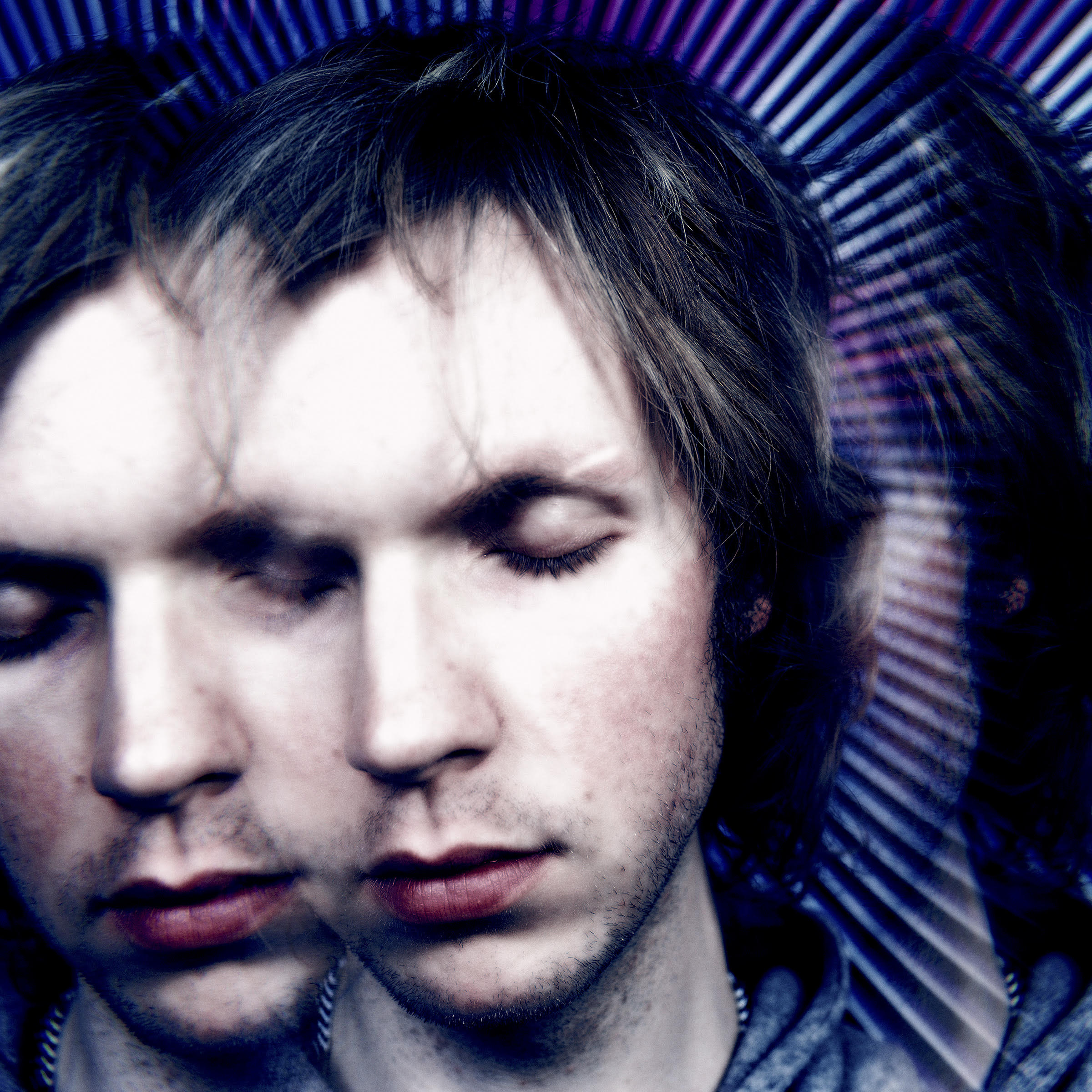
What I feel when I listen to Beck—or what Beck feels when he creates music? For all fans, this portrait is available as a 30 × 24 cm ink print, signed, edition of 25 + 2 AP, available here.
Was ich fühle, wenn ich Beck höre – oder was Beck fühlt, wenn er musiziert? Für alle Fans als 30 × 24 cm Ink-Print, signiert, Edition 25 + 2 AP, hier zu kaufen.
Michel Majerus, Berlin 2000
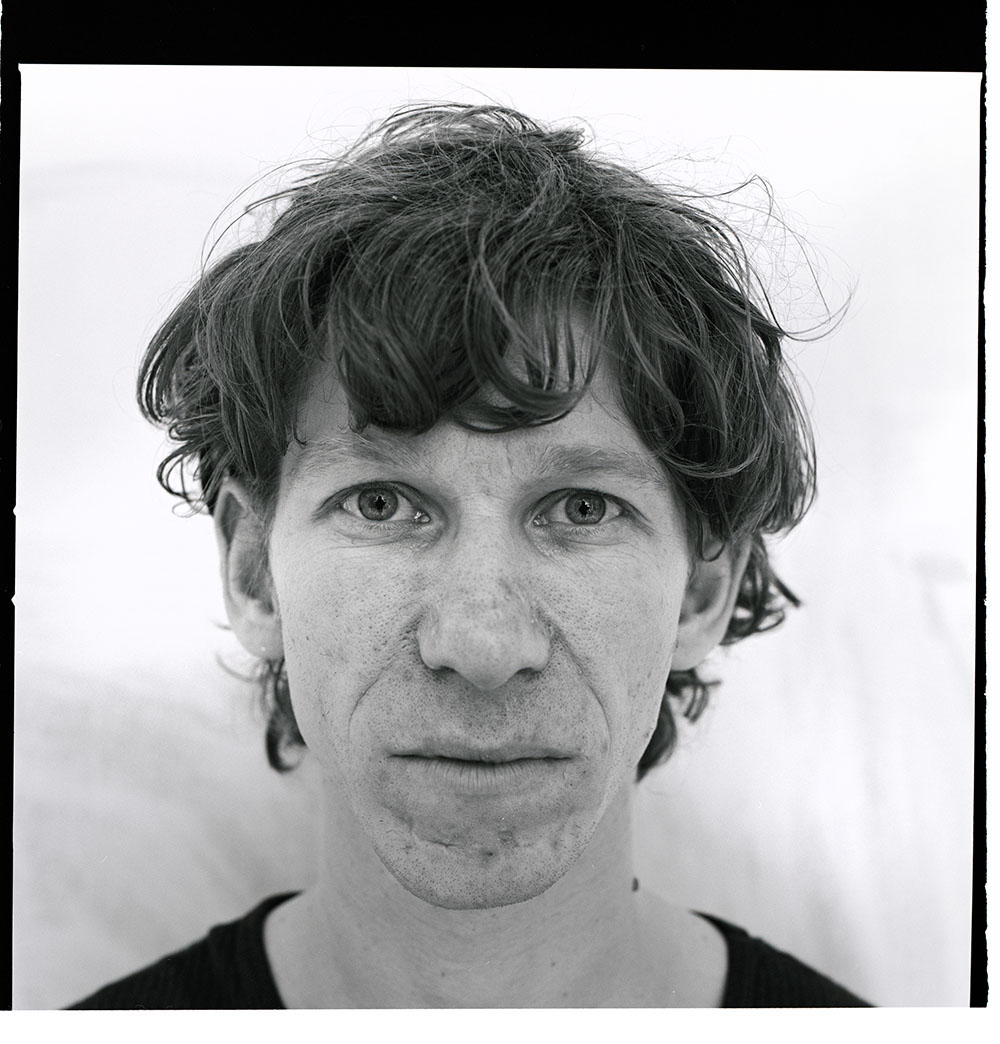
Two years after this direct portrait, which resembles a passport photo in its uncompromising nature, Michel Majerus died tragically in a plane crash. This photo, taken with a Hasselblad in Majerus’ Kreuzberg studio, is a memorial to him.
Zwei Jahre nachdem dieses direkte und in seiner Kompromisslosigkeit einem Passbild ähnliche Porträt gemacht wurde, verstarb Michel Majerus auf tragische Weise bei einem Flugzeugabsturz. Dieses Foto, aufgenommen mit einer Hasselblad in Majerus’ Kreuzberger Atelier, ist eine Erinnerung an ihn.
Sir Anthony Hopkins, Berlin 2001
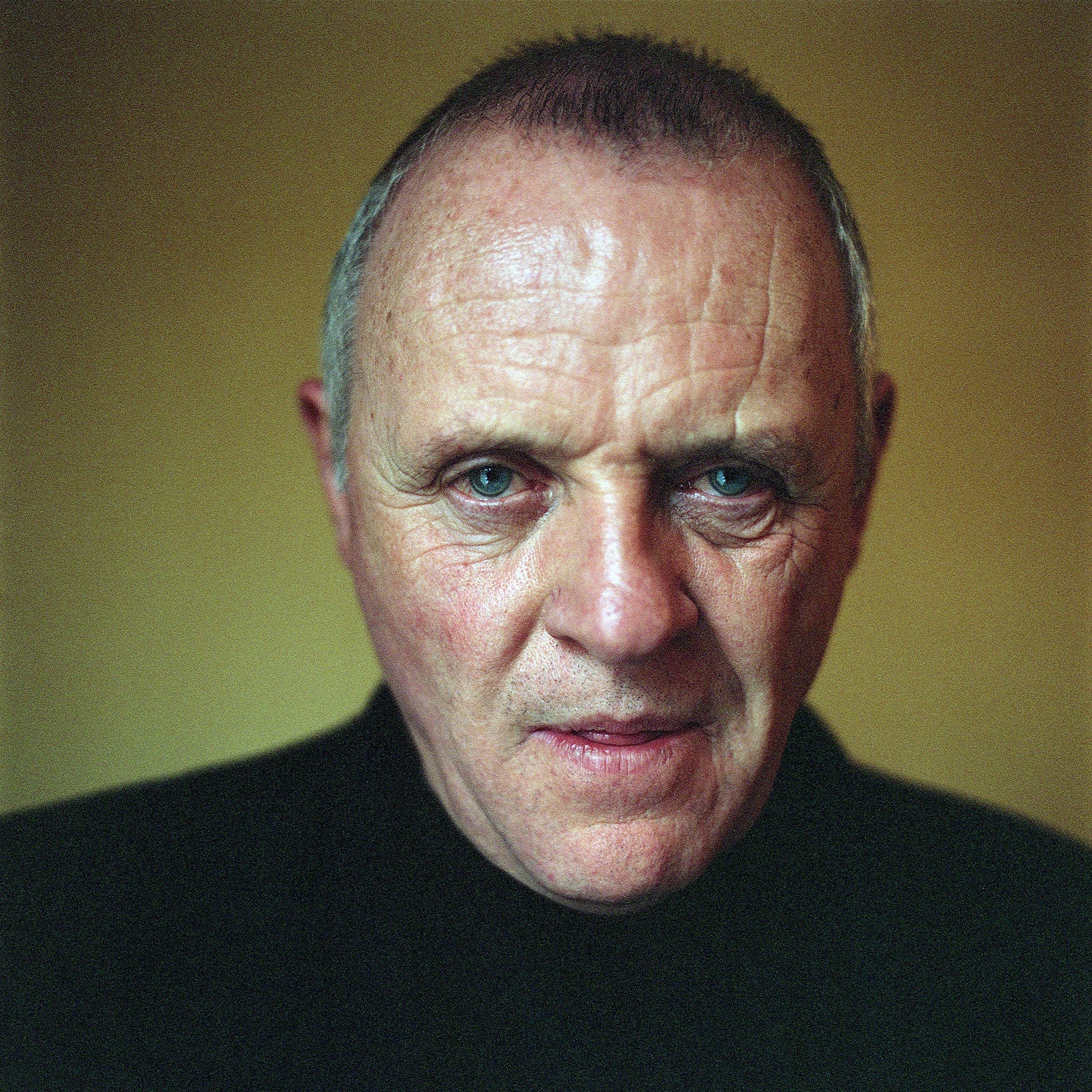
For ZEIT Magazin, Mark created a close-up of Sir Anthony Hopkins. To establish even greater intimacy and intensity between Hopkins and the viewer, Mark used a Distagon 3.5/60 mm lens, which allowed a shooting distance of about 1 meter from the subject. The image was shot on PORTRA 400 film, pushed +2.
Für das ZEIT Magazin machte Mark ein Close-up von Sir Anthony Hopkins. Um eine noch größere Nähe und Intensität zu Hopkins und zum Betrachter aufzubauen, hat er es mit einem Distagon 3.5/60 mm fotografiert, welches eine Entfernung von ca. 1 Meter zum Protagonisten ermöglichte. Als Film wurde ein PORTRA 400, gepusht + 2 verwendet.
Richard Ford, Berlin 2002

When photographing author Richard Ford, Mark captured not just the man but also a piece of urban history. The portrait was taken in an abandoned factory in Prenzlauer Berg, during a time before gentrification transformed the area. Ford was in Berlin on a book tour. The arrangements were concise: date, location, time—and a request to wear beige clothing.
Beim Porträt des Schriftstellers Richard Ford hat Mark nicht nur die Person, sondern auch ein Stück Stadtgeschichte eingefangen. Das Foto entstand in einer leerstehenden Fabrik im Prenzlauer Berg, in einer Zeit vor der Gentrifizierung. Ford war anlässlich einer Lesereise in Berlin. Die Absprache vorab war kurz und knapp: Tag, Ort, Uhrzeit – und die Bitte, beige Kleidung zu tragen.
Okwui Enwezor, Kassel 2002
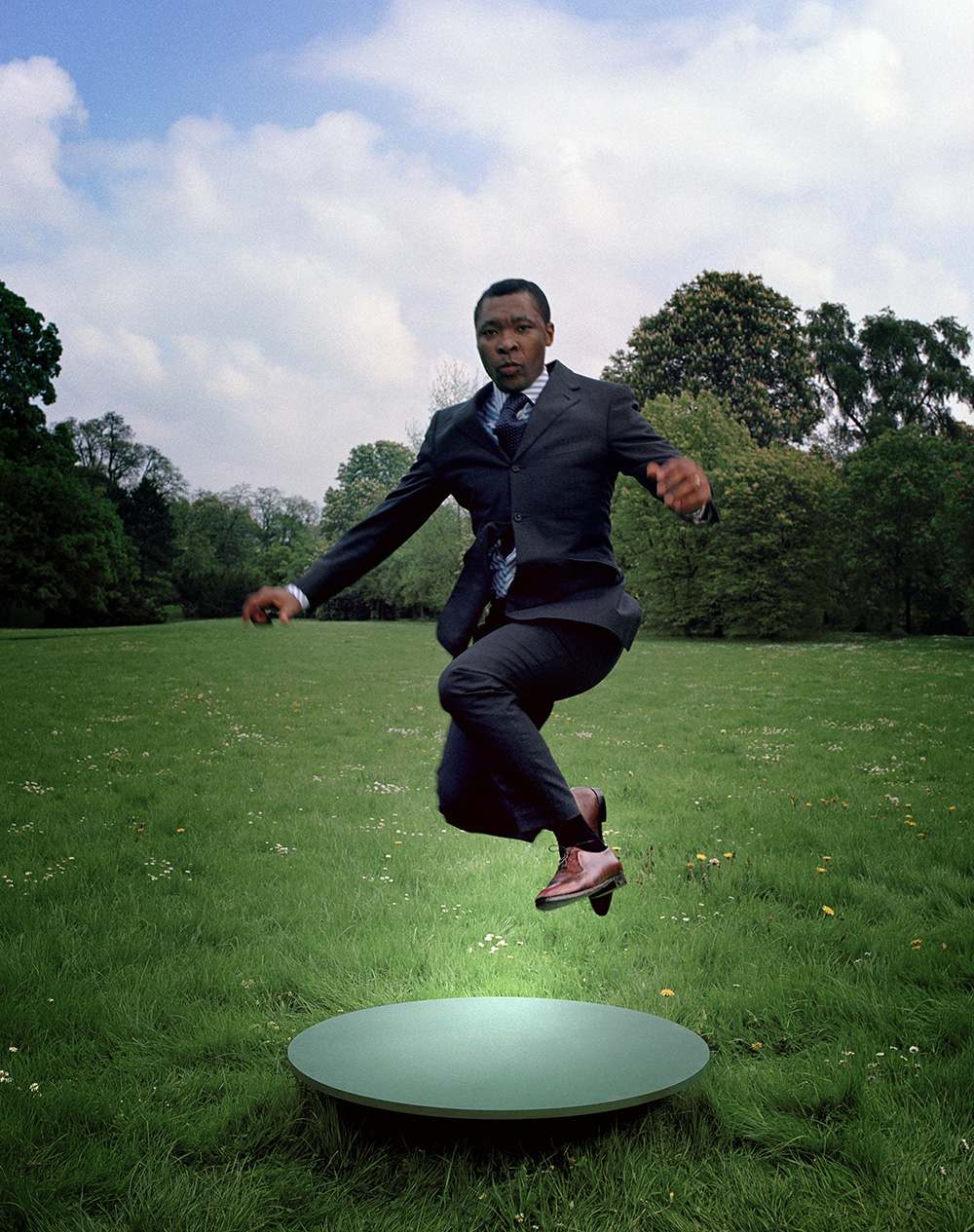
The photographs of Okwui Enwezor were taken in the Karlsruhe State Park during Documenta11 in Kassel for VOGUE. Mark visually translated the concept initiated by Enwezor and his curatorial team at Documenta11—an exploration of democracy as an open, evolving project and an unfinished process. He depicted this idea through a green platform: a flat, elevated structure designed for someone or something to stand on, offering space for reflection and interpretation.
Die Aufnahmen von Okwui Enwezor entstanden im Staatspark Karlsruhe während der Documenta11 in Kassel für die VOGUE. Mark greift die von Okwui Enwezor und seinem kuratorischen Team anlässlich der Documenta11 initiierte Idee internationaler Diskussionsplattformen auf – etwa die Vorstellung, Demokratie als ein offenes und wachsendes Projekt sowie als unvollendeten Prozess zu betrachten. Das hat Mark visuell durch die grüne Plattform übersetzt: eine flache, erhöhte Struktur, auf der jemand oder etwas stehen kann und die Raum für Reflexion und Interpretation schafft.

Lars von Trier, Copenhagen 2003
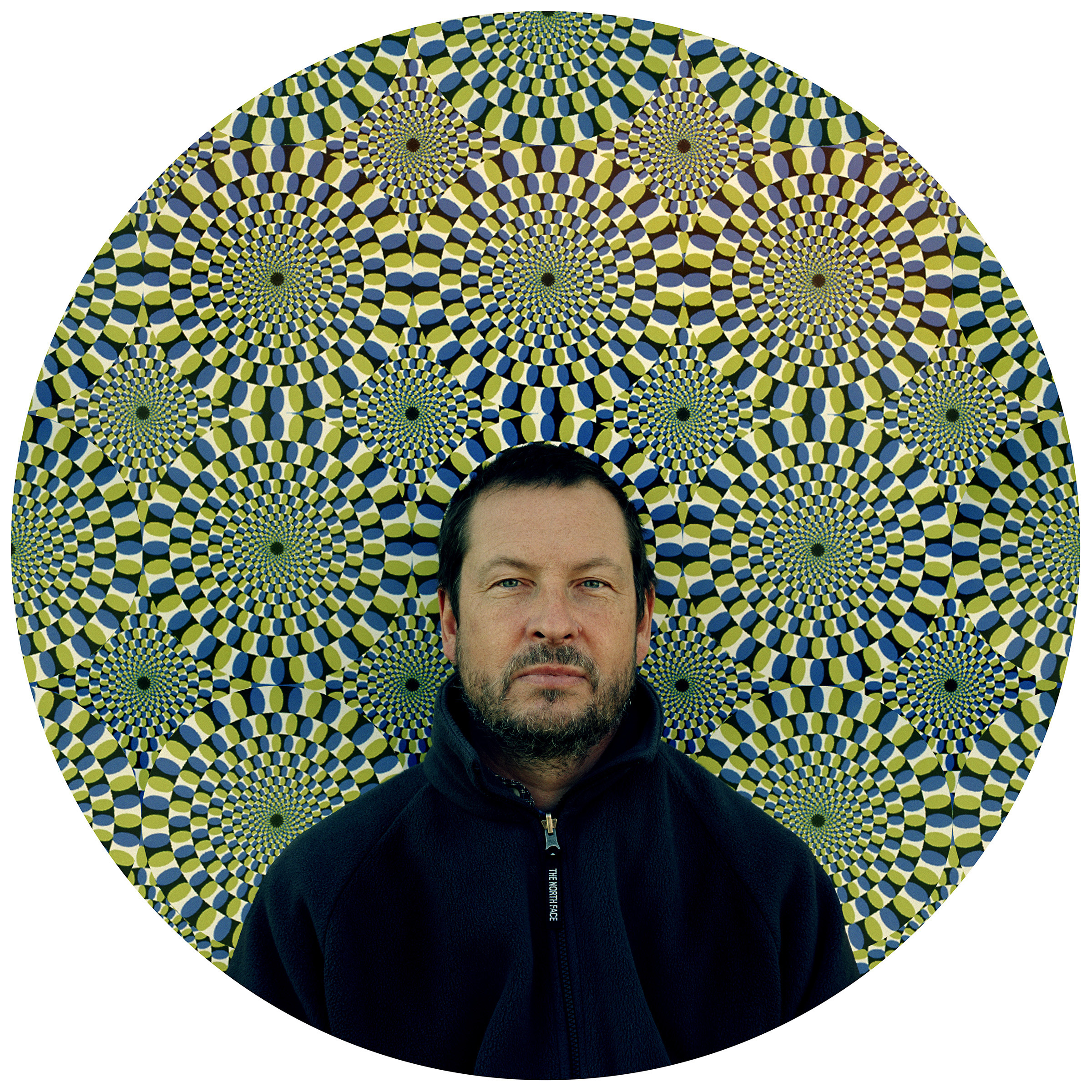
Looking at Lars von Trier’s portrait evokes a sense of movement—an effect created by the background that Mark selected for this assignment from ZEIT Magazin. This movement helps the viewer engage with Trier’s visual and conceptual world as expressed in his films. The patterns in the background create an optical illusion, generating motion as the image is observed. This effect mirrors the experience of watching and immersing oneself in Trier’s films.
Beim Blick auf das Porträt von Lars von Trier entsteht Bewegung – ein Effekt, der dem Hintergrund zu verdanken ist, den Mark für diesen Auftrag vom Zeit Magazin gewählt hat. Diese Bewegung hilft, sich der visuellen und gedanklichen Welt von Trier anzunähern, die er als Regisseur in seinen Filmen zum Ausdruck bringt. Die Muster im Hintergrund erzeugen eine optische Täuschung – Bewegung entsteht also beim Betrachten.
Dieser Effekt stellt sich bei dem Porträt ein, ähnlich wie dem Schauen und Erleben von Triers Filmen.
Tom Hanks, Berlin 2004
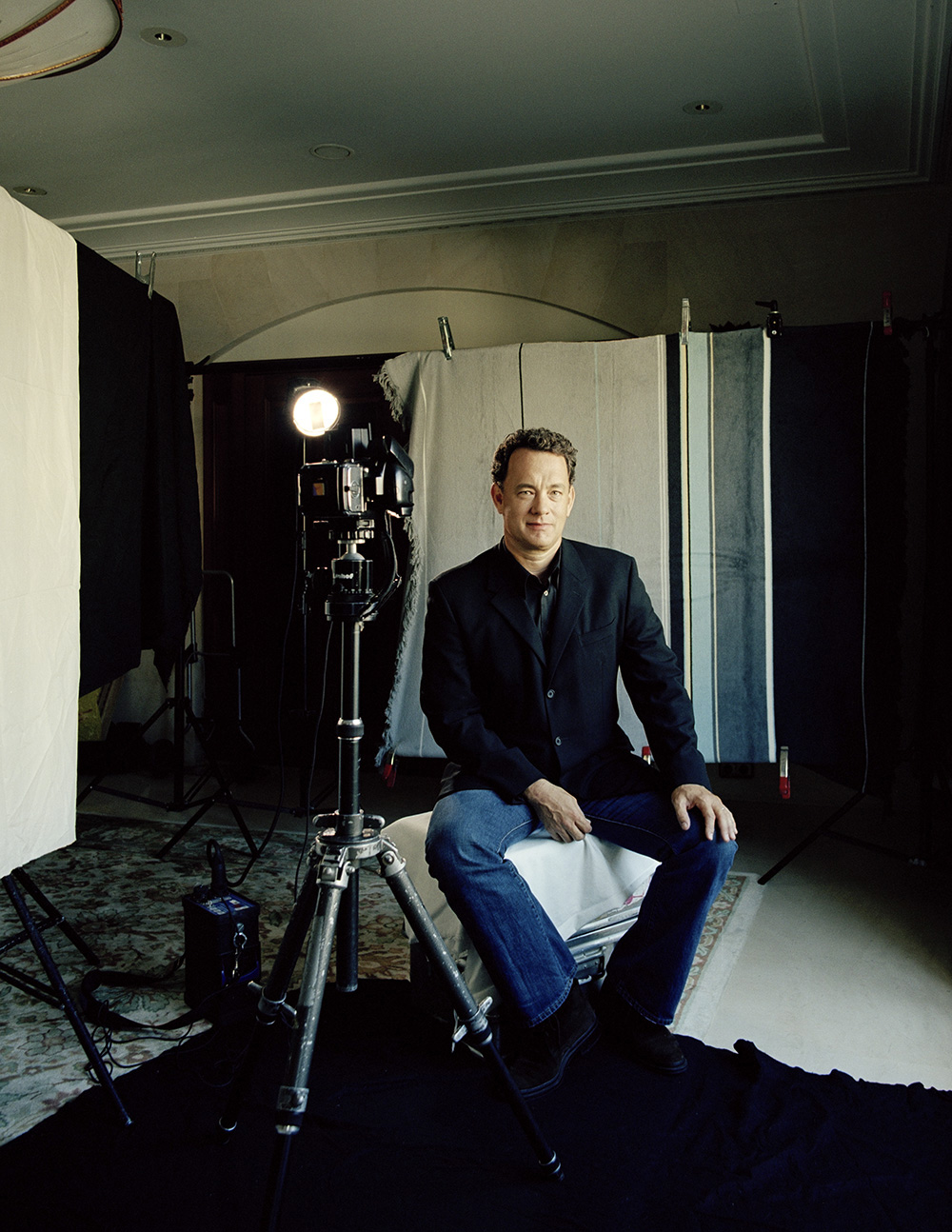
When Hanks and Mark met at the Adlon Hotel for a photo shoot, the following exchange took place: “Hi, I’m Tom. I’m famous.” “Hi, I’m Oliver. I’m working on it.” Due to the limited time available, the shoot was done using two synchronized Hasselblad 500 C/M cameras. The camera visible in the shot is focused on Tom Hanks’ face for a close-up.
Als Hanks und Mark im Adlon für ein Fotoshooting aufeinandertrafen, ergab sich folgender Schlagabtausch: „Hi, I´m Tom. I´m famous.“ – „Hi, I´m Oliver. I‘m working on it.” Die Aufnahme wurde aufgrund der geringen Zeit mit zwei Hasselblad 500 C/M fotografiert, die beide synchronisiert waren. Die Kamera, die im Bild zu sehen ist, ist auf Tom Hanks´ Gesicht für ein Close-up eingestellt.
Claus Peymann, Berlin 2004
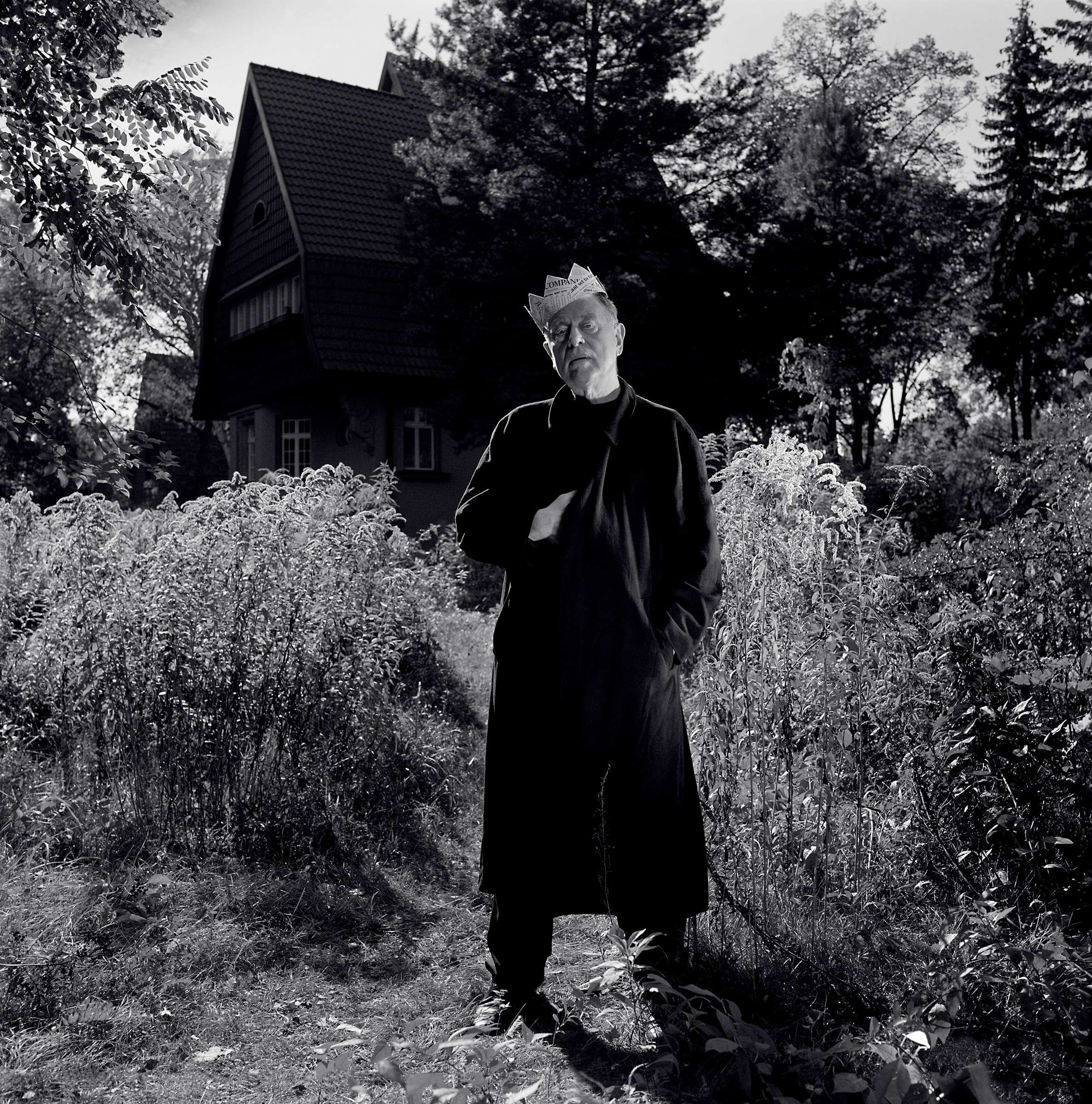
The dual drama of paper crowns: Director Claus Peymann is portrayed here in the garden of his Köpenick villa, styled as Shakespeare’s King Lear. Mark brought a cardboard crown from Burger King for the shoot. However, Peymann found it too trivial and declared that he had his own crown—adorned with stock quotes and charts cut from newspapers. From this interaction, a powerful and compelling portrait emerged.
Doppeldrama der Papierkronen: Regisseur Claus Peymann, hier im Garten seiner Köpenicker Villa als Shakespeares König Lear inszeniert. Für die Aufnahme brachte Mark eine Pappkrone von Burger King mit. Doch Peymann fand sie zu piefig und erklärte, er habe eine eigene Krone – beklebt mit Börsenkursen und Diagrammen aus Zeitungen. Aus dieser Situation ist ein starkes, aufforderndes Porträt entstanden.
Cate Blanchett, Berlin 2005
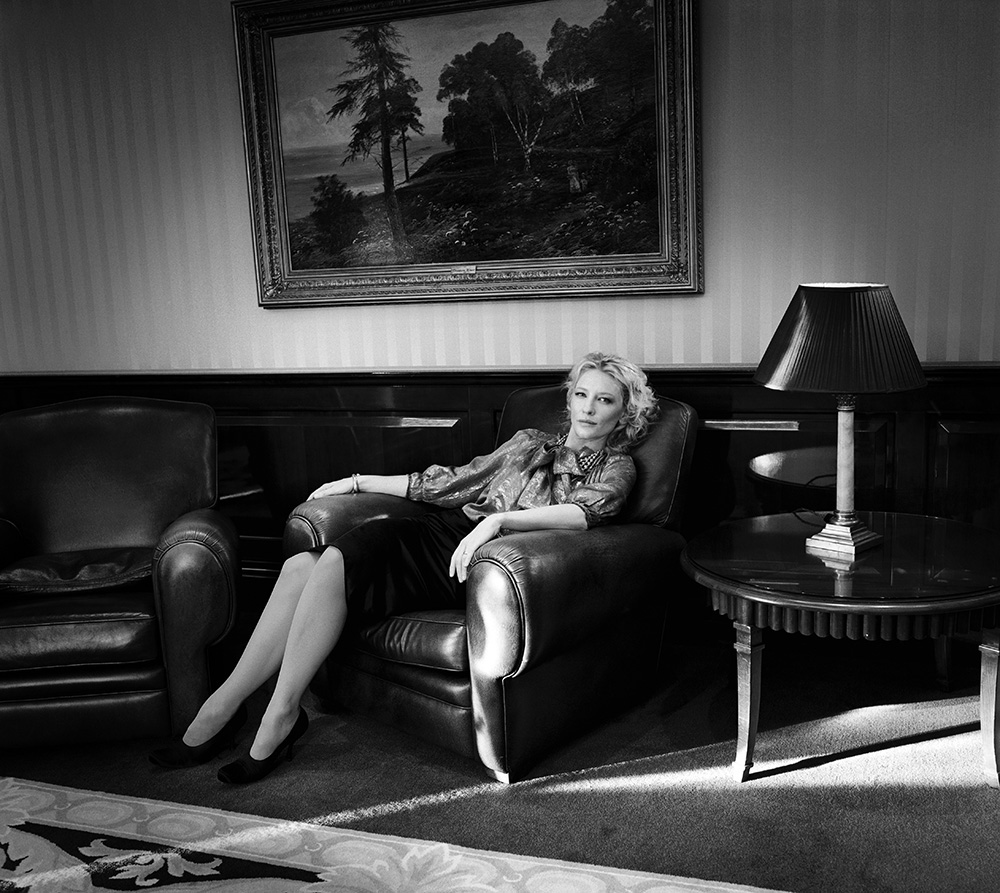
This portrait of Cate Blanchett was taken in a secluded conference room at the Ritz-Carlton Hotel. The composition was meticulously set up and lit by Mark and two assistants beforehand. Time available for the actual portrait: 2 minutes. When Mark quickly attempted to take a Polaroid, one of the four PR agents politely declined the request—but Blanchett whispered to him, “Take your Polaroid!”
Dieses Porträt von Cate Blanchett ist in einem abgeschotteten Konferenzraum im Ritz-Carlton Hotel entstanden. Die Komposition hat Mark vorher mit zwei Assistenten aufgebaut und ausgeleuchtet. Zeit für das eigentliche Porträt: 2 Minuten. Als Mark noch schnell ein Polaroid machen wollte, wurde dies von einem der vier PR-Agenten dankend abgelehnt – doch Blanchett flüsterte ihm zu: “Take your Polaroid!“
Richard Serra, Siegen 2005
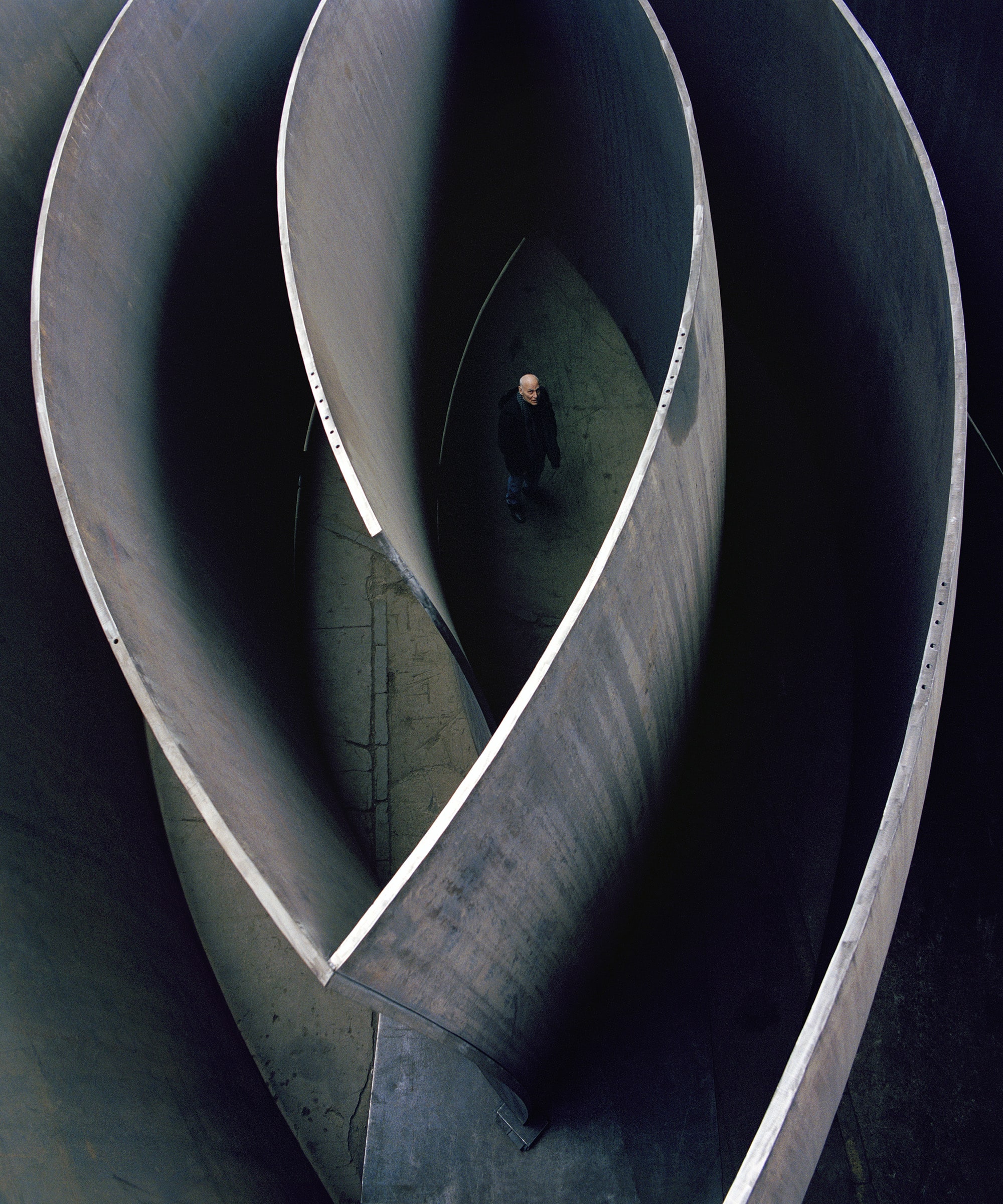
Richard Serra is seen here within one of his works, The Blind Spot, shortly before it was transported to the Guggenheim Museum in Spain. Mark captured this photograph from a crane at Pickhan, the company in Siegen that manufactures all of Serra’s sculptures. To fully grasp a Serra piece, one must physically stand within it. This spatial tightness—contrasted with the soft, nature-exposed form—induces both physical well-being and emotional security.
Richard Serra steht hier in einer seiner Arbeiten, The Blind Spot, kurz bevor sie zum spanischen Guggenheim-Museum verfrachtet wird. Das Foto hat Mark in Siegen von einem Kran gemacht, bei der Firma Pickhan, die alle seine Skulpturen fertigen. Man muss in einer Serra-Arbeit stehen, um sie zu begreifen. Diese räumliche Enge – und gleichzeitig weiche, der Natur ausgesetzte Form – löst körperliches Wohlbefinden und auch emotionale Sicherheit aus.
Self-portrait, Vienna 2005

Room 211, Hotel Sacher, Vienna. Mark on the bed in a bathrobe, holding a self-timer in an outstretched hand. He was staying there to produce a feature on the hotel for Architectural Digest. For Mark, who grew up in modest circumstances—his father a civil servant, his mother an employee in a real estate office—this kind of room was entirely novel. For him, it was a space that offered freedom and scope, one that both unsettled and provoked, encapsulating the multifaceted imagination of a person.
Zimmer 211, Hotel Sacher in Wien. Mark im Bademantel auf dem Bett, Selbstauslöser in der ausgestreckten Hand. Einquartiert war er dort, um für AD eine Geschichte über das Hotel zu machen. Für Mark, der aus eher bürgerlichen Verhältnissen stammt – Vater Verwaltungsangestellter, Mutter Mitarbeiterin in einem Immobilienbüro – war ein solches Zimmer völlig neu. Für ihn ein Raum, der Freiheit und Platz bot, der irritiert und provoziert und in dieser Vielschichtigkeit die Fantasie einer Person abbildet.
Count Ferdinando Brachetti Peretti, Rome 2006
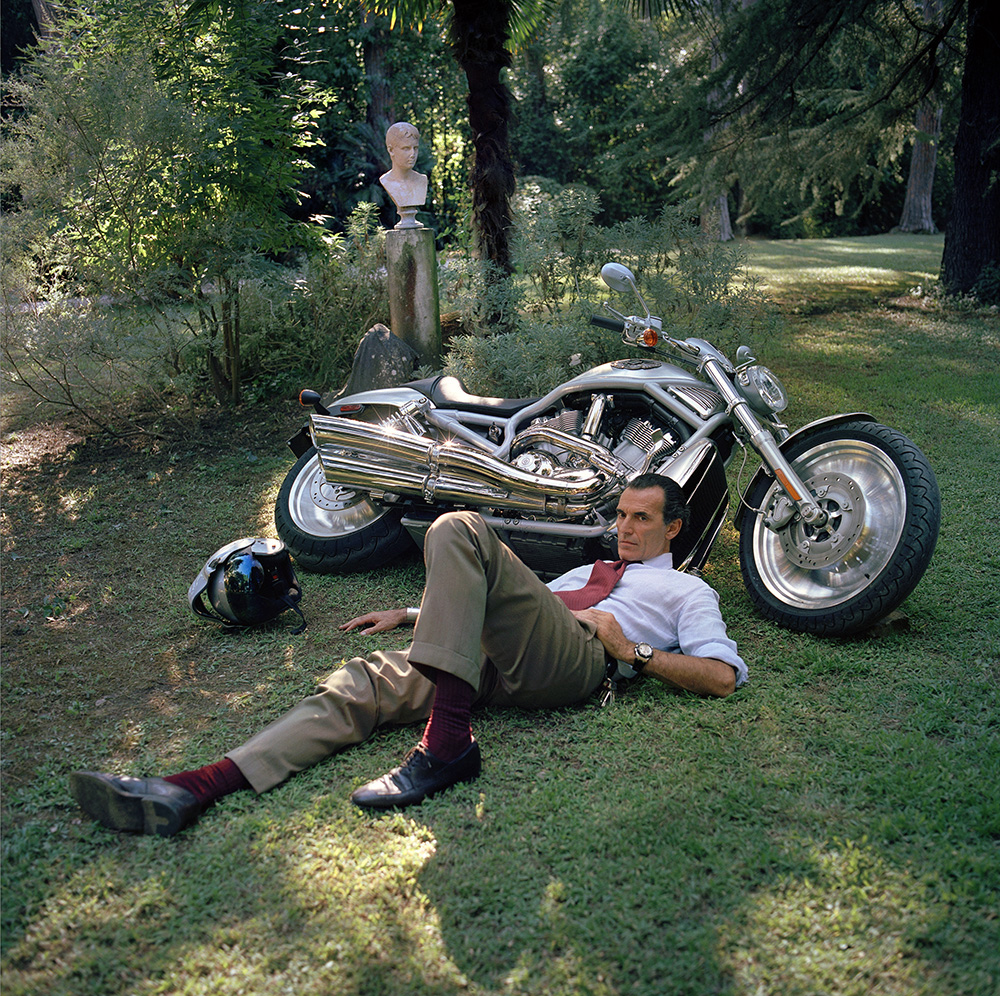
Ferdinando Brachetti Peretti, Chairman and CEO of the Italian energy company APi Group, is photographed on the grounds of Mafalda von Hessen’s estate, Villa Polissena, in northern Rome. Peretti once had a motorcycle accident. Mark captured him laying beside his overturned Harley.
Ferdinando Brachetti Peretti ist Vorsitzender und CEO des italienischen Energieunternehmens, APi Group. Das Bild ist auf dem Anwesen von Mafalda von Hessen, der Villa Polissena im Norden von Rom, entstanden. Peretti hatte mal einen Motorradunfall. Oliver Mark hat ihn vor seiner umgekippten Harley fotografiert.
Otto von Habsburg, Pöcking 2006
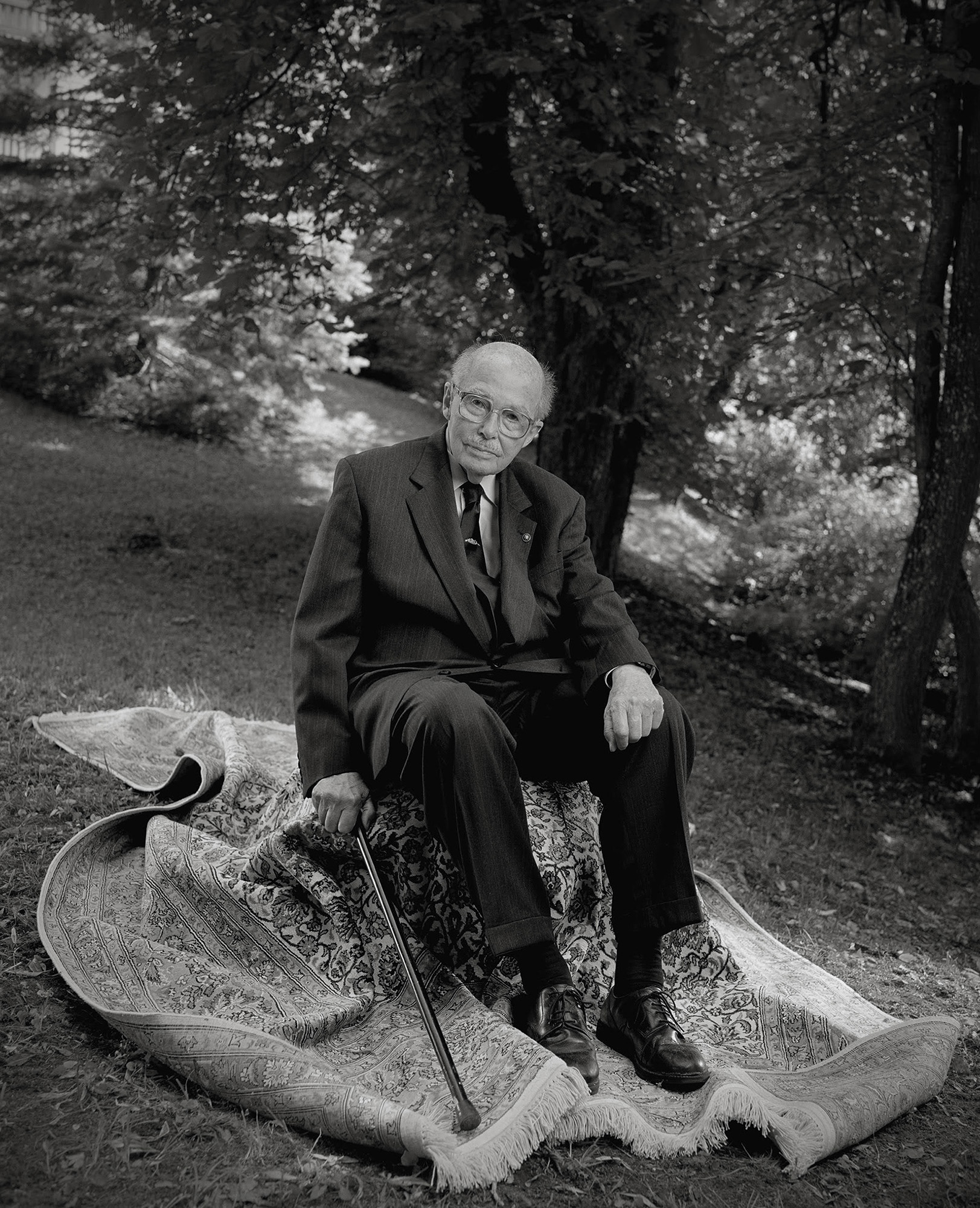
With his best silk rug in tow, Mark traveled to Bavaria to photograph Otto von Habsburg for Vanity Fair’s millennium issue.
Otto, the eldest son of Charles I, the last Emperor of Austria and King of Hungary, is depicted in a suit and tie, seated on two of Mark’s lighting cases draped with the rug, surrounded by nature. The ground slopes gently, the surface is grassy, and the background features trees with occasional rays of sunlight breaking through. From his seat, Otto von Habsburg gazes directly into the camera.
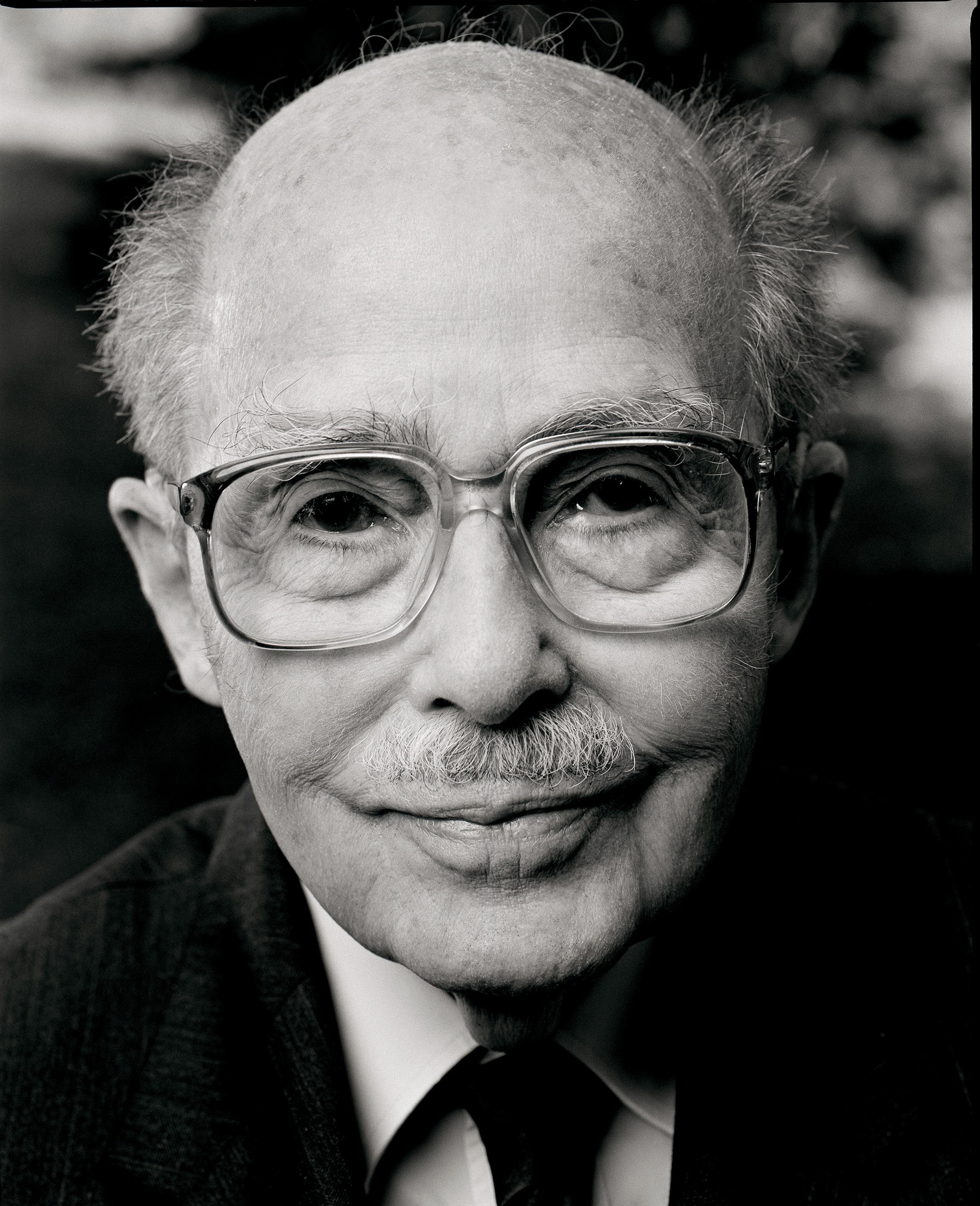
Mit seinem besten Seidenteppich im Gepäck reiste Mark nach Bayern, um anlässlich der Millenniumsausgabe der Vanity Fair ein Porträt von Otto von Habsburg zu fotografieren. Dieser war der älteste Sohn von Karl I., dem letzten Kaiser von Österreich und König von Ungarn. Otto von Habsburg sitzt im Anzug mit Krawatte auf zwei von Marks Lichtkoffern, über die der Teppich drapiert ist, inmitten der Natur. Der Boden ist leicht abschüssig, der Untergrund aus Rasen, und im Hintergrund sind Bäume zu sehen, durch die vereinzelt Sonnenstrahlen fallen. Von seinem Platz aus blickt Otto von Habsburg direkt in die Kamera.
Children in the Garden of Princess Mafalda of Hesse, Rome 2006

This image was originally taken by Mark for AD and was exhibited at the National Portrait Gallery in London in 2013/14. It was photographed against the light using a Hasselblad 500 C/M with a Carl Zeiss Distagon 60mm f/3.5 lens and strong flash fill to freeze the motion, clearly visible in the shadows of the children. The film used was Ilford HP5 Plus.
Dieses Bild nahm Mark ursprünglich für AD auf und war 2013/14 in der National Portrait Gallery in London zu sehen. Fotografiert wurde es im Gegenlicht mit einer Hasselblad 500 C/M, einem Carl Zeiss Distagon 60mm 1:3.5‑Objektiv und einer starken Blitzlicht-Aufhellung, um die Bewegung einzufrieren. Dies zeigt sich deutlich an den Schatten der Kinder. Als Film wurde ein Ilford HP5 Plus verwendet.
Katrin Bellinger, LHR-MST 2006
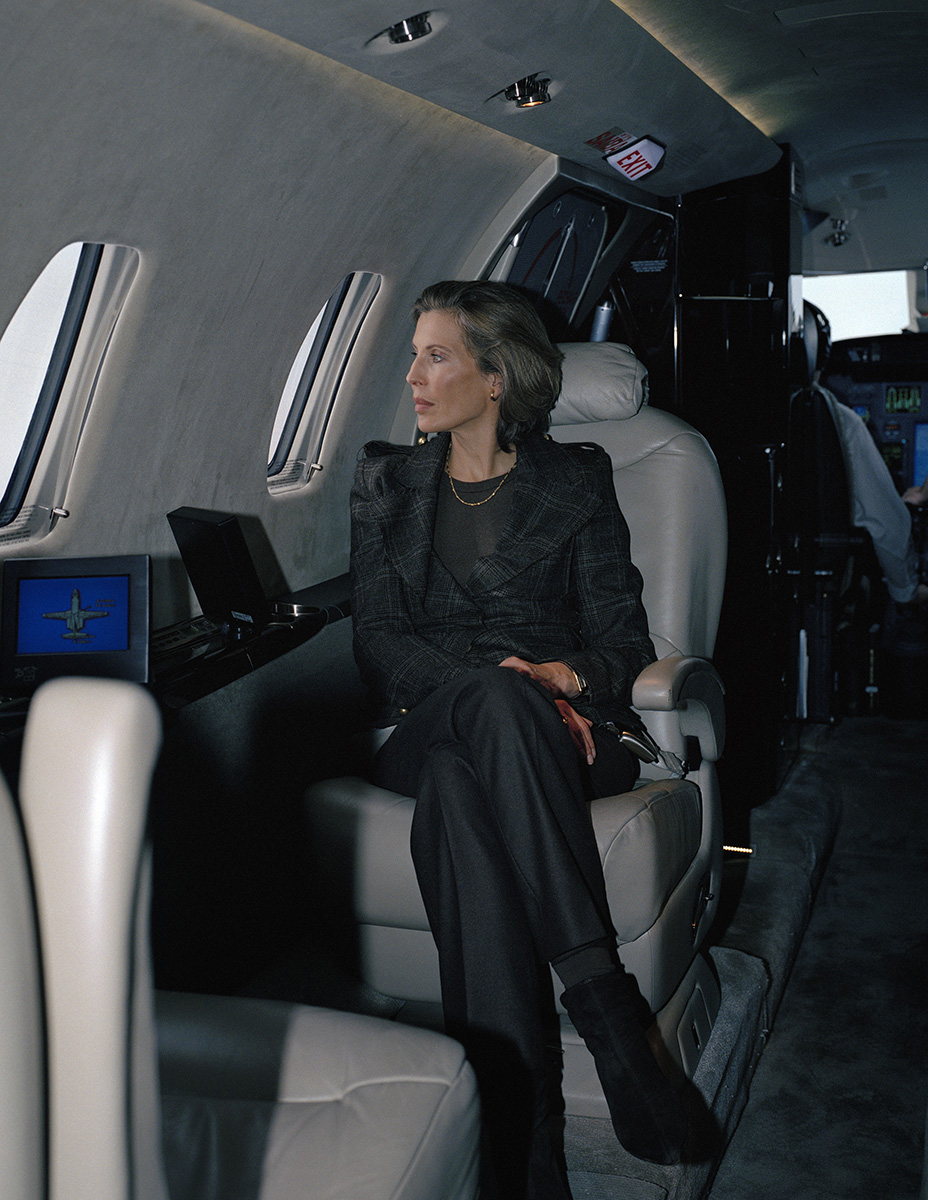
Katrin Bellinger is a German art dealer and collector based in London, specializing in Old Master drawings. The portrait was taken on the flight from London to Maastricht with a Mamiya 7II (6 x 7 cm) and Kodak Portra 400 for AD under the editorial direction of Margit J. Mayer. The Mamiya 7II is not particularly suited for portrait photography, as it is a rangefinder camera, which significantly slows down the shooting process. Mark chose the system anyway, as its low weight (around 1.8 kilograms, including a 65mm lens) and excellent handling in the confined space of a private jet proved advantageous. This portrait is one of only two portrait shoots Mark did with the Mamiya 7II, the other being of actress Martina Gedeck at the Czech Republic Embassy in Berlin for Playboy Germany.
Katrin Bellinger ist eine in London ansässige deutsche Kunsthändlerin und ‑sammlerin, die sich auf Zeichnungen Alter Meister spezialisiert hat. Entstanden ist das Porträt auf dem Flug von London nach Maastricht mit einer Mamiya 7II (6 x 7 cm) und einem Kodak Portra 400 für AD unter der Chefredakteurin Margit J. Mayer. Für Portraitaufnahmen ist die Mamiya 7II nicht besonders geeignet, da sie eine Messsucher-Kamera ist, die das Fotografieren erheblich verlangsamt. Mark hat sich dennoch für das System entschieden, da es aufgrund des geringen Gewichts, ca. 1,8 Kilogramm (inkl. eines 65er Objektivs) und der sehr guten Handhabung in dem begrenzten Raum eines Privatjets von Vorteil war. Daneben ist nur eine weitere Portraitstrecke mit der Mamiya 7II entstanden, und zwar von der Schauspielerin Martina Gedeck in der Botschaft der Tschechischen Republik in Berlin, für den deutschen Playboy.
Luc Tuymans, Berlin 2006

Oliver Mark photographed Luc Tuymans in 2005 at the Carlier Gebauer Gallery in front of his painting Dough, for Monopol magazine. The work, an oil on canvas (431 x 575 cm), was acquired for the Bonnefantenmuseum with the support of the Mondriaan Fund and the BankGiro Lottery. In the portrait, which shows Tuymans in a contemplative pose, a profound engagement with his work, his own reality, and the present is reflected.
Oliver Mark fotografierte Luc Tuymans 2006 in der Carlier Gebauer Galerie vor seinem Gemälde Dough, für das Monopol Magazin. Das Werk, Öl auf Leinwand (431 x 575 cm), wurde mit Unterstützung des Mondriaanfonds und der BankGiro Loterij für das Bonnefantenmuseum erworben. In dem Porträt, das Tuymans in nachdenklicher Pose zeigt, spiegelt sich eine tiefgehende Auseinandersetzung mit seiner Arbeit, seiner eigenen Realität und der Gegenwart wider.
Benazir Bhutto, Dubai 2006
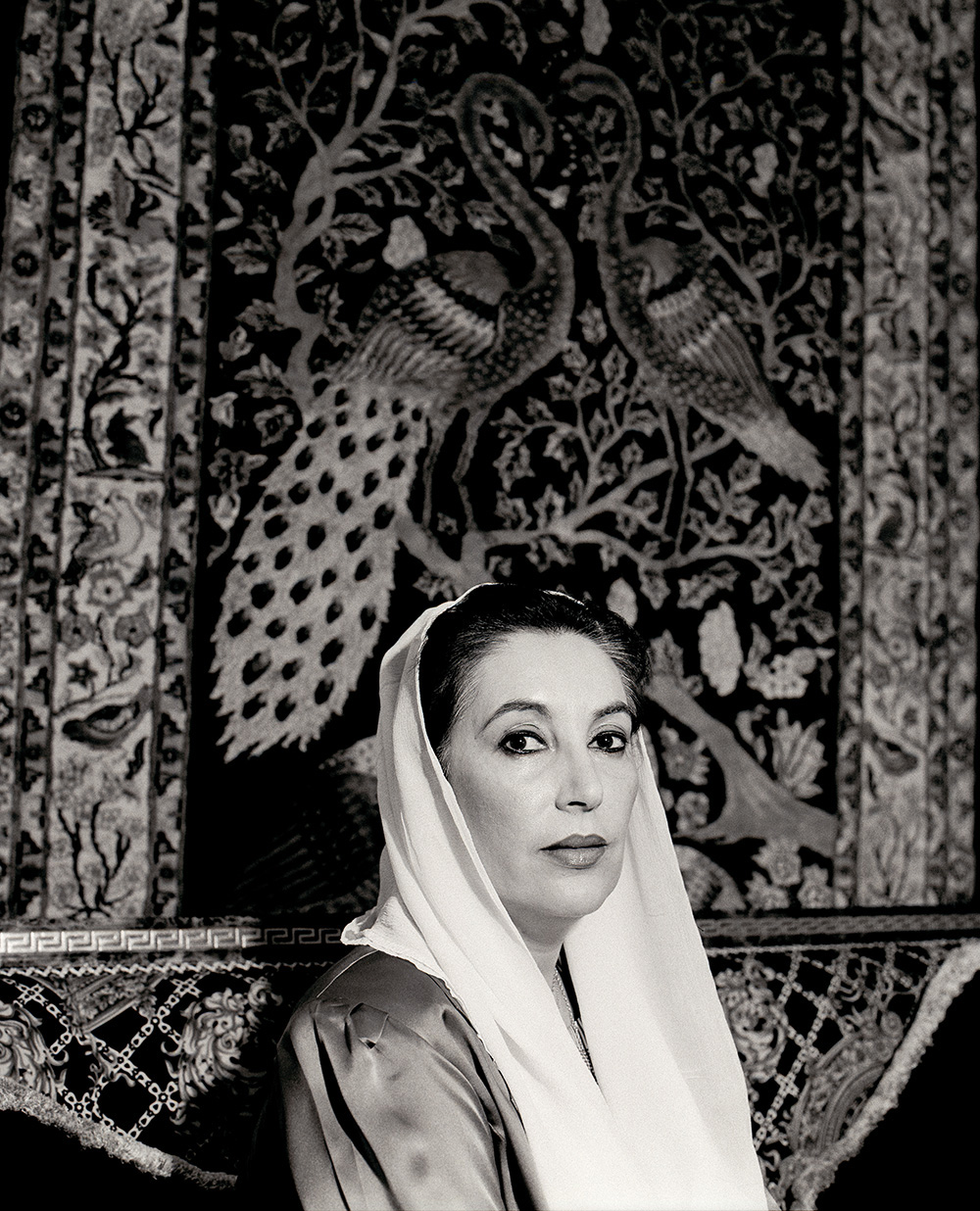
The portrait of Benazir Bhutto was taken during her exile in Dubai, United Arab Emirates. Together with Dagmar von Taube, the chief reporter of Welt am Sonntag, Mark spent two days in Dubai to photograph Benazir Bhutto and Princess Haya. Benazir Bhutto, her children, Dagmar von Taube, and Oliver Mark first had a three-hour lunch together. Following this, Mark had ten minutes for the photography session.
Das Porträt von Benazir Bhutto entstand während ihres Exils in Dubai, Vereinigte Arabische Emirate. Gemeinsam mit Dagmar von Taube, der Chefreporterin der Welt am Sonntag, war Mark zwei Tage vor Ort, um Porträts von Benazir Bhutto und Prinzessin Haya aufzunehmen. Benazir Bhutto, ihre Kinder, Dagmar von Taube und Oliver Mark verbrachten zunächst ein dreistündiges Mittagessen zusammen. Im Anschluss daran hatte Mark zehn Minuten Zeit für die Fotografie.
Max Raabe and Marilyn Manson, Berlin 2006

Two men stand side by side, photographed from a slight low angle. Their upper bodies are slightly turned toward each other, and each has bent their outer arm across their chest, supporting the arm that points toward the other; their hands are directed toward their chins. Both are impeccably groomed and dressed, their posture almost mirroring each other. Max Raabe and Marilyn Manson might seem to be opposites at first glance, but in Mark’s photograph, a strong similarity becomes apparent—a shared eye level. The shot was taken during a conversation between the two for VOGUE, which Mark recalls as being very profound. He believes both showed an intelligent attitude and a special sensitivity to the present moment, and this is exactly what he captured in his portrait of them.
Zwei Männer stehen nebeneinander, aus leichter Untersicht fotografiert. Ihre Oberkörper sind etwas zueinander gedreht, und ihren jeweils äußeren Arm haben sie vor der Brust angewinkelt. Darauf stützen sie den Arm, der zum anderen hinzeigt; ihre Hand weist in Richtung Kinn. Beide sind sehr gepflegt und herausgeputzt – ihre Körperhaltung spiegelt sich beinahe. Max Raabe und Marilyn Manson könnten auf den ersten Blick nicht gegensätzlicher erscheinen, doch in Marks Fotografie tritt eine starke Ähnlichkeit zutage – eine Augenhöhe. Die Aufnahme entstand anlässlich eines Gesprächs der beiden für die VOGUE, an das sich Mark als sehr tiefgründig erinnert. Für ihn zeigten beide eine intelligente Haltung und ein besonderes Gespür für die Gegenwart – und genau das hat Mark in seinem Porträt der beiden dokumentiert.
Hans Neuenfels, Berlin 2006
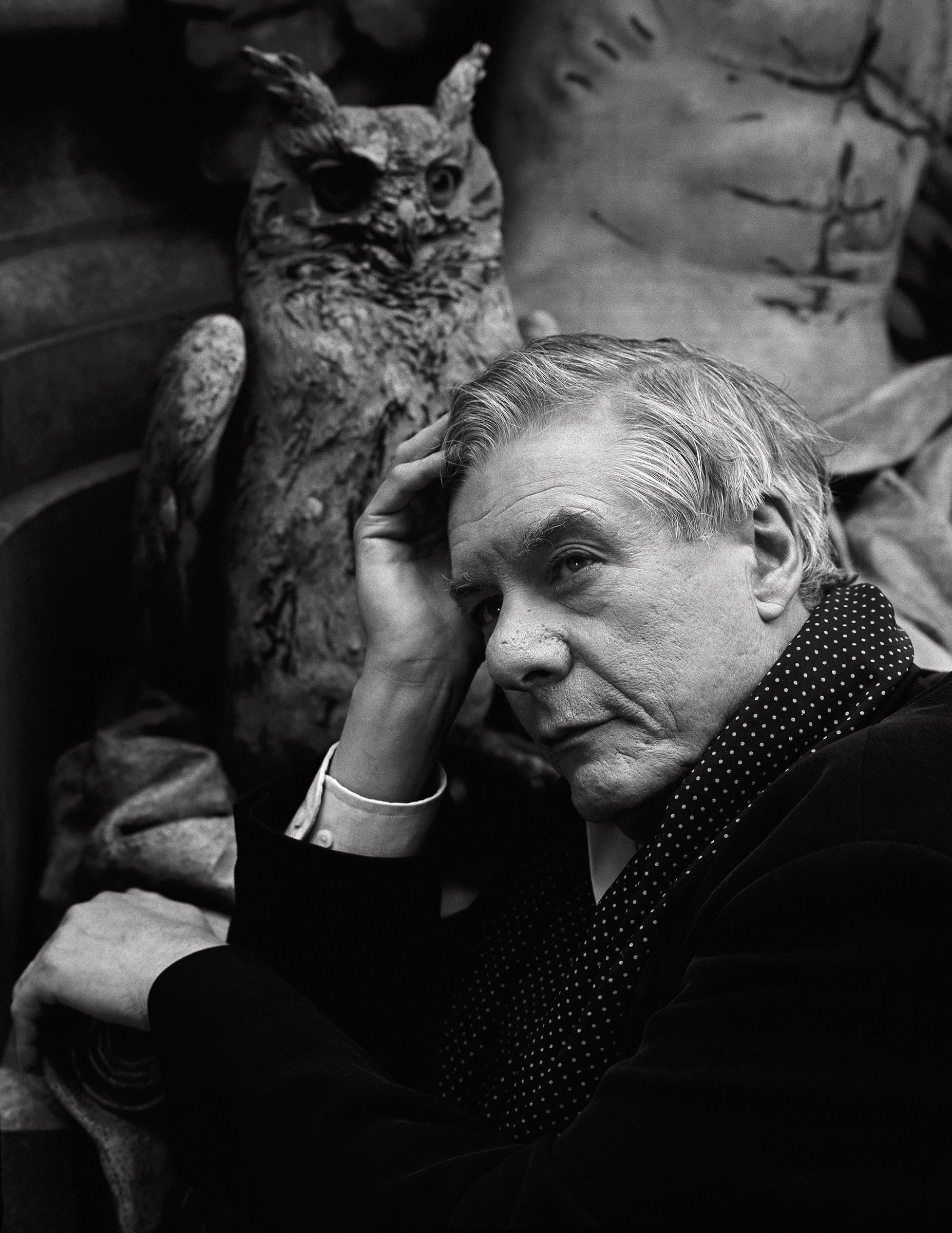
Portrait with Owl. Hans Neuenfels (*1941–†2022) was a defining figure in German theater. His portrait with an owl, a symbol of wisdom and intuition, reflects his artistic spirit. Photographer Oliver Mark followed his own intuition when he asked Neuenfels to come to the Lessing Monument in Berlin’s Tiergarten for the photo. The portrait was used as the cover of the book HANS NEUENFELS, Fast Nackt. Letzte Texte (2022), featuring an obituary by Elke Heidenreich – a powerful tribute to the artist.
Porträt mit Eule. Hans Neuenfels (*1941–†2022) war eine prägende Figur des deutschen Theaters. Sein Porträt mit einer Eule, dem Symbol der Weisheit und Intuition, spiegelt seinen künstlerischen Geist wider. Fotograf Oliver Mark folgte seiner eigenen Intuition, als er Neuenfels bat, für das Bild zum Lessing-Denkmal im Berliner Tiergarten zu kommen. Das Porträt wurde als Cover des Buches HANS NEUENFELS, Fast nackt. Letzte Texte (2022) mit einem Nachruf von Elke Heidenreich verwendet – eine eindrucksvolle Erinnerung an den Künstler.
Wolfgang Schäuble, Berlin 2007
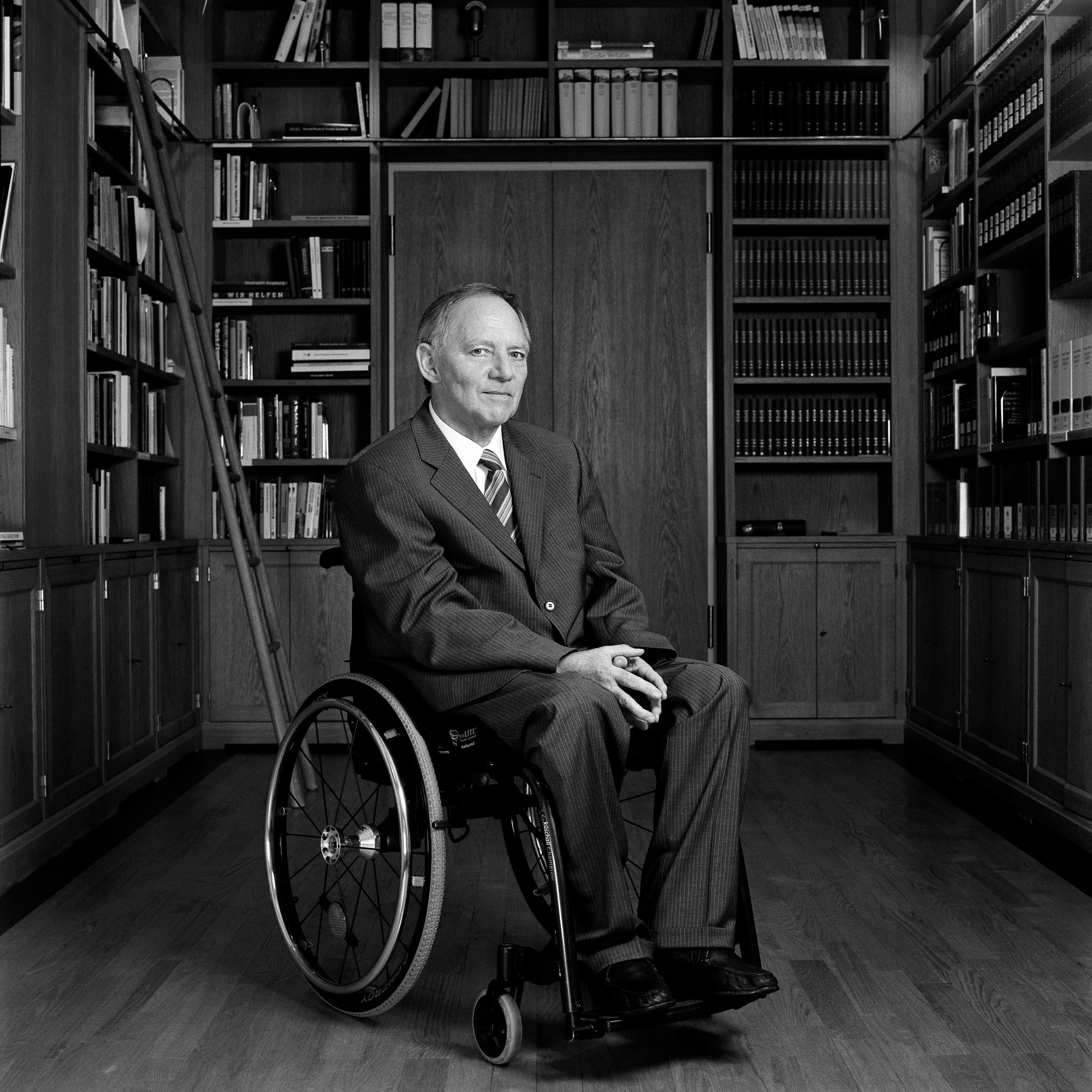
In the center of the image, a well-dressed man is seated—wearing a suit and tie, a white shirt, and laced shoes. He has a sharp gaze and a gentle smile, with his hands resting in his lap, his fingertips touching. He sits in a wheelchair in a library. To the left behind him, a small ladder leans against a bookshelf. This is the private library of the Ministry of the Interior in Berlin.
Mittig im Bild ist eine gut gekleidete männliche Person zu sehen – in Anzug und Krawatte, mit weißem Hemd und geschnürten Schuhen. Er hat einen wachen Blick und ein sanftes Lächeln; die Hände liegen im Schoß, die Fingerspitzen berühren sich. Er sitzt in einer Bibliothek im Rollstuhl. Links hinter ihm steht eine kleine Leiter am Bücherregal. Es handelt sich um die Privatbibliothek des Innenministeriums in Berlin.
Mia Farrow, Berlin 2007

Time pressure is a constant companion when it comes to photography, as it was during the photo session with Mia Farrow for the ZEIT Magazin series “I Have a Dream.” Her frustration and disinterest in the appointment were clearly palpable to Mark. After just two shots, he declared that he had the image, deciding not to push further in this situation. This unexpected step piqued Farrow’s interest in his work and broke her out of the routine of endless press appointments. She eventually looked at Mark’s portfolio, leading to this shot—a serendipitous moment of luck for Mark.
Zeitdruck ist ein ständiger Begleiter beim Fotografieren – so auch bei den Aufnahmen von Mia Farrow für die Serie „Ich habe einen Traum“ im ZEIT Magazin. Ihre Entnervtheit und das Desinteresse an dem Termin waren für Mark deutlich spürbar. Nach nur zwei Aufnahmen rief er daher, dass er das Bild habe, um sich nicht weiter an dieser Situation abzuarbeiten. Dieser unerwartete Schritt weckte Farrows Interesse an seiner Arbeit und brachte sie aus dem Gewohnheitstrott der unzähligen Pressetermine. Sie schaute sich schließlich doch Marks Portfolio an, und es entstand dieses Bild – für Mark ein unverhoffter Glücksmoment.
Knut, Berlin 2007
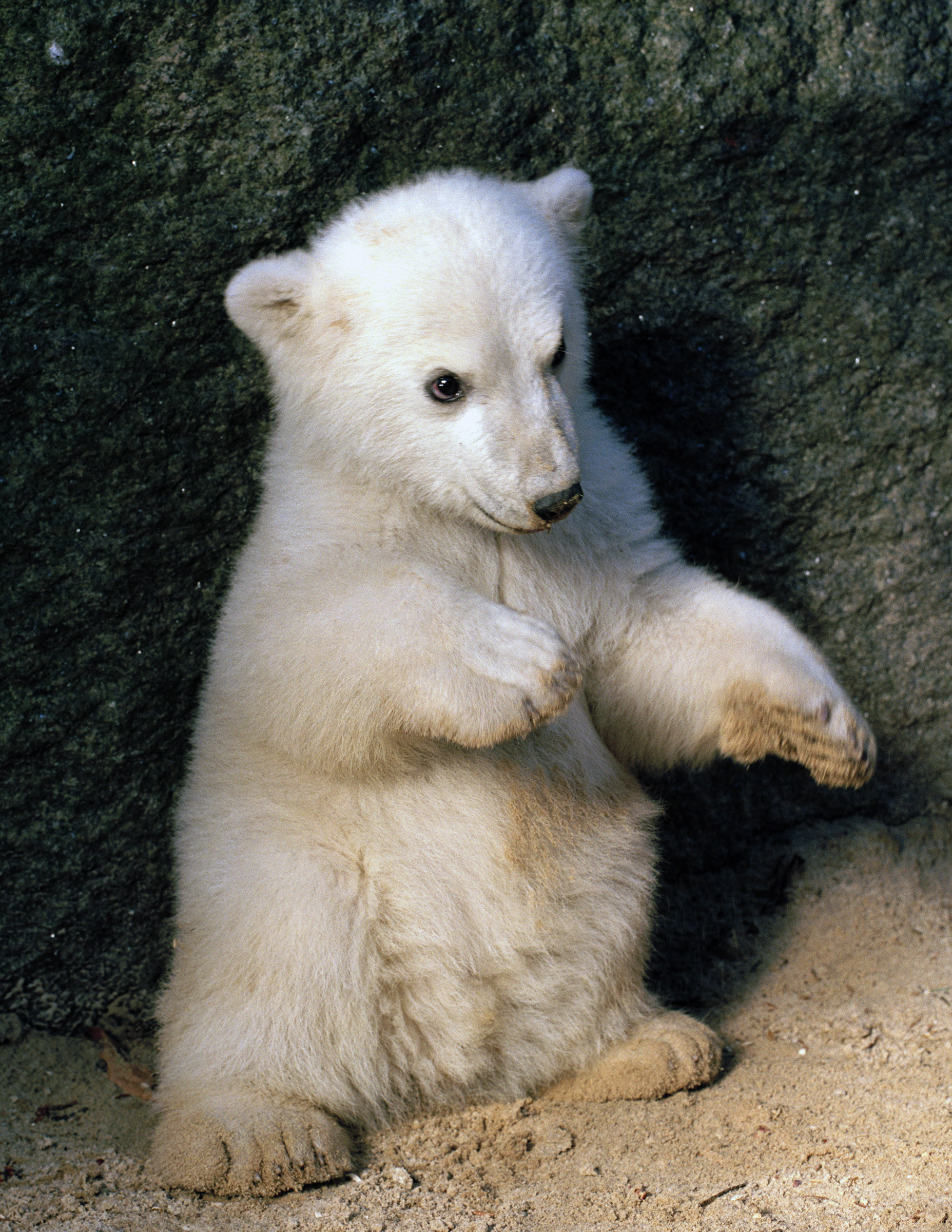
From February 2007 to February 2009, Oliver Mark was the chief photographer for Vanity Fair Germany. One of the many covers Mark shot for Vanity Fair was the March 29, 2007, cover of the German edition. It was the first time an animal—polar bear Knut—appeared on the cover of a People magazine. During this period, Mark switched his camera system from a Hasselblad 6 x 6 cm to the Mamiya RZ Pro II, as the 6 x 7 cm format resulted in less cropping for his editorial publications. Additionally, the Mamiya RZ, with its wide-angle M 65mm f/4 lens, became significant for Mark’s photography as a “location and action in space” tool.
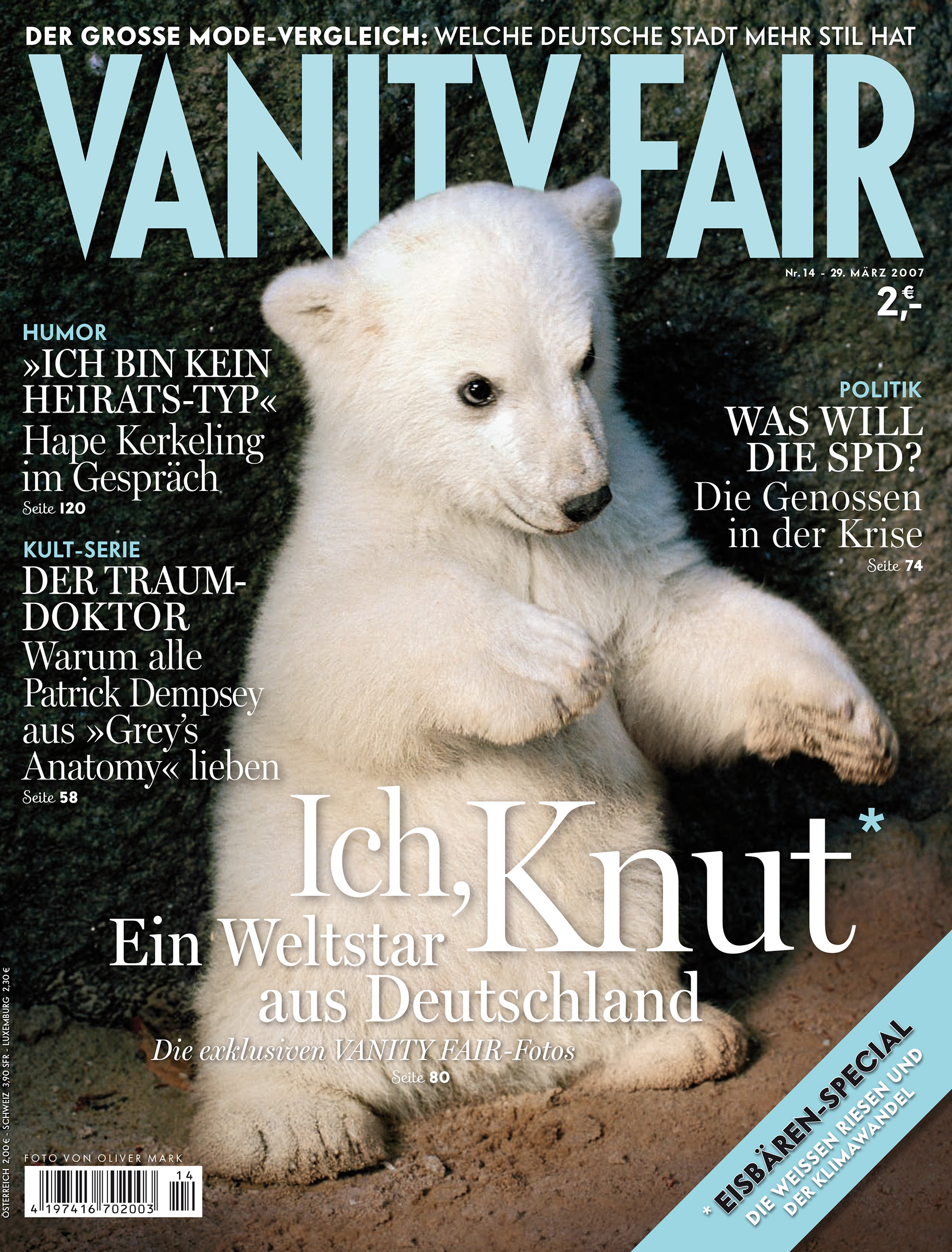
Von Februar 2007 bis Februar 2009 war Oliver Mark Cheffotograf der deutschen Vanity Fair. Eines der vielen Vanity Fair-Cover, die Mark fotografiert hat, war das Titelcover Nr. 14 der deutschsprachigen Ausgabe vom 29. März 2007. Gleichzeitig war es das erste Mal, dass ein Tier – der Eisbär Knut – auf dem Cover eines People-Magazins gezeigt wurde. In diesem Zeitraum wechselte Mark sein Kamerasystem von Hasselblad 6 x 6 cm auf die Mamiya RZ Pro II, da das Format 6 x 7 cm bei seinen redaktionellen Veröffentlichungen weniger Beschnitt bedeutete. Außerdem wurde die Mamiya RZ, unter Verwendung eines Weitwinkelobjektivs, des M 65mm F/4, für Marks Fotografie als „Verortung und Handlung im Raum” bedeutsam.
Richard Baron Cohen, Berlin 2007

Known in Germany for his love of hippos and his porcelain collection, part of which was auctioned in Cologne and Berlin in 2018. Pictured here in Queen Luise’s bedroom at Charlottenburg Palace.
In Deutschland bekannt durch seine Vorliebe für Hippos und seine Porzellansammlung, die er 2018 in Köln und Berlin teilweise versteigert wurde. Hier zu sehen im Schlafzimmer der Königen Luise im Schloss Charlottenburg.
Thomas Harlan, Berchtesgadener Land 2007

When Oliver Mark visited Thomas Harlan (*1929–2010) in a lung sanatorium near Berchtesgaden in 2007 for a portrait for Vanity Fair, only 18% of his lung capacity was still functioning. Mark asked Harlan: “What can I expect of you? Where do we want to take the portraits, here in the hospital room?” to which Harlan replied: “You can expect anything from me.” Mark then drove with him to the Obersalzberg. Background on Harlan: Son of director Veit Harlan and actress Hilde Körber, he met Joseph Goebbels and was taken to visit Adolf Hitler at the age of eight. His family belonged to Nazi prominence. Harlan has positive memories of his childhood in Berlin and spent his (professional) life dealing with the guilt of his father’s actions. See.
Als Oliver Mark Thomas Harlan (*1929–2010) 2007 in einem Lungensanatorium bei Berchtesgaden für ein Porträt für Vanity Fair besuchte, funktioniert nur noch 18 % seiner Lungenkapazität. Mark fragte Harlan: „Was darf ich Ihnen zumuten, wo wollen wir die Portraits machen, hier im Krankenzimmer?” worauf Harlan antwortete: „Sie dürfen mir alles zumuten.“ Mark fuhr mit ihm daraufhin auf den Obersalzberg.
Hintergrund zu Harlan: Sohn des Regisseurs Veit Harlan und der Schauspielerin Hilde Körber, lernte Goebbels kennen und wurde mit acht Jahren zu Besuch bei Adolf Hitler mitgenommen. Die Familie gehörte zur NS-Prominenz. Harlan erinnert sich positiv an seine Kindheit in Berlin. Er verbrachte sein (berufliches) Leben damit, sich mit der Schuld seines Vaters auseinanderzusetzen. Siehe.
Oliver Pocher, Berlin 2007
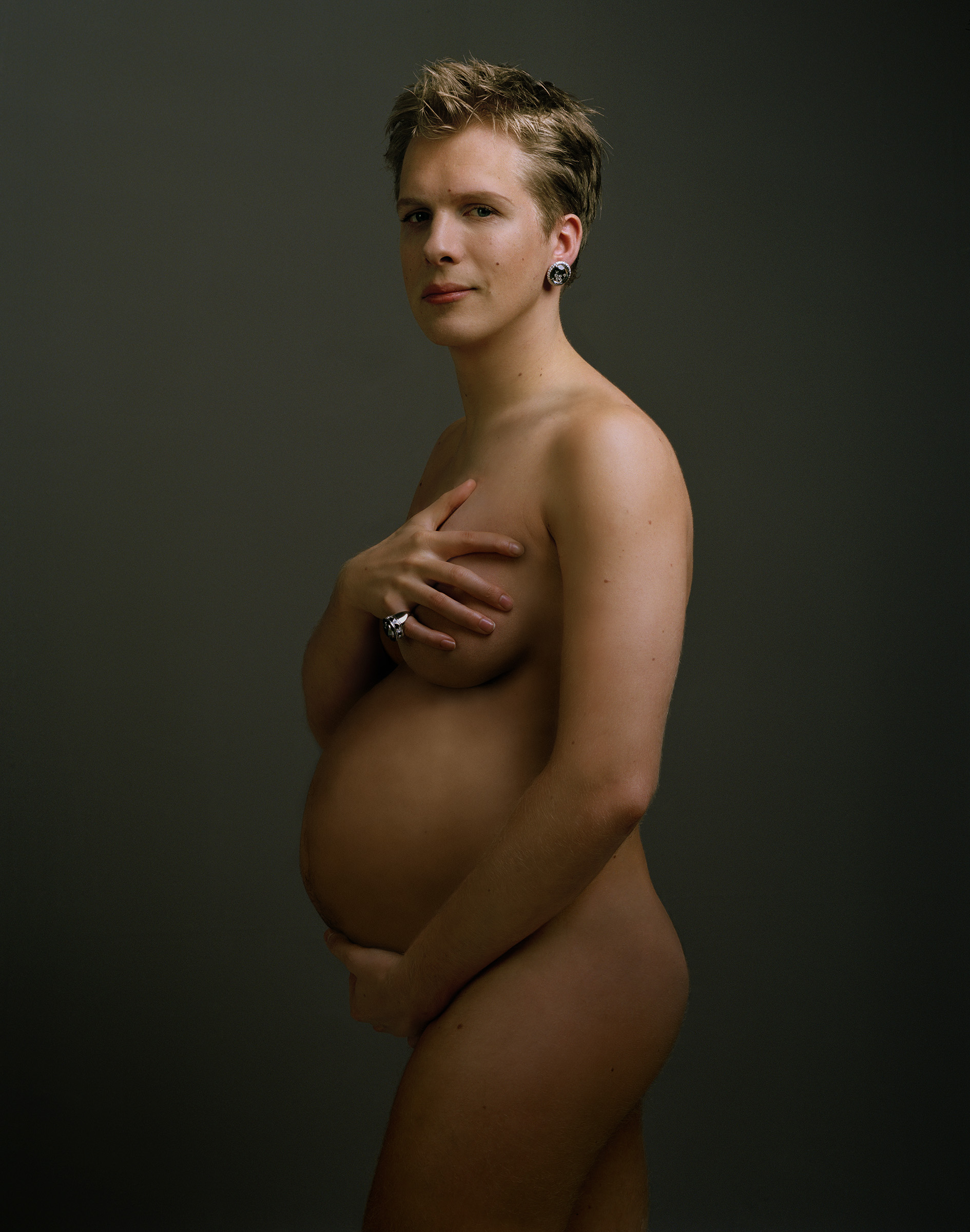
In 2007, Vanity Fair Germany published a story about German comedian and entertainer Oliver Pocher, in which he was asked to choose three photos by Annie Leibovitz to recreate. Oliver Mark was tasked with the photographic execution – a testament to the precision with which Mark approaches his craft. As part of the photo series, the iconic Vanity Fair cover from August 1991 was recreated, featuring Demi Moore seven months pregnant with her daughter Scout. Another recreated image was the famous photo of Walter Matthau and Jack Lemmon. From a technical perspective, it offers a fascinating analogy between Leibovitz and Mark.

Im Jahr 2007 veröffentlichte Vanity Fair Deutschland eine Geschichte über den deutscher Komiker und Entertainer Oliver Pocher, in der er gebeten wurde, drei Bilder von Annie Leibovitz auszusuchen, die er nachstellen sollte. Oliver Mark wurde mit der fotografischen Umsetzung beauftragt – ein Zeugnis der Präzision, mit der Mark in seinem Handwerk arbeitet. Im Rahmen der Fotostrecke wurde das ikonische Cover von Vanity Fair aus dem August 1991 nachgestellt, das Demi Moore, sieben Monate schwanger mit ihrer Tochter Scout, zeigt. Ein weiteres Bild, das nachgestellt wurde, ist das berühmte Foto von Walter Matthau und Jack Lemmon. Aus technischer Sicht eine spannende Analogie zwischen Leibovitz und Mark.
Joschka Fischer, Berlin 2007
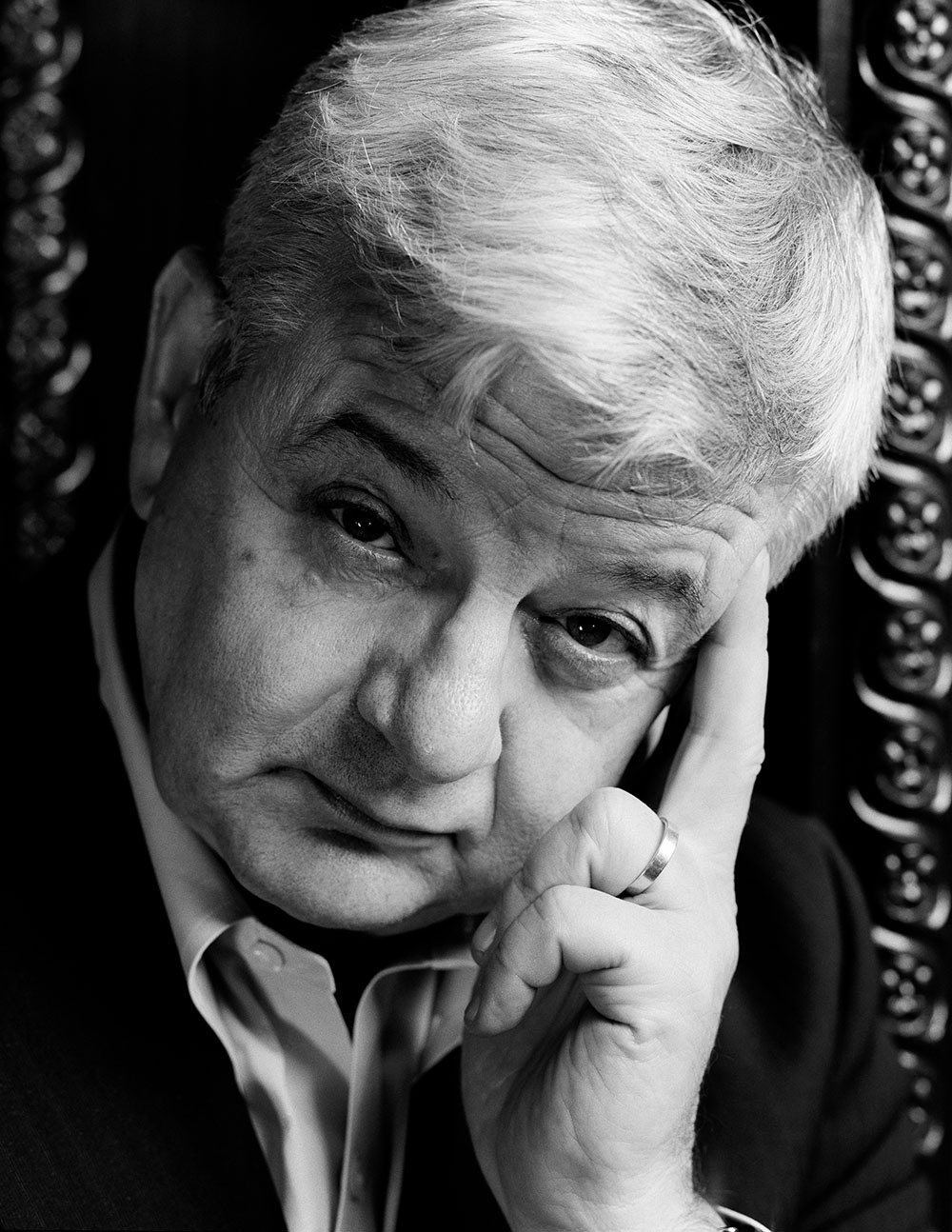
Joschka Fischer gazes intensely and confidently into the camera. Mark had planned the portrait in the library of the Schlosshotel Berlin for ZeitMagazin, with a lightbox as a seat for Fischer. The box would have been invisible in the final image. However, Fischer insisted on being photographed standing – he didn’t want to sit on a box. No problem for Mark. After taking a few shots, he showed Fischer the results and suggested, “Maybe try sitting after all – it might make the double chin less noticeable.” This is how this striking portrait came to be – with Fischer looking satisfied.
Joschka Fischer blickt eindringlich und selbstbewusst in die Kamera. Mark hatte das Porträt in der Bibliothek des Schlosshotels Berlin für das ZeitMagazin vorbereitet – mit einer Lichtkiste als Sitzgelegenheit für Fischer. Diese wäre im Bild nicht sichtbar gewesen. Doch Fischer bestand darauf, im Stehen fotografiert zu werden – er wollte auf keiner Kiste sitzen. Kein Problem für Mark. Nach einigen Aufnahmen zeigte er Fischer die Ergebnisse und intervenierte: Vielleicht doch einmal im Sitzen versuchen, dann wäre das Doppelkinn weniger präsent. So entstand dieses unmittelbare Porträt – und Fischer wirkt zufrieden.
Sandra Hüller, Berlin 2008

Actress Sandra Hüller in action.
Schauspielerin Sandra Hüller in Aktion.
Simon de Pury, Berlin 2008

A striking contrast: a sharp, bold suit against a backdrop of graffiti. Simon de Pury reclines sideways on a table in Mauerpark, wearing a double-breasted pinstripe ensemble. His feet are crossed, his knees slightly parted like an open shell. In front of him lies a crimson notebook with a small red ribbon serving as a bookmark. Supporting himself on one arm, he gazes into the camera with a faintly amused expression. The inspiration for this pose? The iconic fold-out image of a nude man in a magazine – none other than actor Burt Reynolds. It reminds me a bit of 007 on an undercover mission – I like it and can’t help but anticipate the double-page spread in Cosmo.
Guter Kontrast: ein ziemlich krasser, guter Anzug vor sehr viel Graffiti. Simon de Pury liegt hier im Zweireiher-Nadelstreifen-Ensemble seitlich auf einem Tisch im Mauerpark, die Füße voreinander überschlagen, die Knie wie eine Muschel geöffnet. Vor ihm liegt ein karmesinfarbenes Notizbuch mit einem kleinen roten Band, das als Lesezeichen dient. Er stützt sich auf einen Unterarm ab und blickt leicht amüsiert in die Kamera. Vorbild für diese Pose: das erste Ausklappbild eines nackten Mannes in einer Zeitschrift von niemand geringerem als dem Schauspieler Burt Reynolds. Erinnert mich ein bisschen an 007 auf Recherche-Reise – mir gefällt’s und ich warte auf die Doppelseite in der Cosmo.
Roberto Cavalli, Florence 2008
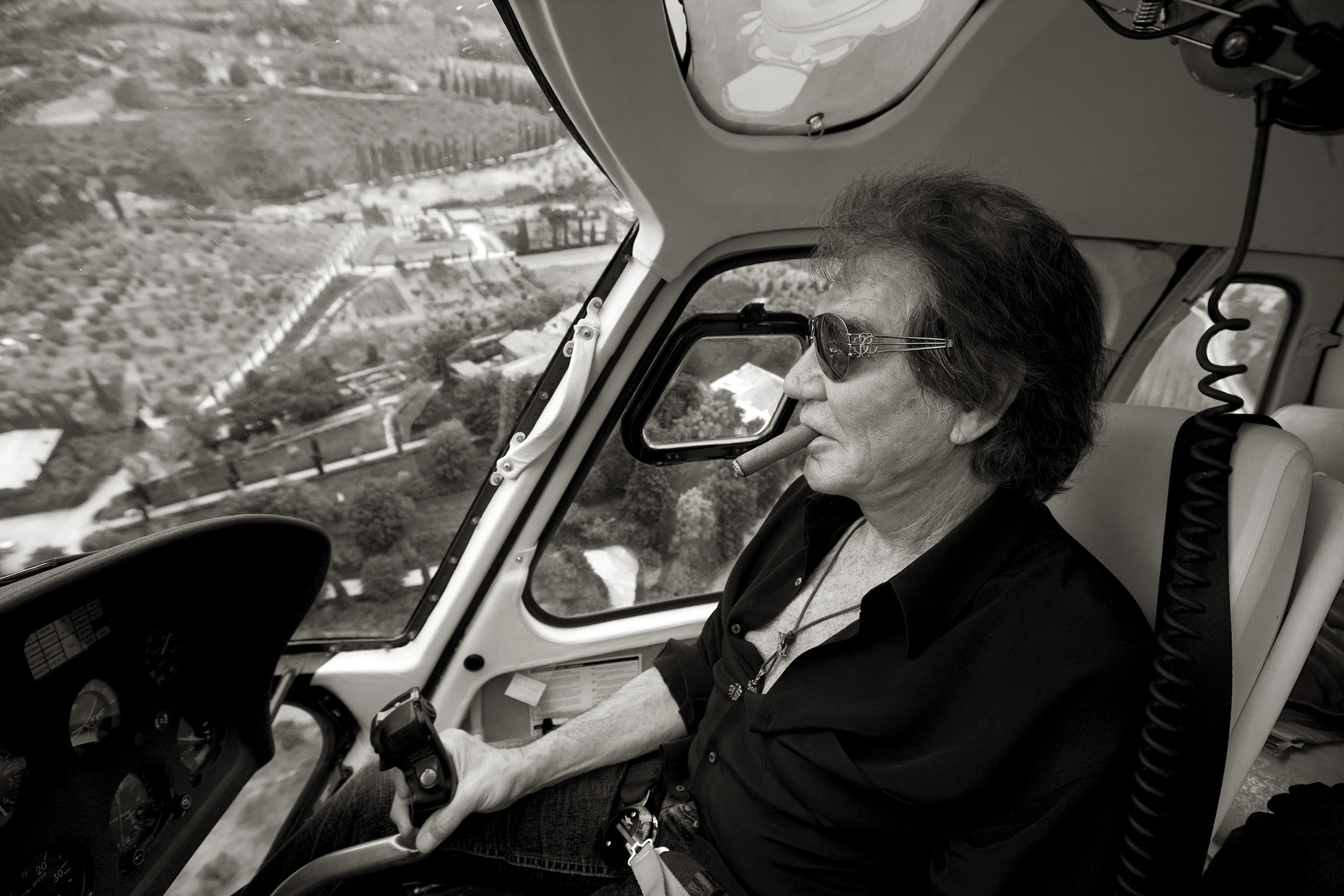
…flying in a helicopter in a casual pose, with a beautiful décolletage and a cigar in his mouth, taking a little scenic flight over Florence. Ciao, cliché.
…fliegt hier im Helikopter in lässiger Pose, schönem Dekolleté und Zigarre im Mund einen kleinen Rundflug über Florenz. Ciao, cliché.
Philipp Demandt, Greifswald 2008
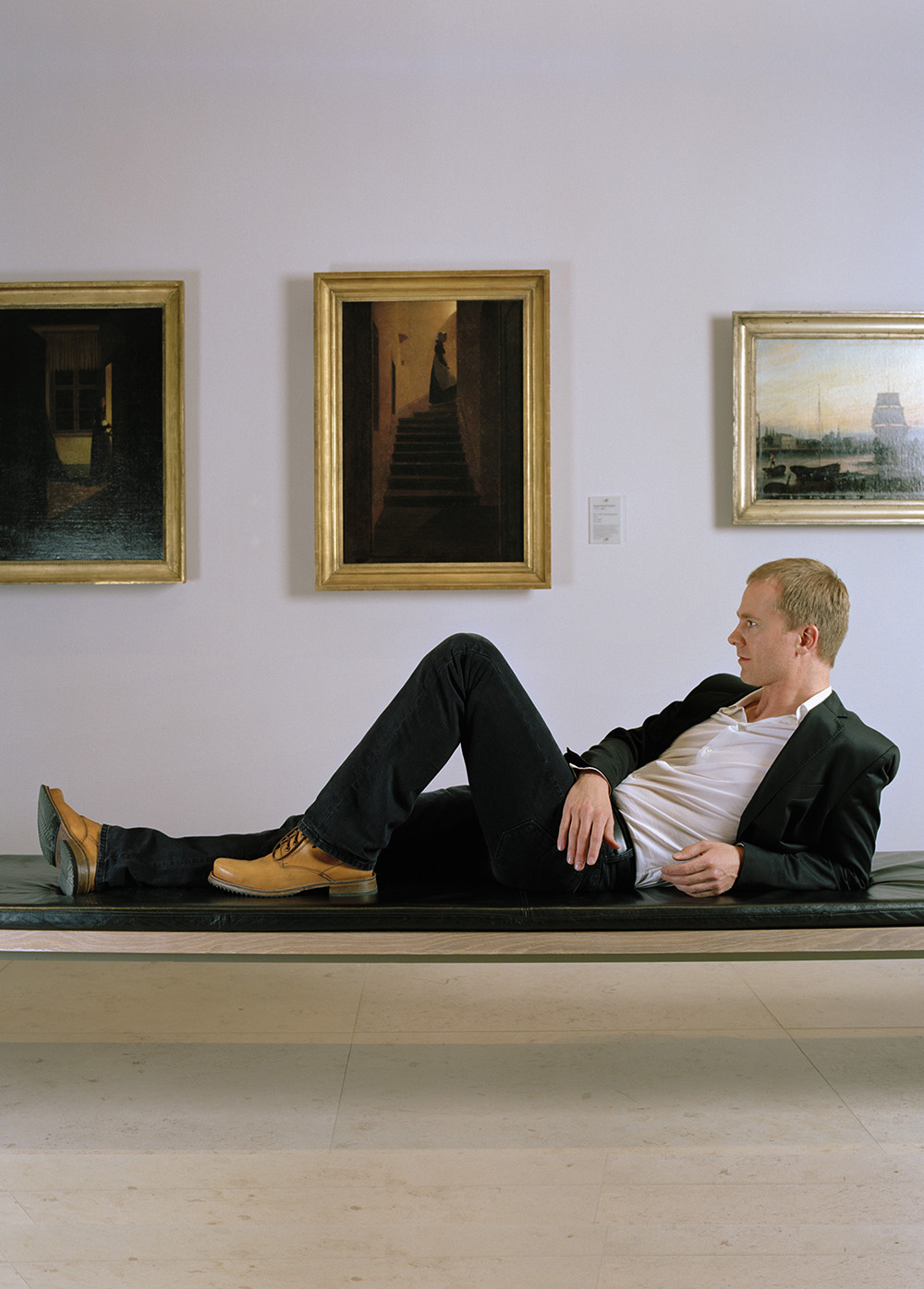
This portrait of the art historian and director of the Städel Museum and the Liebieghaus Sculpture Collection in Frankfurt was taken at the Pommersches Landesmuseum in front of Caspar David Friedrich’s Woman Rising Towards the Light in Greifswald. Mark photographed it for Arsprototo – The Magazine of the Culture Foundation of the Länder. The appropriate shoes were specially purchased for this portrait of Philipp Demandt.
Dieses Portrait von dem Kunsthistoriker und Direktor des Städel Museums und der Liebieghaus Skulpturensammlung in Frankfurt am Main entstand im Pommerschen Landesmuseum vor Caspar David Friedrichs Zum Licht hinaufsteigende Frau in Greifswald. Mark hat es für Arsprototo – Das Magazin der Kulturstiftung der Länder fotografiert. Die passenden Schuhe wurden extra für das Porträt von Philipp Demandt erworben.
Angela Merkel, Berlin 2009

“Make a picture – make history.” — This was the phrase Queen Elizabeth II said to Angela Merkel on July 2, 2021, as the two turned toward the photographers. The scene is shown here. This meeting marked Angela Merkel’s final official audience as the sitting Chancellor of Germany with Queen Elizabeth II. Whenever Mark works on a portrait of Merkel—whether retrospectively or in one of his collaborations, such as with Saâdan Afif / Oliver Mark—he reflects on these fitting words.
„Make a picture – make history.“ — Das sagte Queen Elizabeth II. am 2. Juli 2021 zu Angela Merkel, während sich die beiden den Fotografen zuwandten. Die Szene ist hier zu sehen. Dieses Treffen war die letzte offizielle Audienz von Angela Merkel als amtierende Bundeskanzlerin bei Queen Elizabeth II. Wann immer Mark sich seitdem mit einem Porträt von Merkel auseinandersetzt – sei es rückblickend oder in einer seiner Collaborations, zum Beispiel mit Saâdan Afif / Oliver Mark – denkt er an diese treffenden Worte.
Nicole Hackert, Jonathan Meese, Gunny Gudmunsdottir, Marc Brandenburg, and Bruno Brunett, Berlin 2009
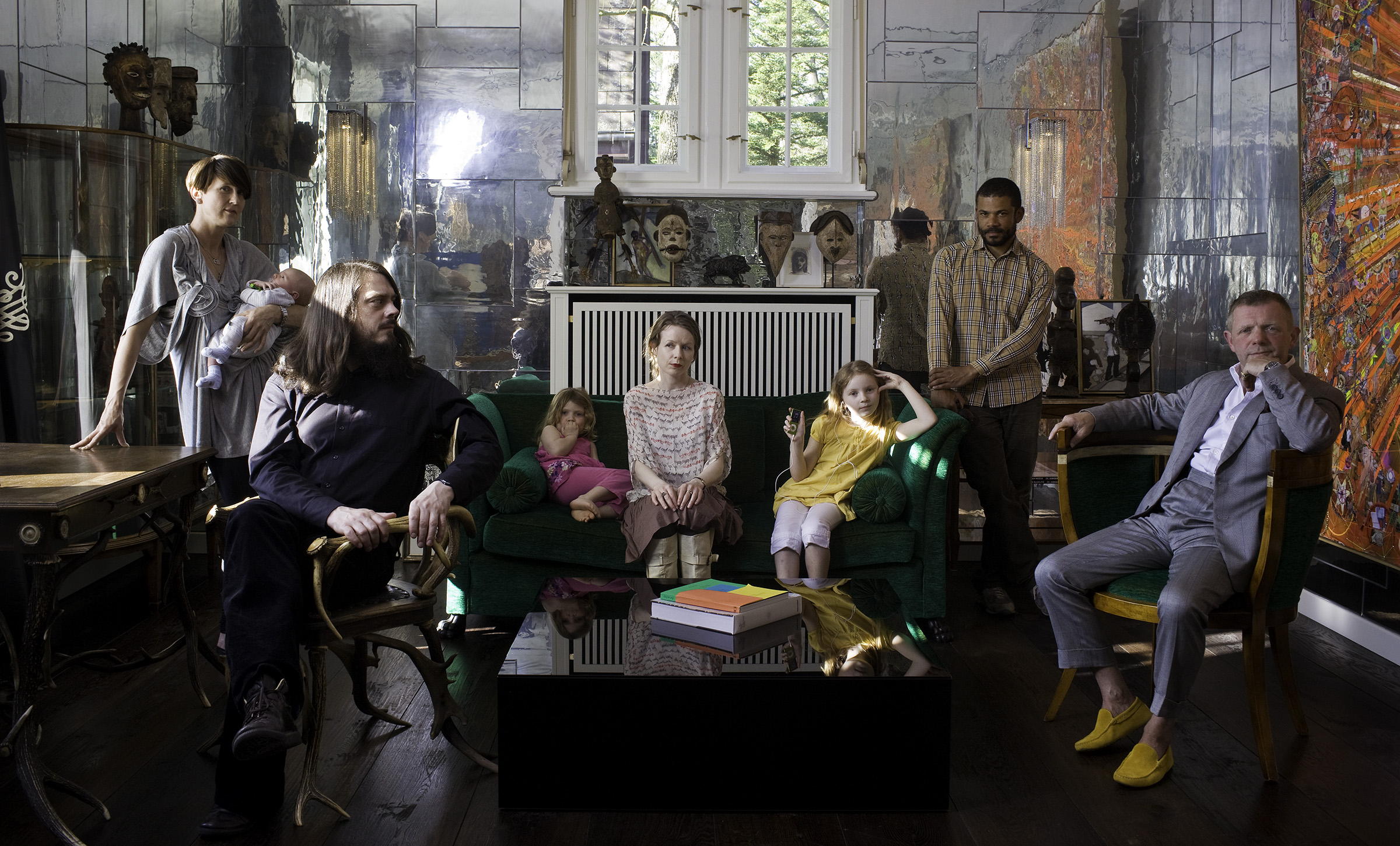
The home of gallery owners Nicole Hackert and Bruno Brunett is impressively stylish, providing a captivating setting for this shot. The photograph features Hackert and Brunett along with their children and the artists Jonathan Meese, Gudny Gudmundsdottir, and Marc Brandenburg. This was a personal project for Mark, intended for publication in a feature about contemporary Berlin and its cultural scene. After the picture was taken, a barbecue followed, and Jonathan Meese gifted Mark a “grill poem,” which is shown here.

Das Zuhause der Galeristen Nicole Hackert und Bruno Brunett ist beeindruckend stilsicher eingerichtet und bildet hier eine sehr spannende Szenerie. Auf der Aufnahme sind neben Hackert und Brunett auch deren Kinder sowie die Künstler Jonathan Meese, Gudny Gudmundsdottir und Marc Brandenburg zu sehen. Es war eine freie Arbeit für Mark, geplant zur Veröffentlichung in einer Publikation – ein Gesellschaftsbeitrag über das zeitgenössische Berlin und seine Kulturszene. Nachdem sie das Bild gemacht hatten, wurde gegrillt. Jonathan Meese schenkte Mark an diesem Abend ein Grillgedicht. Es ist hier zu sehen.
Joachim Gauck, Berlin 2010
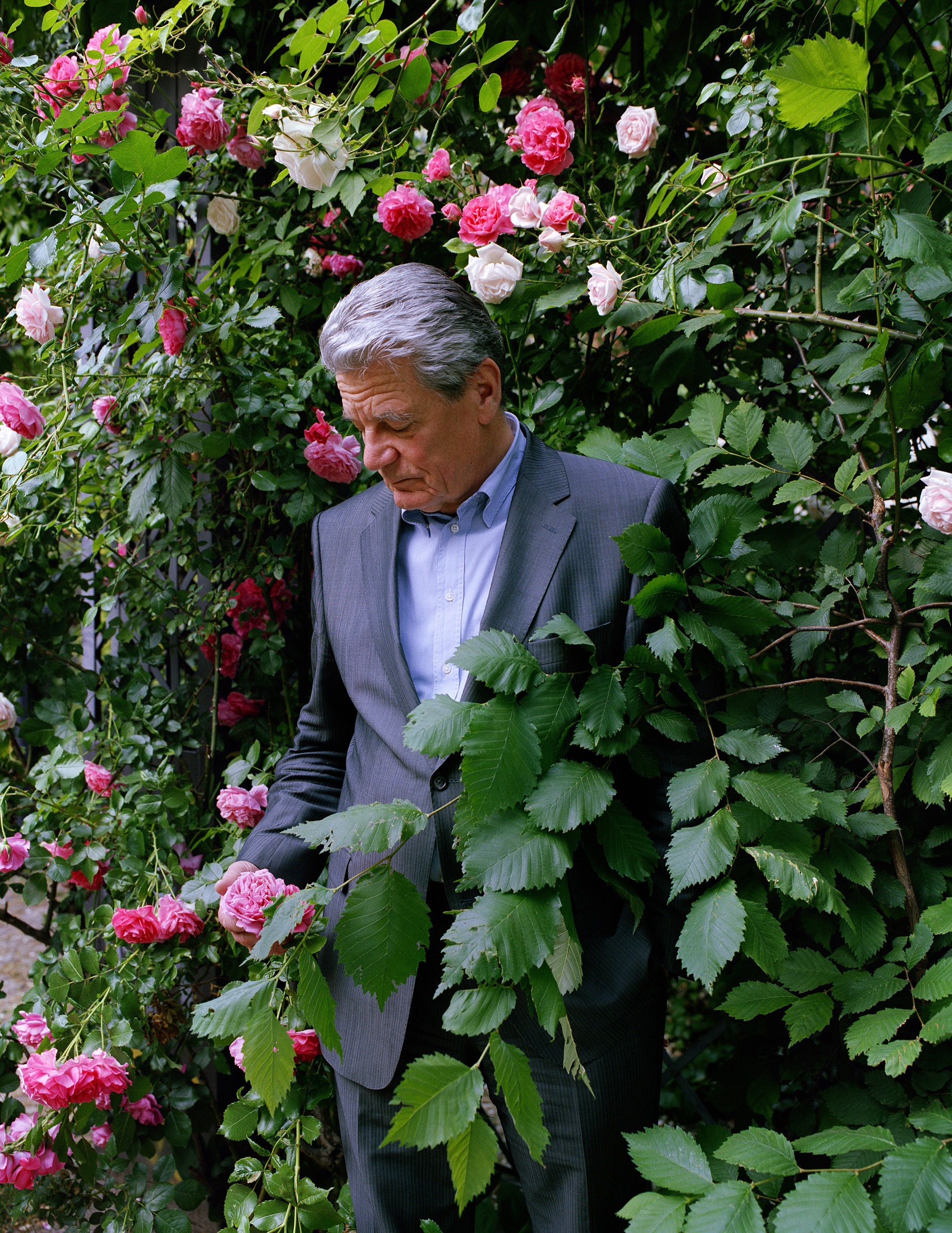
Mark’s portrait of Joachim Gauck was taken in 2010 in a Berlin rose garden for Die Zeit, during the time of the federal presidential election by the 14th Federal Convention. The opposing candidate was Christian Wulff, who ultimately assumed office. The interview and initial photo shoot took place in a modest prefab building: a stark office with a table and three chairs, walls covered in wallpaper from the 1970s, and flickering neon lights in the ceiling. Mark found the location quite depressing. However, within walking distance, he discovered a rose garden. He took a Polaroid of the garden, showed it to Gauck, and the former president agreed to do the portrait there.
Marks Porträt von Joachim Gauck entstand 2010 in einem Berliner Rosengarten für Die Zeit, zur Zeit der Wahl des Bundespräsidenten durch die 14. Bundesversammlung. Gegenkandidat war Christian Wulff, der schließlich auch das Amt übernahm. Das Interview und die Porträtaufnahmen fanden zunächst in einem unscheinbaren Plattenbau statt: ein karger Büroraum mit einem Tisch und drei Stühlen, an den Wänden Raufaser und Tapeten aus den Siebziger Jahren, die Beleuchtung bestand aus flackernden Neonröhren an der Decke. Oliver Mark empfand die Location als deprimierend. In Gehweite entdeckte er jedoch einen Rosengarten. Er machte ein Polaroid des Gartens, zeigte es Gauck, und der ehemalige Bundespräsident a.D. stimmte zu, das Porträt dort aufzunehmen.
Philip Topolovac, Berlin 2010

When Mark’s son, at 17, first saw the work Aggregat by Philip Topolovac in the upper corner of the studio, he was fascinated and immediately declared his inheritance wish. To Mark, the work sometimes looks like a piece from outer space, at other times like a star—it certainly embodies a sense of vastness and spatiality. Perhaps it is an artwork that can be passed down from one generation to the next.
Als Marks Sohn mit 17 das erste Mal die Arbeit Aggregat von Philipp Topolovac in der oberen Ecke des Studios sah, war er fasziniert und meldete direkt seinen Erbwunsch an. Auf Mark selbst wirkt das Werk mal wie ein Stück aus dem Weltall, mal wie ein Stern – es birgt auf jeden Fall eine gewisse Weite und Räumlichkeit in sich. Vielleicht lässt es sich also gut von einer Generation zur nächsten tragen?
Thomas de Maizière, Berlin 2010

This image beautifully demonstrates how quickly a photo can come together. We find ourselves once again in the back room of the Ministry of the Interior, specifically at the entrance. Mark was familiar with this space, as he had previously photographed Wolfgang Schäuble here. When de Maizière walked toward him from this hallway, Mark asked him to stop at a specific spot. It was at that moment the photo was taken. What’s especially intriguing about this location, particularly in a political context, is the wooden cross on the wall. Mark consciously combines the themes of religion and politics in his setup, creating not only a multi-layered portrait but also an interesting prompt for reflection.
Wie schnell ein Foto entstehen kann, zeigt diese Arbeit eindrucksvoll. Wir befinden uns erneut im Hinterzimmer des Innenministeriums, genauer gesagt, am Eingang dazu. Mark kannte diese Räumlichkeiten bereits, da er hier Schäuble fotografiert hatte. Als de Maizière aus diesem Durchgang auf ihn zukam, bat Mark ihn, an einer bestimmten Stelle stehen zu bleiben. Genau in diesem Moment entstand das Foto. Besonders spannend an diesem Ort, vor allem im politischen Kontext, ist das hölzerne Kreuz an der Wand. Mark kombiniert in seiner Inszenierung bewusst die Themen Religion und Politik, wodurch er nicht nur ein vielschichtiges Porträt schafft, sondern auch einen interessanten Denkanstoß vermittelt.
Umberto Eco’s Bed, Milan 2011
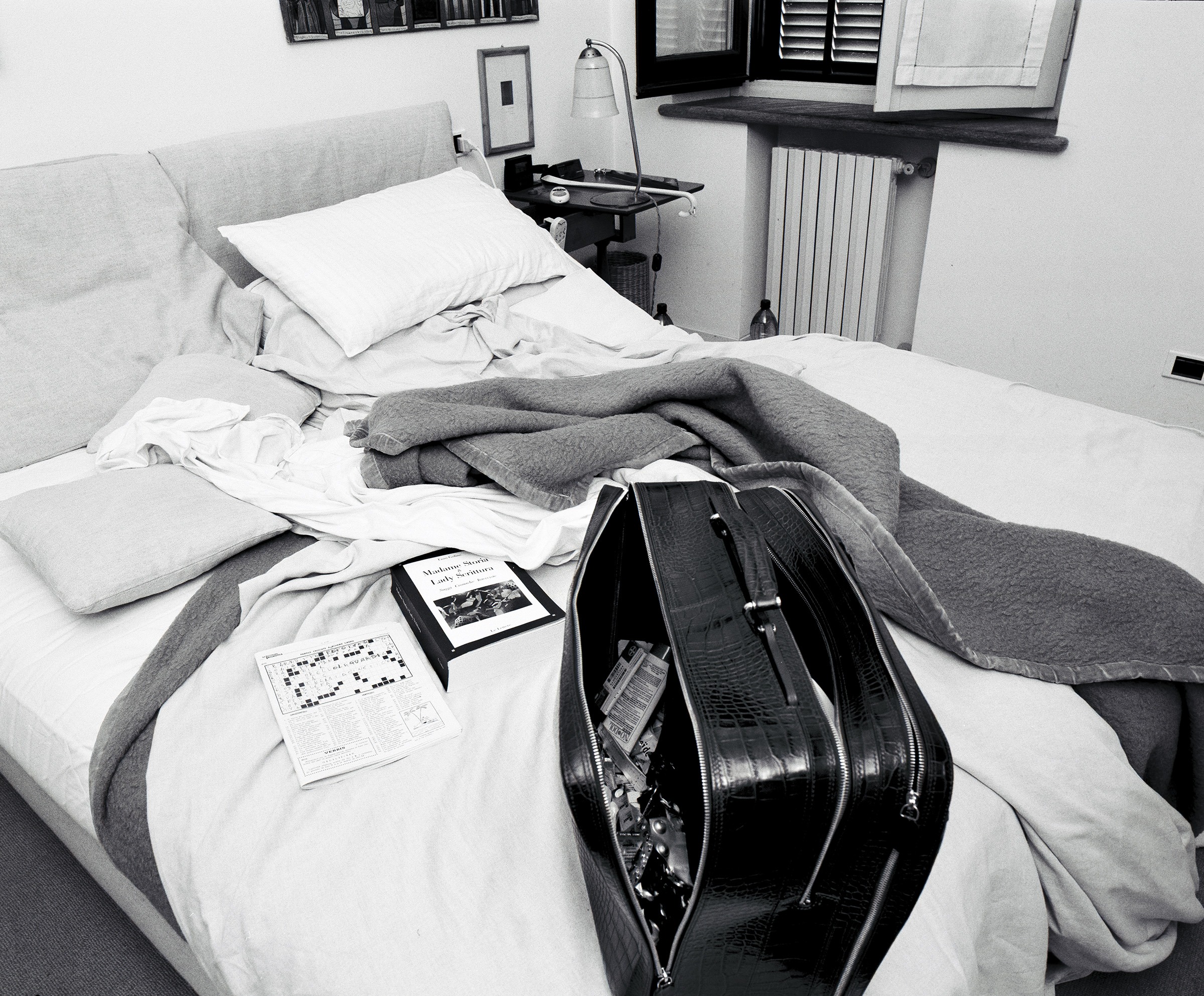
This image offers a very personal view from Umberto Eco’s bedroom: the unmade bed with a Prada bag filled with various medications, next to a crossword puzzle and a book by Enzo Golino, Madame Storia & Lady Scrittura. This photograph, titled Umberto Eco’s Bed, Milan 2011, exists as a silver gelatin print in three copies, each measuring 30 × 40 cm. In 2011, Mark photographed Umberto Eco in his spacious Milan apartment for Die ZEIT. Mark had asked Eco where he could take photos, to which Eco simply replied: “Anywhere.” Mark chose to photograph him in the impressive private library, which houses over 30,000 contemporary books and 1,500 rare and antique volumes.
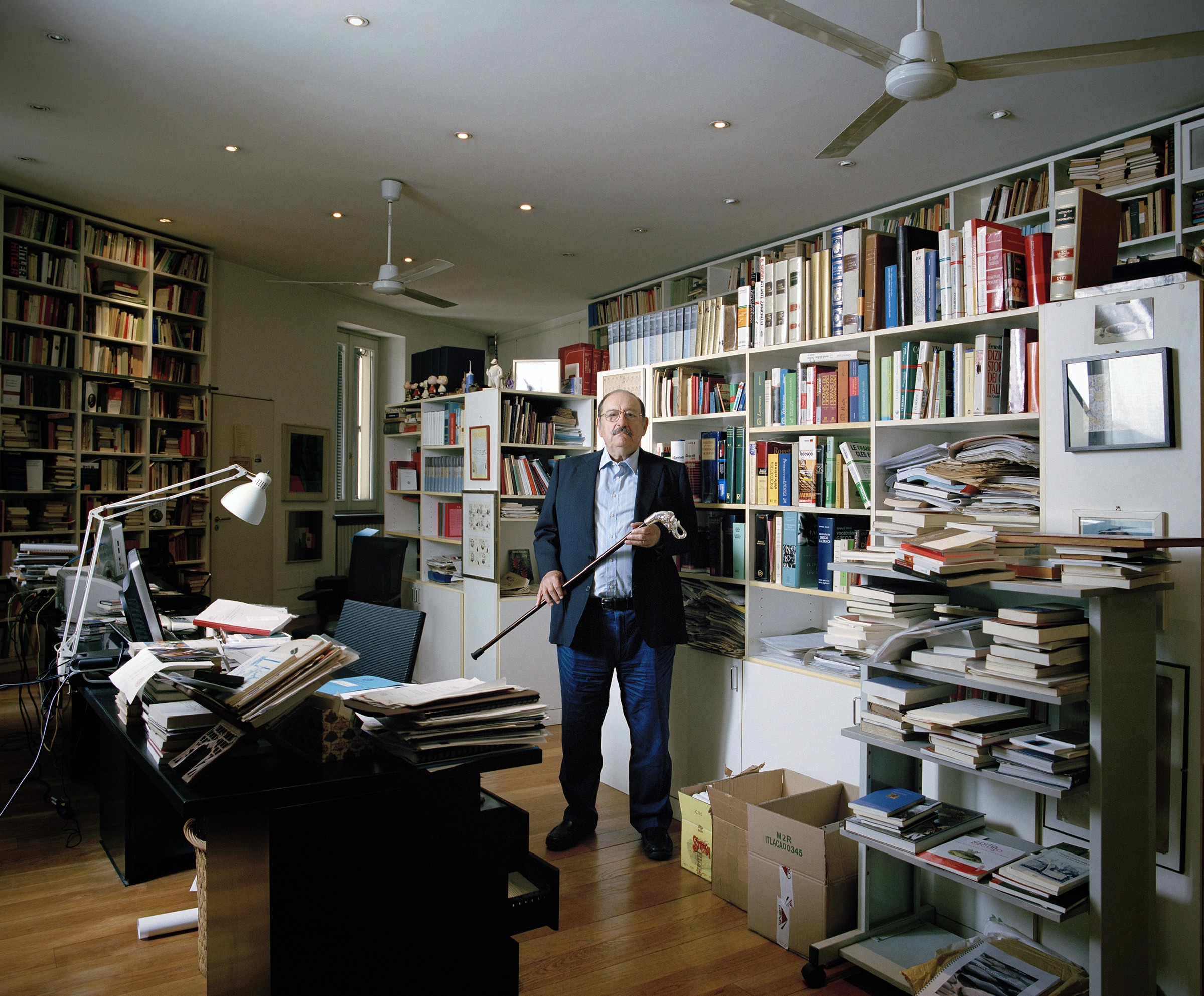
Dieses Bild zeigt eine sehr persönliche Aufnahme aus Umberto Ecos Schlafzimmer: das aufgeschlagene Bett, auf dem eine Prada-Tasche liegt, gefüllt mit verschiedenen Medikamenten, daneben ein Kreuzworträtsel und ein Buch von Enzo Golino, Madame Storia & Lady Scrittura. Diese Aufnahme, betitelt Titel Umberto Ecos Bed, Mailand 2011, existiert als Silbergelatine-Print in drei Exemplaren im Format 30 × 40 cm. 2011 fotografierte Mark Umberto Eco in seiner großzügigen Mailänder Wohnung für Die ZEIT. Mark hatte Eco gefragt, wo er fotografieren dürfe, und Eco antwortete schlicht: überall. Mark entschied sich für die beeindruckende Privatbibliothek des Schriftstellers mit mehr als 30.000 zeitgenössischen Büchern und 1.500 seltenen und antiken Bänden.
Pope Benedict XVI., Erfurt 2011
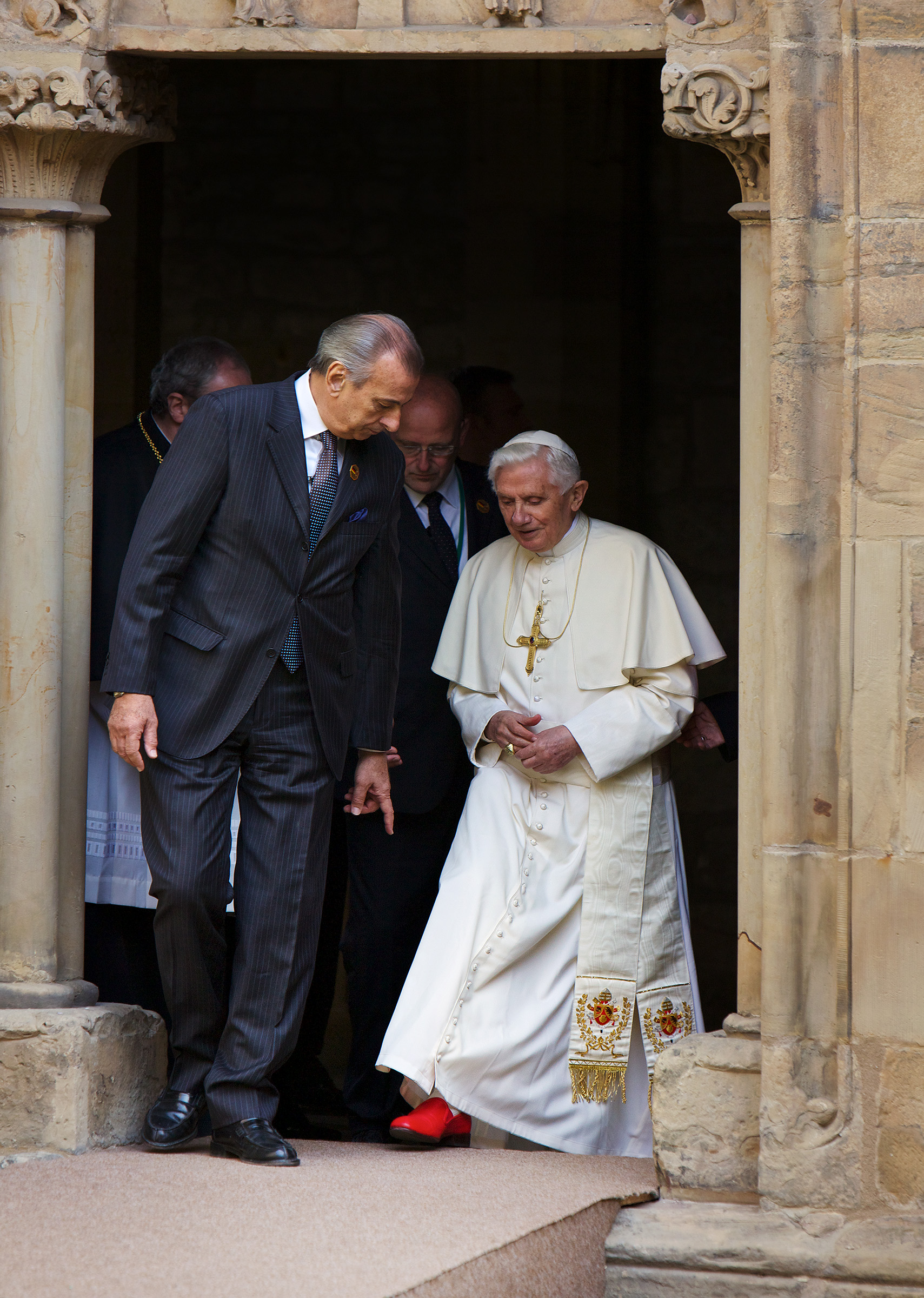
Pope Benedict XVI walks through the cloister of St. Mary’s Cathedral in Erfurt, though not without the assistance of the papal travel marshal Alberto Gasbarri, who points out a step to him.
Benedikt XVI. schreitet durch den Kreuzgang der Domkirche St. Marien zu Erfurt, jedoch nicht ohne die Hilfe des Reisemarschall Alberto Gasbarri, der ihn auf eine Stufe im hinweist.
Günther Uecker, Düsseldorf 2011
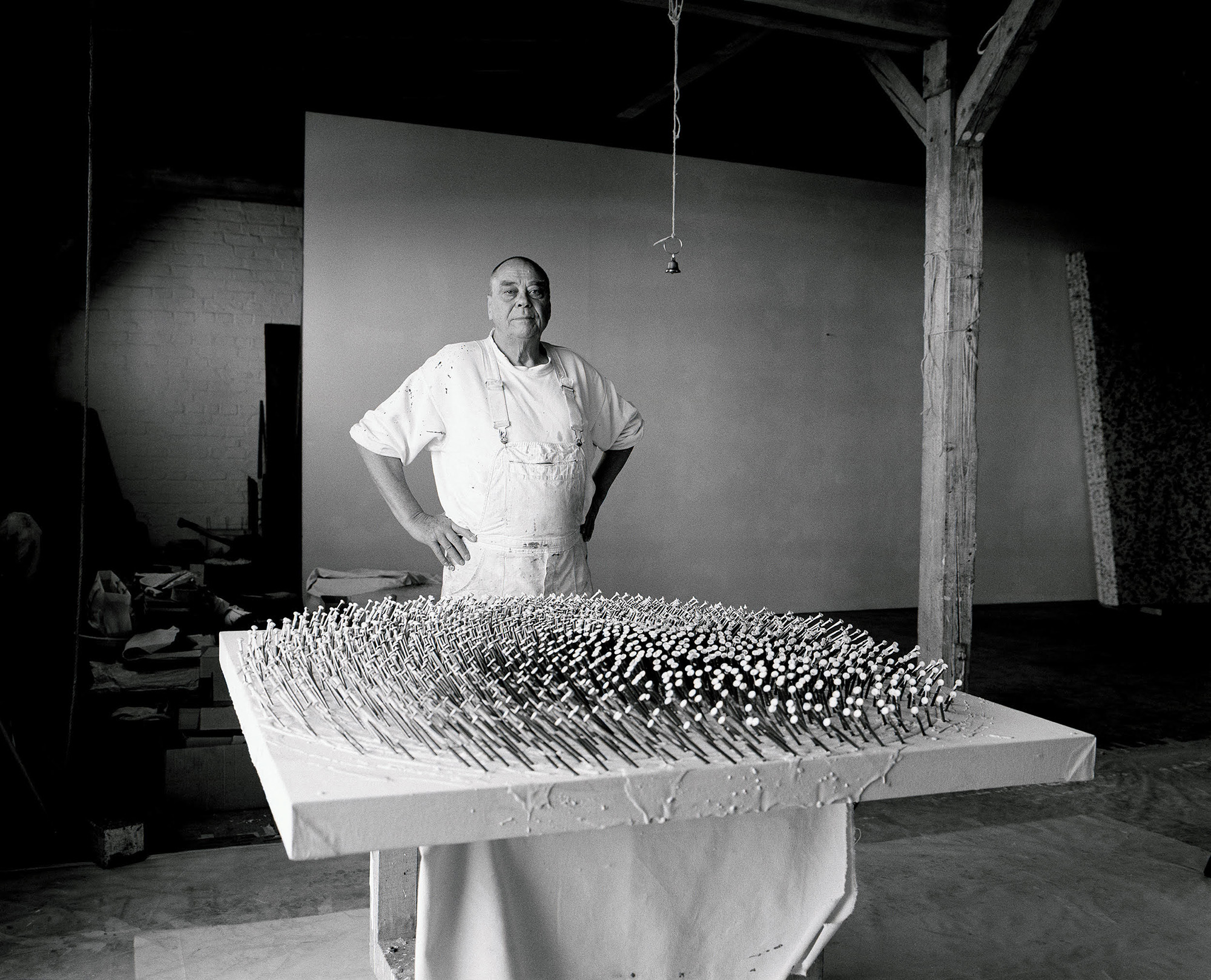
In 2011, Florian Illies, partner and managing director of the Grisebach auction house (2011–2018), commissioned Oliver Mark to photograph Günther Uecker in Düsseldorf. The occasion was the artist’s generous donation: he contributed his nail painting Spirale (120 x 120 x 16 cm, 2011) to benefit the St. Johannes bell of his hometown church in Rerik. The portrait was taken on December 7, 2011, using a Mamiya RZ II camera and 400 ISO film. To achieve the best lighting conditions, Mark, with the help of Uecker’s assistant, positioned the nail painting on two sawhorses next to a tall window to capture natural daylight from the left. The small bell featured in the image was found by Mark in Uecker’s studio and deliberately hung on a cord. Günther Uecker, who grew up on the Wustrow peninsula and attended school in Rerik, was named an honorary citizen of the Baltic resort town in 2010. In the fall of 2011, he created the nail painting, which was auctioned in spring 2012 for €340,000 to support the bells and the restoration of the Rerik church tower. In addition to the portraits, Mark also captured studio shots, which remain unpublished to this day.
Im Jahr 2011 gab Florian Illies, Gesellschafter und Geschäftsführer des Auktionshauses Grisebach (2011–2018), Oliver Mark den Auftrag, Günther Uecker in Düsseldorf zu porträtieren. Anlass war die großzügige Spende des Künstlers: Er stiftete sein Nagelbild Spirale (120 x 120 x 16 cm, 2011) für die St. Johannesglocke seiner Heimatkirche in Rerik. Das Porträt wurde am 07.12.2011 mit einer Mamiya RZ II und einem 400 ISO-Film aufgenommen. Um das Bild unter optimalen Lichtverhältnissen zu gestalten, stellte Mark das Nagelbild gemeinsam mit Ueckers Assistenten auf zwei Böcke neben ein hohes Fenster, um das natürliche Tageslicht von links einzufangen. Die kleine Glocke im Bild fand Mark im Studio von Uecker und hängte sie extra an einer Kordel. Günther Uecker, der auf der Halbinsel Wustrow aufwuchs und in Rerik zur Schule ging, wurde 2010 Ehrenbürger des Ostseebades. Im Herbst 2011 schuf er das Nagelbild, das im Frühjahr 2012 zugunsten der Glocken und der Turmsanierung der Reriker Kirche für 340.000 Euro versteigert wurde. Neben den Porträts entstanden auch freie Studioansichten, die bisher nicht veröffentlicht wurden.
Ronald de Bloeme, Berlin 2011

The main focus of this portrait is a body in portrait format. More specifically, a half-naked person – bare-chested, wearing jeans below. Why does the nudity fade into the background thematically and become perceived primarily as a body? Because, at the moment of the shot, there were actually two half-naked people: Mark and de Bloeme. By doing so, Mark dissolves the separating element of a photoshoot where one person disrobes and the other observes, breaking the hierarchy between the subject, the camera, and the photographer. This could only have been achieved because Mark respects his model and identifies with their position. Compositional elements can be traced in the upright posture in contraposto and the calm, distant gaze.
Hauptaugenmerk dieses Porträts: ein Körper im Hochformat. Genauer gesagt, eine halb nackte Person – Oberkörper frei, unten eine Jeans. Warum tritt die Nacktheit thematisch hier in den Hintergrund und wird in erster Linie als Körper wahrgenommen? Weil es im Moment der Aufnahme tatsächlich zwei halbnackte Personen waren: Mark und von de Bloeme. Damit hebt Mark das trennende Element eines Fotoshootings auf, bei dem sich eine Person entblößt und die andere sie beobachtet, und bricht die Hierarchie zwischen Objekt, Kamera und Fotograf. Dies konnte nur entstehen, weil Mark sein Modell respektiert und sich mit dessen Position identifiziert hat. Kompositorisch lässt sich dies anhand der aufrechten Körperhaltung im Kontrapost und dem ruhigen, in die Ferne schweifenden Blick nachvollziehen.
Bernhard von Barewisch, Groß Pankow 2011

Another porcelain collector. His collection of Meissen’s “Blue Onion” pattern is said to be the largest Mark has ever encountered, and it simply had to be included in the photo. Perhaps Mark has a soft spot for porcelain?
Ein weiterer Porzellan-Sammler. Seine Sammlung des Meißener „Zwiebelmusters“ soll die größte sein, die Mark kennt, und musste daher unbedingt mit ins Bild. Eventuell hat Mark eine Schwäche für Porzellan?
Hereditary Prince Maximilian and Hereditary Princess Marissa zu Bentheim-Tecklenburg with Their Children, Rheda 2012

The camera: Mamiya. The process: technically slow—first the film is loaded, then the mirror lifts, and the aperture opens. Per film: 10 shots. The biggest challenge: small children don’t always stay still. The masks: to protect the privacy of the children. The composition: successful—reminds me of Las Meninas by Velázquez.
Die Kamera: Mamiya. Der Prozess: technisch langsam – zuerst spannen, dann klappt der Spiegel hoch, die Blende öffnet sich. Pro Film: 10 Aufnahmen. Größte Herausforderung: dass kleine Kinder nicht immer stillstehen. Die Masken: zum Schutz der Privatsphäre der Kinder. Die Komposition: gelungen – erinnert mich an Las Meninas von Velásquez.
Cameron Carpenter and his Personal Trainer, Berlin 2012

In 2012, Oliver Mark met musician Cameron Carpenter at a private concert in St. Matthias Church at Winterfeldtplatz in Berlin. Mark was so impressed with Carpenter’s virtuosity and appearance that he suggested a photo series about Carpenter to Jan Koch, who was briefly editor-in-chief of Interview magazine in Germany and publisher of 032c magazine. In addition to individual portraits of Carpenter, Mark proposed photographing double portraits with prominent personalities from Berlin’s cultural scene. Stylist Klaus Stockhausen provided three suitcases with selected clothes and shoes for the shoot. The double portraits included shots of artist Katharina Grosse in her studio and of Margot Friedländer and André Schmitz in Schmitz’s library. For the lead image of the series, Mark chose a shot of Carpenter and his personal trainer – naked with the trainer lying on top of Carpenter. Mark drew inspiration for this from a 1973 self-portrait by Helmut Newton, showing Newton with an almost naked woman in bed. Mark’s work Cameron Carpenter and His Personal Trainer was exhibited at the National Portrait Gallery in London in 2012.
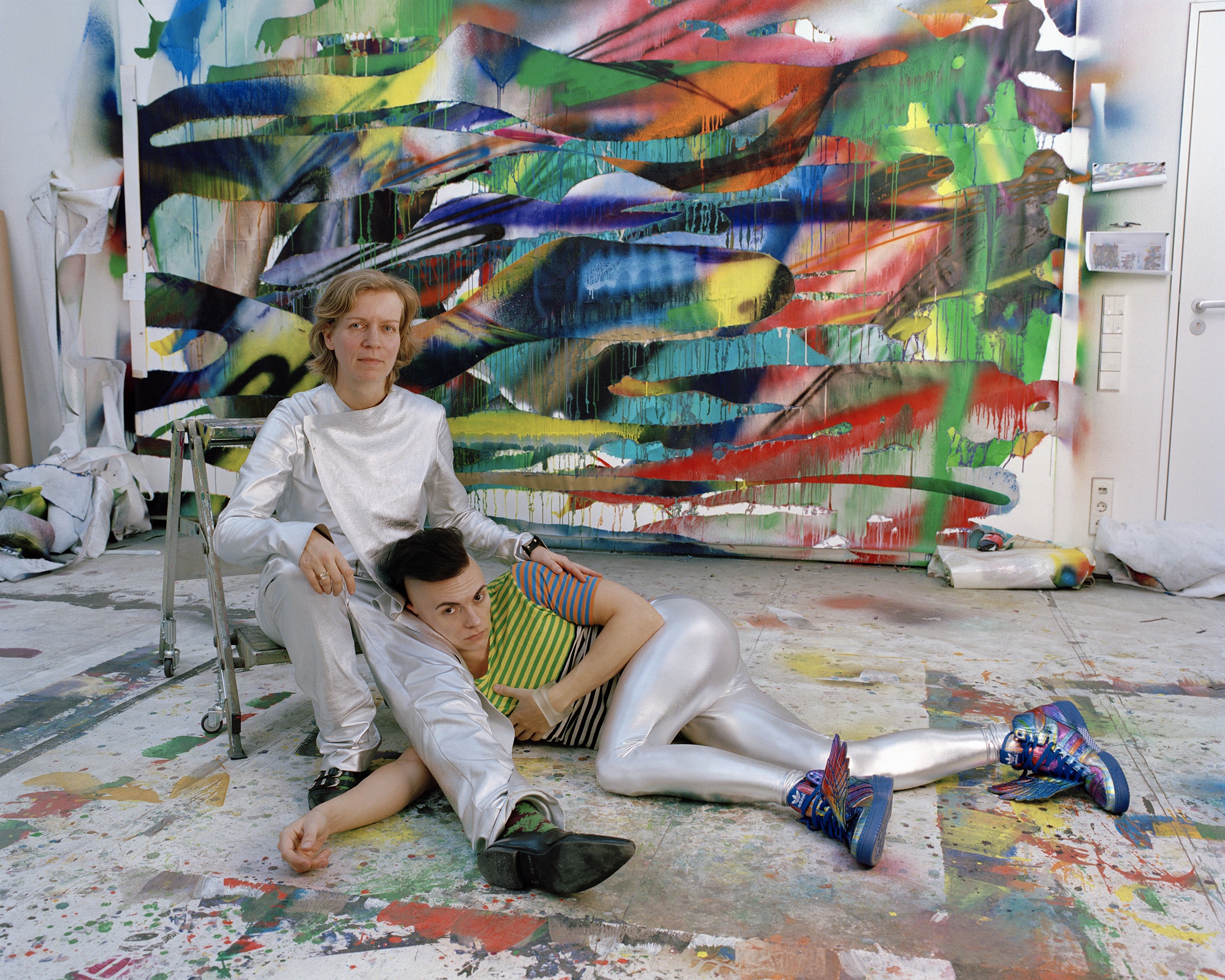
2012 lernte Oliver Mark den Musiker Cameron Carpenter bei einem Privatkonzert in der Kirche St. Matthias am Winterfeldtplatz in Berlin kennen. Marks Begeisterung für Carpenters Virtuosität und sein Erscheinungsbild war so groß, dass er Jan Koch, damals kurzzeitig Chefredakteur des deutschen Interview Magazins und Herausgeber der Zeitschrift 032c, eine Fotostrecke über Carpenter vorschlug. Neben Einzelporträts von Carpenter schlug Mark vor, Doppelporträts mit prominenten Persönlichkeiten des Berliner Kulturlebens zu fotografieren. Der Stylist Klaus Stockhausen stellte dafür drei Koffer mit ausgewählter Kleidung und Schuhen bereit. Zu den Doppelporträts gehörten Aufnahmen der Künstlerin Katharina Grosse in ihrem Studio und von Margot Friedländer und André Schmitz in Schmitz’ Bibliothek. Als Aufmacher der Serie wählte Mark ein Bild von Carpenter und dessen Personal Trainer – nackt auf Carpenter liegend. Die Inspiration dazu entnahm Mark einem Helmut Newton-Selbstporträt von 1973, das Newton mit einer fast unbekleideten Frau im Bett zeigt. Marks Werk Cameron Carpenter and his Personal Trainer wurde 2012 in der National Portrait Gallery in London ausgestellt.
Yoko Ono, Berlin 2012
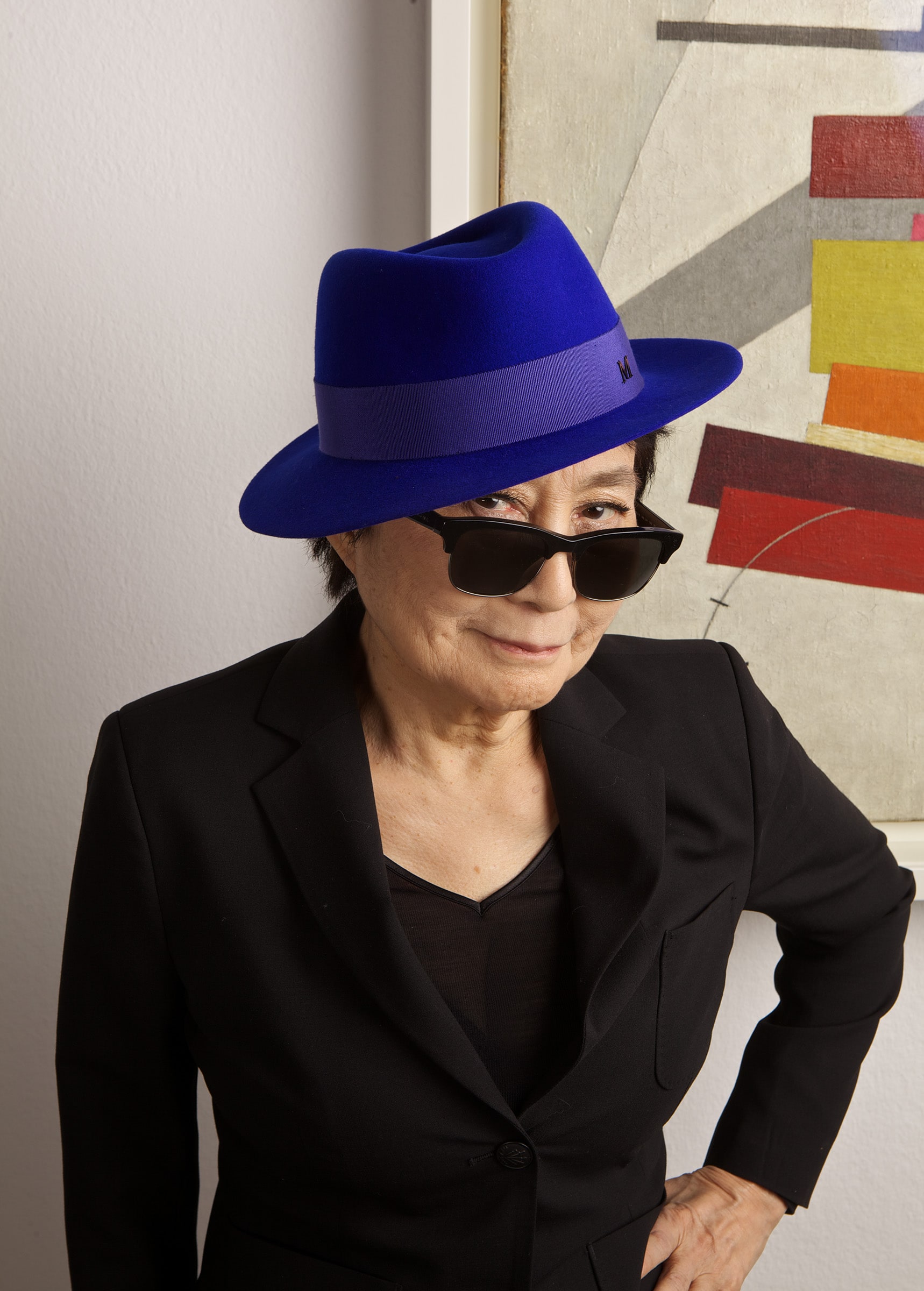
Royal blue hat: Mühlbauer, black sunglasses: Prada, a picture with colorful cut-outs in the background: Kurt Schwitters. The protagonist: Yoko Ono on the cover of Weltkunst No. 69. The painting in the background was chosen by the editorial team, while Ono styled herself. Mark needed 10 minutes for the shoot, and three additional Polaroids were taken in the process.
Königsblauer Hut: Mühlbauer, schwarze Sonnenbrille: Prada, Bild mit bunten Farbschnitten im Hintergrund: Kurt Schwitters. Protagonistin: Yoko Ono auf dem Cover der Weltkunst No. 69. Das Gemälde im Hintergrund war von der Redaktion vorgegeben, Ono stylte sich selbst, Mark benötigte 10 Minuten für die Aufnahmen, nebenbei entstanden noch drei Polaroids.


Tacita Dean, Berlin 2012
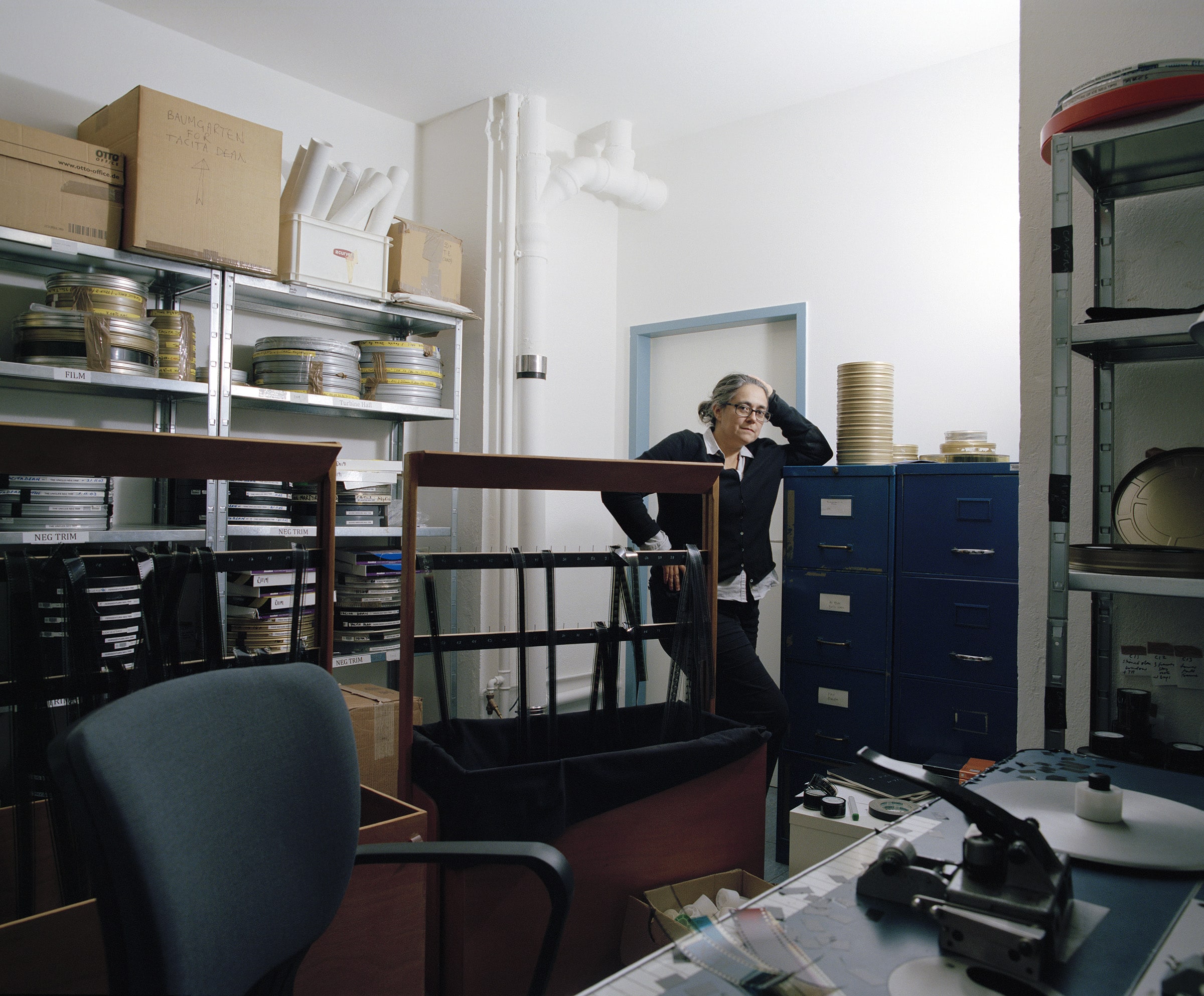
A figure in the background – but of what? Film reels. The artist with the wonderful name Tacita – Latin for “the silent one” – primarily works with film, photography, and visual storytelling. Another portrait of an artist, positioning the person in relation to their work.
Eine Person im Hintergrund – aber von was? Filmrollen. Die Künstlerin mit dem wunderbaren Namen „Tacita“, lat. „die Schweigende“, arbeitet vornehmlich mit Film, Fotografie und visueller Erzählung. Ein weiteres Porträt einer Künstlerin, in dem sich die Person im Verhältnis zu ihrem Werk positioniert.
Madeleine Albright, Berlin 2013

Mark photographed Madeleine Albright for Die ZEIT in front of the Jewish Museum, placing special emphasis on the interaction between the architecture and the person. However, after the photoshoot, the proportion between the human subject and the building did not feel balanced because of the metallic background. After a tour, Mark took one more photograph, this time using his 680 Polaroid camera – and that became the best image. It remains a unique piece.
Mark fotografierte Madeleine Albright für Die ZEIT vor dem Jüdischen Museum und legte dabei besonderen Wert auf das Zusammenspiel von Architektur und Person. Doch nach dem Fotografieren wirkte die Proportion zwischen Mensch und Gebäude durch den metallenen Hintergrund nicht stimmig. Nach einer Führung machte er noch ein einziges weiteres Foto, diesmal mit seiner 680 Polaroid-Kamera – und dabei entstand das beste Bild. Es bleibt ein Unikat.
Maria Furtwängler and Ursula von der Leyen, Berlin 2013

A title and a Polaroid created on the occasion of their conversation with Süddeutsche Zeitung Magazin in July 2013 about their fathers’ battles with dementia. Like the conversation itself, the photographs feel honest and unfiltered. The interview, conducted by Alexandra Borchardt and Susanne Schneider, can be read here.
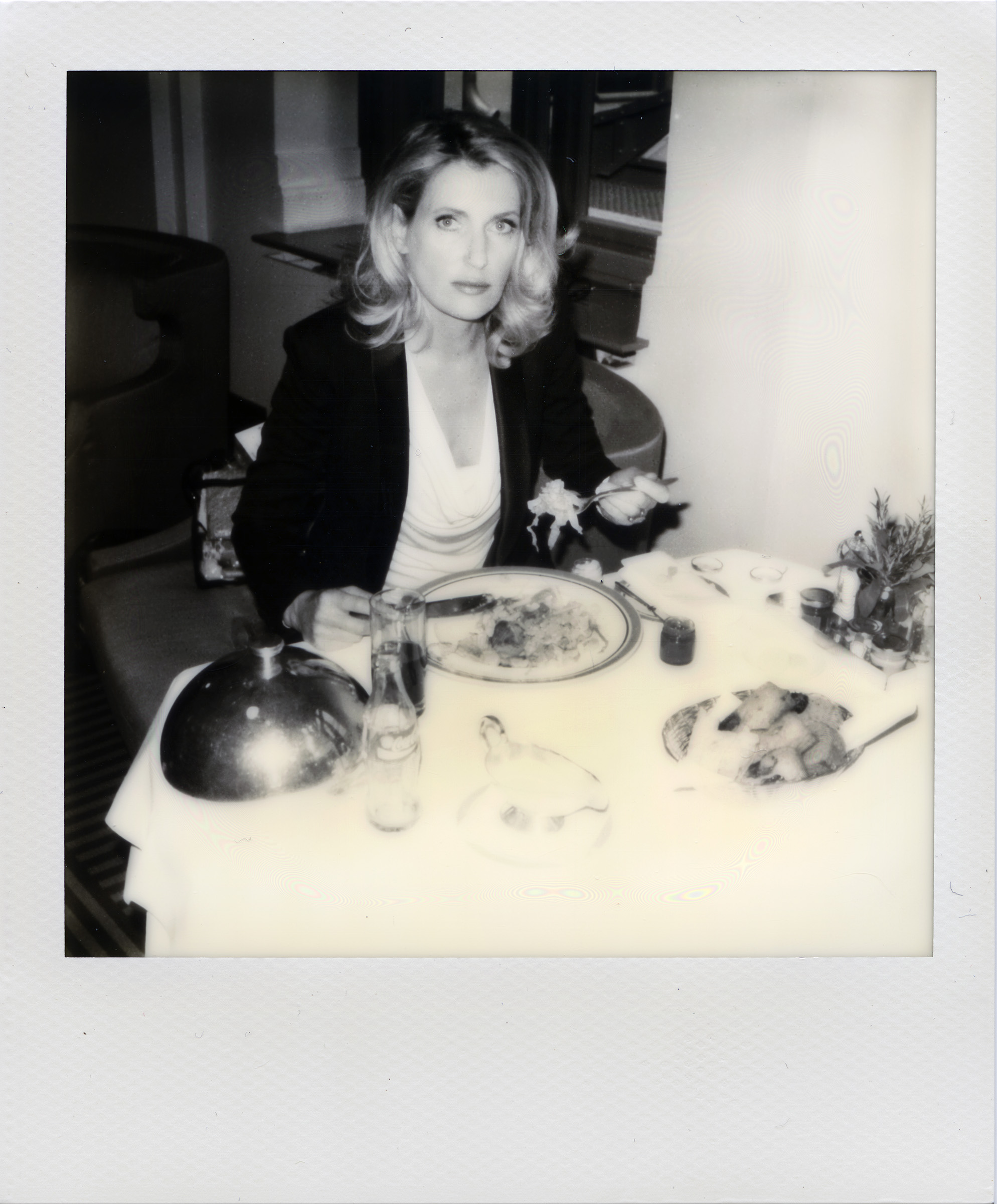
Ein Titel und ein Polaroid, die anlässlich ihres Gesprächs mit dem Süddeutsche Zeitung Magazin im Juli 2013 über die Demenz-Erkrankung ihrer Väter entstanden sind. Wie auch das Gespräch, wirken die Aufnahmen ehrlich und unverstellt. Das Interview, geführt von Alexandra Borchardt und Susanne Schneider, können Sie hier lesen.
Thomas Oppermann and Alexander Dobrindt, Berlin 2013

“I just wanna have your energy – that’s it.” — Oliver Mark. Is this too much to ask? What does it mean, and how does it work? This is about a small provocation, a surprise – about capturing a person in motion while simultaneously balancing their posture and expression. It’s about bringing the subject back into their body and mind from the situation. This moment became even more challenging when Mark, working with a medium-format camera and limited time, aimed to capture this balance in a more static setting. The surprise for Mr. Oppermann (SPD) and Mr. Dobrindt (CSU) was Mark’s comment, based on his research, immediately recognizing which of them had served in the military. This was the moment of irritation, of movement – and from it came this picture.
„I just wanna have your energy – that’s it” — Oliver Mark. Zuviel verlangt? Was bedeutet das und wie funktioniert das? Hier geht es um die kleine Provokation, die Überraschung – um eine Person vor der Kamera in Bewegung und gleichzeitig Balance zu bringen – von Körperhaltung und Ausdruck. Das Modell aus der Situation wieder in ihren Körper und Geist zu holen. Besonders wenn Mark wie hier in einem eher statischen Setting mit einer Mittelformatkamera und knapper Zeitvorgabe arbeitet. Die Überraschung für Herrn Oppermann (SPD) und Herrn Dobrindt (CSU): ein kleiner Kommentar darüber, dass Mark, der im Vorfeld natürlich etwas recherchiert hat, sofort erkenne, wer von ihnen gedient habe. Das war die Irritation, die Bewegung – und daraus entstand dieses Bild.
Dieter Hallervorden, Berlin 2013

Undressed, but not naked. This is a typical Mark moment. Wrapped in a wool blanket, Mr. von Hallervorden appears pensive and musical, as if he were contemplating a feeling or a sound. Such a portrait only emerges when both the photographer and the subject are open to each other.
Ausgezogen, aber nicht nackt. Das ist ein typischer Mark-Moment. In eine Wolldecke gehüllt wirkt Herr von Hallervorden hier auf mich gedankenversunken, musisch – als ob er einem Gefühl oder einem Klang nachforschen würde. Ein solches Porträt entsteht nur, wenn sich Fotograf und Modell aufeinander einlassen.
Ursula von der Leyen, Berlin 2014

“Please photograph the Federal Minister of Defence at the Ministry of Defence.” Ugh, tricky – a German office building at Stauffenbergstraße 18 in Berlin. Long hallways, countless doors, adorned with official black-and-white portraits of former ministers and a few unwanted plants. How can one use such a real, dreary place with all its bleakness and sobriety as a backdrop without losing oneself or the personality of the person being portrayed? Mark approached this task and location with awareness and discovered a copy room during his preparations, where a wall map of the Middle East was hanging. This map in the portrait symbolically represents a conflict that was omnipresent at the time: the UN Security Council sanctions against the support of Islamist terrorist groups in Iraq and Syria – imposed with the goal of preventing the financing and recruitment of the terrorist organizations Islamic State (IS) and Al-Nusra Front. If you’re rightly wondering where the sunlight suddenly comes from in this government-issue architectural dream, where Frau von der Leyen stands – it’s not real. The photo was taken with a Profoto Pro Hard Box, which creates a very harsh light and prevents any spill light (at 1/32 second to include ambient light, at f/9 and ISO 200, with an EF 16–35mm f/2.8L at 27mm). The light is shaped through the flaps of the Hard Box to give it the character of sunlight.
Fotografieren Sie bitte die Bundesverteidigungsministerin im Verteidigungsministerium. Uff, schwierig – ein deutsches Bürogebäude in der Stauffenbergstraße 18 in Berlin. Lange Flure, zahllose Türen, geschmückt mit den offiziellen schwarz-weißen Aufnahmen ehemaliger Minister*innen und einigen ungeliebten Pflanzen. Wie kann man einen solchen, realen Ort mit all seiner Tristesse und Nüchternheit als Kulisse nutzen, ohne sich selbst oder die Persönlichkeit der hier Porträtierten zu verlieren? Mark ging mit diesem Bewusstsein für seine Aufgabe und den Ort in die Situation und entdeckte während seiner Vorbereitungen einen Kopierraum, in dem eine Wandkarte des Nahen Ostens hing. Diese Karte steht im Porträt sinnbildlich für einen zu dieser Zeit allgegenwärtigen Konflikt: die Sanktionen des UN-Sicherheitsrats gegen die Unterstützung islamistischer Terrorgruppen im Irak und in Syrien – verhängt mit dem Ziel, die Finanzierung und Rekrutierung der Terrorvereinigungen „Islamischer Staat“ (IS) und der Al-Nusra-Front zu unterbinden. Falls Sie sich zu Recht fragen, woher in diesem behördlichen Träumchen von Architektur plötzlich das Sonnenlicht kommt, in dem Frau von der Leyen steht – das ist nicht echt. Fotografiert wurde mit einer Profoto Pro Hard Box, die ein sehr hartes Licht erzeugt und jegliches Streulicht verhindert (bei 1/32 Sekunde, um das Umgebungslicht mit einzubeziehen, auf f/9 und ISO 200 sowie mit einem EF 16–35mm f/2.8L bei 27 mm). Durch die Torklappen der Hard Box lässt sich das Licht so steuern, dass es den Charakter von Sonnenlicht erhält.
Idris Elba, Berlin 2014

…in handcuffs and bound to the floor – this was the concept for a portrait intended to make a connection with Idris Elba’s portrayal of Mandela. When Elba’s assistant arrived on set, she was startled and immediately intervened, demanding that Mark stop the shoot and show her the photos. However, Mark explained that there was nothing to see, as he was shooting on film, not digitally. Unfortunately, the staging in print didn’t have the desired impact. Fortunately, this close-up image was taken in the meantime, when Elba was having his head massaged by a makeup artist.
…in Handschellen und am Boden gefesselt – das war die Idee für ein Porträt, um eine Verbindung zu Idris Elbas Darstellung von Mandela herzustellen. Als Elbas Assistenz zum Set kam, erschrak sie und intervenierte sofort heftig. Sie forderte Mark auf, das Shooting sofort zu stoppen und die Aufnahmen zu zeigen. Mark erklärte jedoch, dass es nichts zu sehen gäbe, da er auf Film und nicht digital fotografierte. Leider hatte die Inszenierung im Print nicht die gewünschte Wirkung. Glücklicherweise entstand nebenbei dieses Close-up, als Elba sich gerade von einem Visagisten den Kopf massieren ließ.
Adrian Ghenie, Berlin 2014
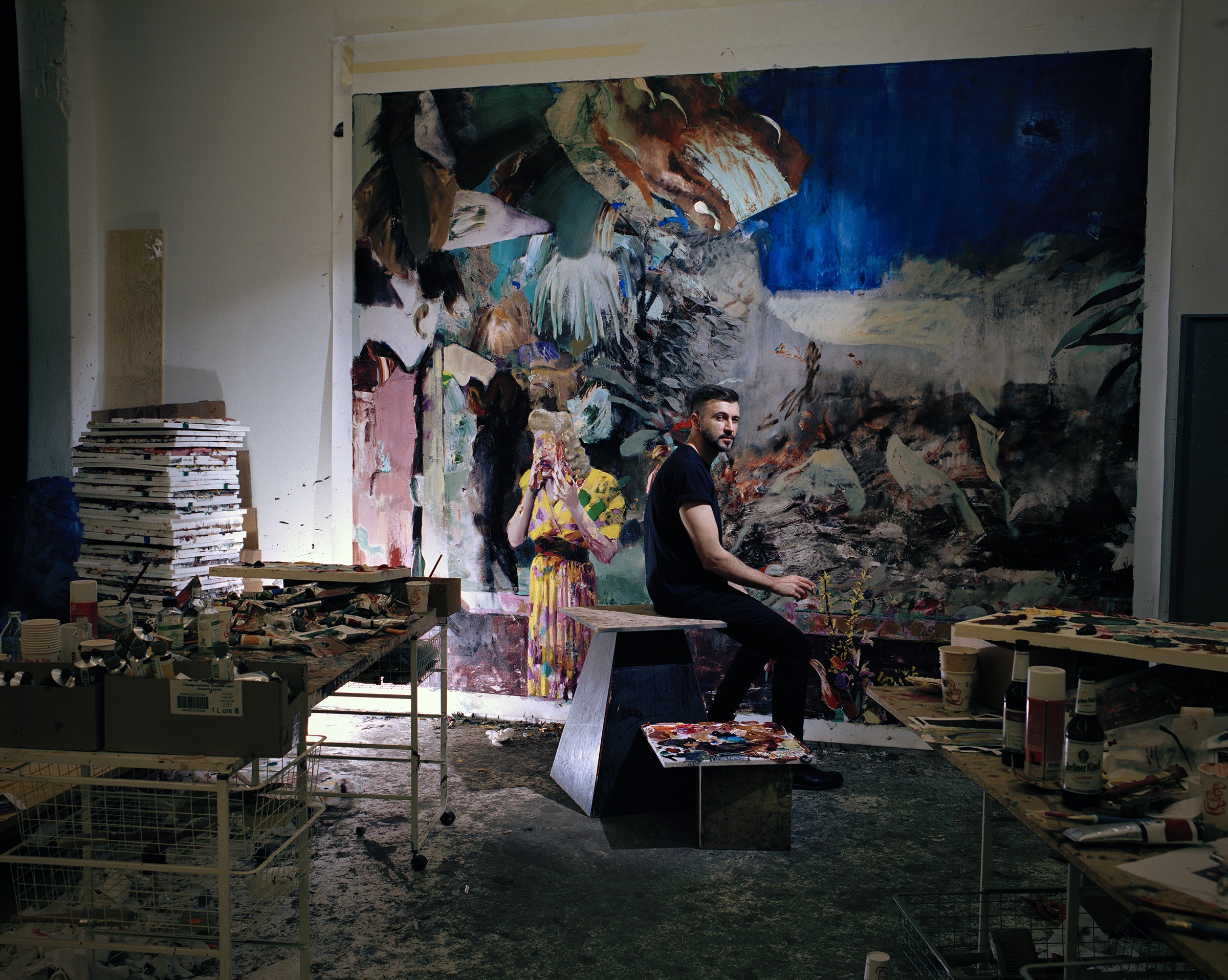
Artist at work – in the studio. Bravo – the epitome of a studio portrait! Adrian Ghenie is rarely photographed, so whenever one of his paintings is auctioned at Christie’s or Sotheby’s in London, New York, or Hong Kong, this portrait is often requested. For Mark, it has become a bestseller. For me, it’s completely understandable: it looks like a still from a film – colors and stacked canvases, indirect light, and Ghenie in front of a huge piece on the wall, a cigarette in hand, with a few beer bottles scattered here and there. Painting as craft, the studio as a workspace. Definitely worth seeing. Mark photographed Ghenie two more times in 2014: for his exhibitionThe Darwin Room at the Centre Pompidou in Paris, and in his studio-library in Berlin. The common thread: the indirect lighting. In the studio shot, the main light was set with a Profoto Softbox Square 40 x 40 cm, approximately 45 degrees to the camera and 3 meters away from the subject, from a height of 4 meters, so that the eyeballs wouldn’t be shadowed. To the left in the frame, a Profoto B2 light without a reflector rests on the floor, positioned so that it isn’t captured. The softbox creates a targeted vignette, as it doesn’t fully illuminate the space. In the library shot, a flash unit is hidden in the right corner of the room under a white sheet of paper.


Artist at work – in the studio. Bravo – der Inbegriff eines Studioporträts! Adrian Ghenie lässt sich wohl selten fotografieren, sodass oft, wenn eines seiner Gemälde bei Christie’s oder Sotheby’s in London, New York oder Hongkong versteigert wird, dieses Porträt angefragt wird. Für Mark ist es ein Bestseller geworden. Für mich absolut nachvollziehbar: Es wirkt wie ein Filmstill – Farben und gestapelte Leinwände, indirektes Licht und Ghenie vor einer riesigen Arbeit an der Wand, Zigarette in der Hand, hier und da ein paar Bierflaschen. Malerei als Handwerk, das Atelier ein Arbeitsplatz. Bitte unbedingt ansehen. Mark hat Ghenie 2014 noch zwei weitere Male fotografiert: Zu seiner Ausstellung The Darwin Room im Centre Pompidou in Paris und in seiner Studio-Bibliothek in Berlin. Der rote Faden: die indirekte Beleuchtung. In der Studioaufnahme wurde das Hauptlicht mit einer Profoto Softbox Square 40 x 40 cm gesetzt, ca. 45 Grad zur Kamera und 3 Meter Abstand zum Protagonisten, aus einer Höhe von 4 Metern, sodass die Augäpfel nicht verschattet werden. Links im Bild liegt eine Profoto B2 Leuchte ohne Reflektor auf dem Boden, perspektivisch so, dass sie nicht erfasst wird. Die Softbox erzeugt eine gezielte Vignettierung, da sie den Raum nicht vollständig ausleuchtet. In der Bibliotheksaufnahme verbirgt sich in der rechten Ecke des Raumes eine Blitzleuchte unter einem weißen Blatt Papier.
Otto Piene, 2014

…an image that sadly never came to be. Here is the response to Mark’s email to Otto Piene (*1929–2014), in which Piene requested to wait until the Sky Event on July 19th for the photoshoot. Unfortunately, Otto Piene passed away on the evening of July 17th, following his opening at the Neue Nationalgalerie, during a taxi ride through Berlin.
…ein Bild, das leider nie entstand. Hier zu sehen ist die Antwort auf Marks E‑Mail an Otto Piene (*1929–2014), in der dieser darum bat, mit dem Termin für ein Foto das Sky Event am 19. Juli abzuwarten. Bedauerlicherweise verstarb Otto Piene am Abend des 17. Juli nach seiner Eröffnung in der Neuen Nationalgalerie während einer Taxifahrt durch Berlin.
Marcel Reich-Ranicki and Andrew Alexander Ranicki, Frankfurt am Main 2014

The train ride from Frankfurt am Main to Berlin lasts about four hours. However, Mark found it much more entertaining when he traveled it with Marcel Reich-Ranicki and his son. Here, Marcel Reich-Ranicki is looking at Oliver Mark’s portrait of Daniel Barenboim.
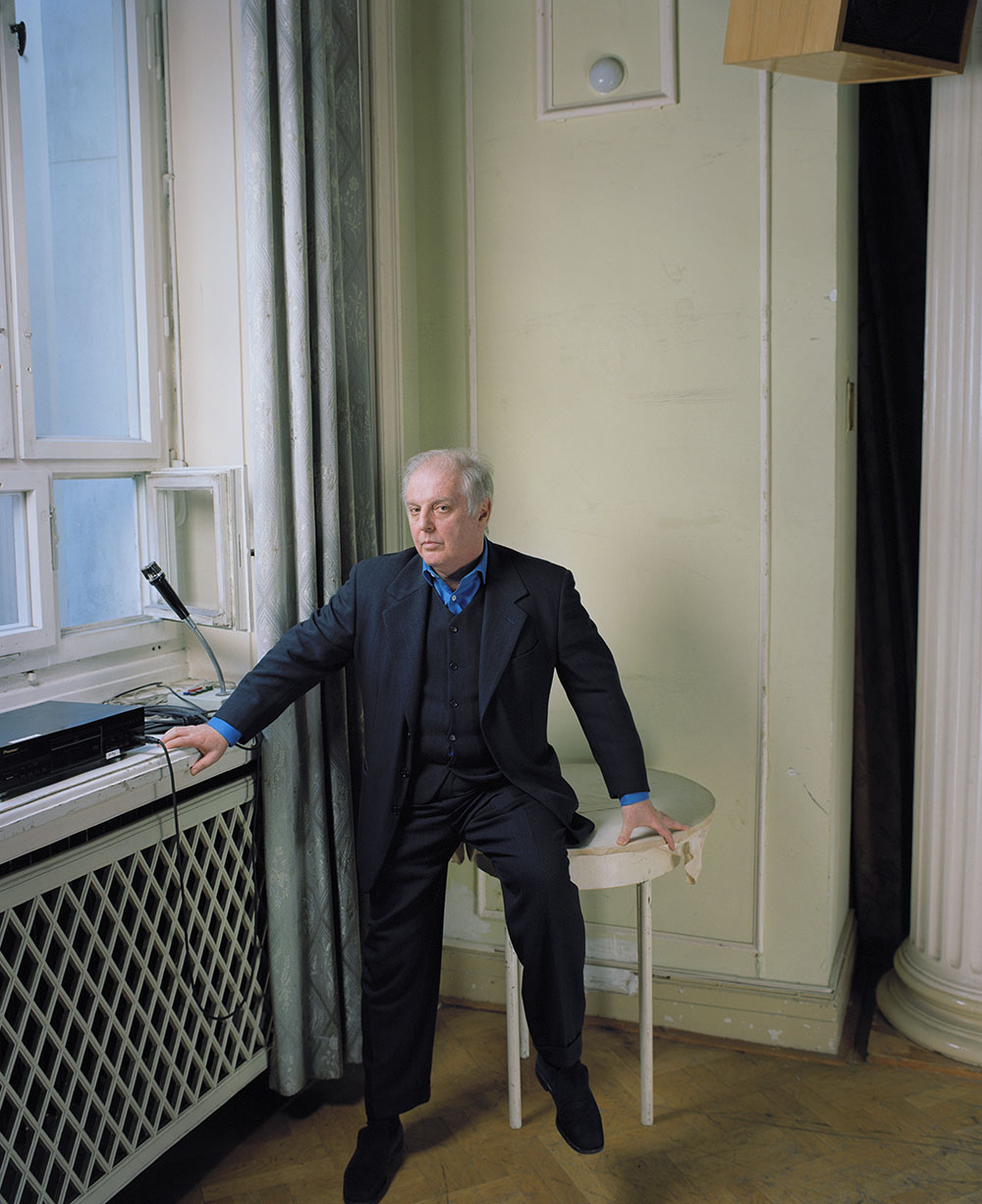
Die Zugfahrt von Frankfurt am Main nach Berlin dauert etwa vier Stunden. Mark kam sie jedoch deutlich kurzweiliger vor, als er sie mit Reich-Ranicki und dessen Sohn unternahm. Hier schaut sich Marcel Reich-Ranicki Oliver Marks Portrait von Daniel Barenboim an.
Der Jungbrunnen, Berlin 2015
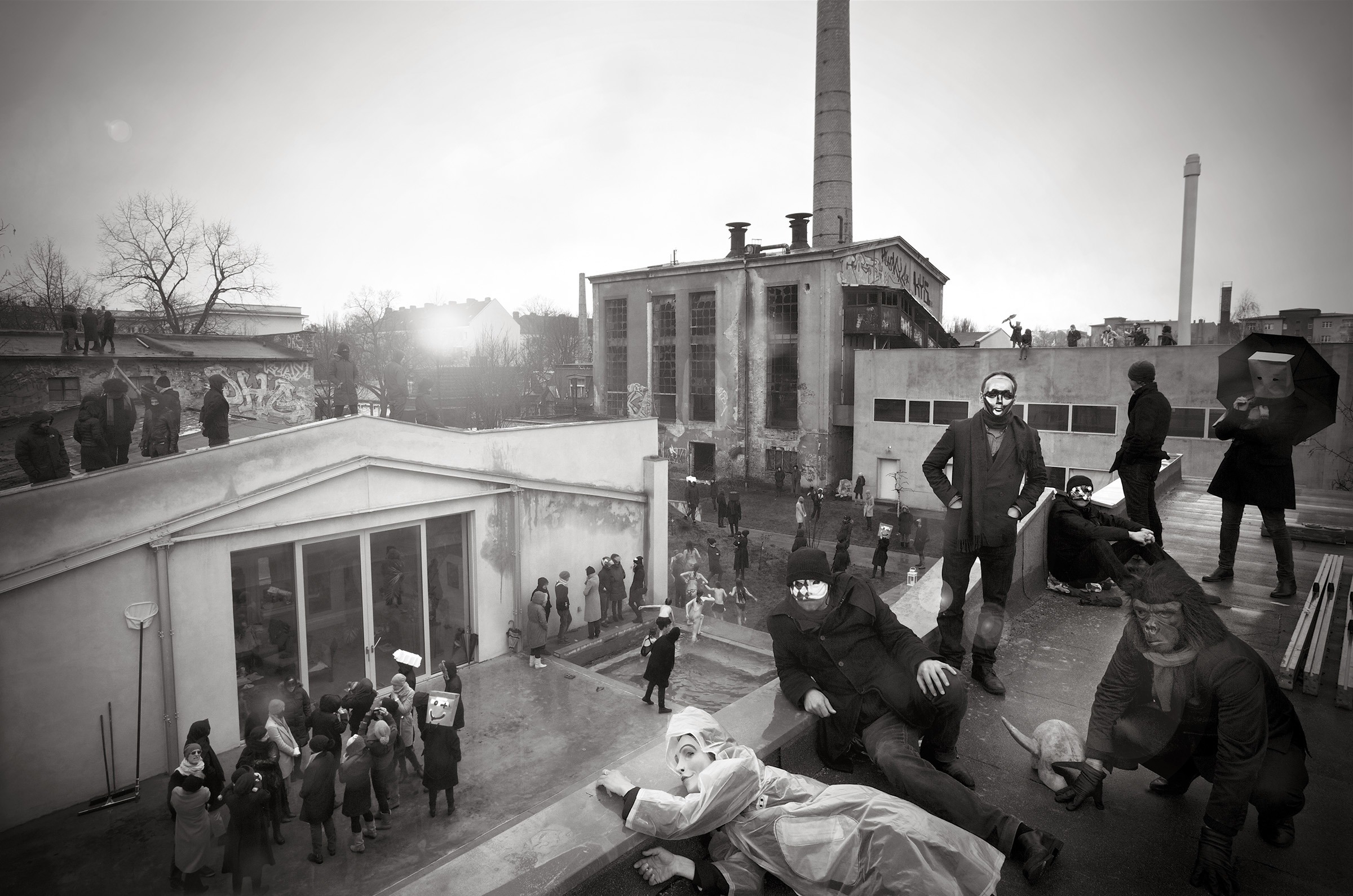
Der Jungbrunnen is a painting by Lucas Cranach the Elder from 1546. The piece belonged to the collection of the former Prussian royal castles and is now part of the Gemäldegalerie of the State Museums in Berlin. Oliver Mark’s version of Der Jungbrunnen was created in Berlin in 2015 and was first shown in his No Show exhibition in 2019 at the Villa Dessauer – Museums of the City of Bamberg. Gelatin silver print, 68.0 x 100.5 cm (printed 2015).
Der Jungbrunnen ist ein Gemälde von Lucas Cranach dem Älteren aus dem Jahr 1546. Das Bild gehörte zum Bestand der ehemaligen preußischen königlichen Schlösser und hängt heute in der Gemäldegalerie der Staatlichen Museen zu Berlin. Oliver Marks Jungbrunnen ist 2015 in Berlin entstanden und wurde erstmals in seiner Ausstellung No Show 2019 in der Villa Dessauer – Museen der Stadt Bamberg gezeigt. Gelatin silver print, 68,0 x 100,5 cm (printed 2015).
Don’t be afraid of the truth, 2015

Der Spiegel’s new brand claim: “Don’t be afraid of the truth” was developed by the agency group thjnk Hamburg. A stroke of luck for Oliver Mark, who photographed the image campaign. He had a lot of freedom in his photography because the campaign was presented in advance with his pictures. The unique, uncorrupted view of the world of Spiegel journalism with the editorial-like portraits by Oliver Mark inform and inspire. The portraits can be seen here: Martin Hesse, Michael Sauga and Christian Reiermann; Klaus Brinkbäumer and Gershom Schwalfenberg; Maria Gresz; Hause Janssen; Florian Harms; Volker Weidermann.


Der neue Markenclaim des Spiegel: „Keine Angst vor der Wahrheit“ wurde von der Agenturgruppe thjnk Hamburg entwickelt. Ein Glücksfall für Oliver Mark, der die Imagekampagne fotografierte. Er hatte bei der Fotografie weitgehend freie Hand, da die Kampagne vorab mit seinen Bildern präsentiert wurde. Der einzigartige, unverfälschte Blick auf die Welt des Spiegel-Journalismus mit den redaktionell anmutenden Portraits von Oliver Mark informieren und inspirieren. Die Portraits sind hier zu sehen: Martin Hesse, Michael Sauga und Christian Reiermann, Maria Gresz, Hause Janssen, Klaus Brinkbäumer und Gershom Schwalfenberg, Florian Harms, Volker Weidermann.
Hoischen / Mark – “Christian Louboutin”, 46,9 × 38,4 cm, Mixed media, C‑Print, framed, 2017

The collaboration with artist Christian Hoischen marked Mark’s first such project and laid the groundwork for his future collaborative works. The photographed stilettos come from Mark’s private shoe archive – part of his collection of objects that inspire him and that he enjoys photographing. Hoischen edited the photograph, distorting and recomposing the object in a new way.
Die Zusammenarbeit mit dem Künstler Christian Hoischen war für Mark die erste ihrer Art und bildet die Grundlage für seine weiteren Kollaborationsprojekte. Die fotografierten Stilettos stammen aus Marks privatem Schuharchiv – einem Teil seiner Sammlung von Objekten, die ihn inspirieren und die er gerne fotografiert. Hoischen hat die Fotografie bearbeitet, den Gegenstand somit entfremdet und neu komponiert.
Bucovina Monasteries, Romania 2017
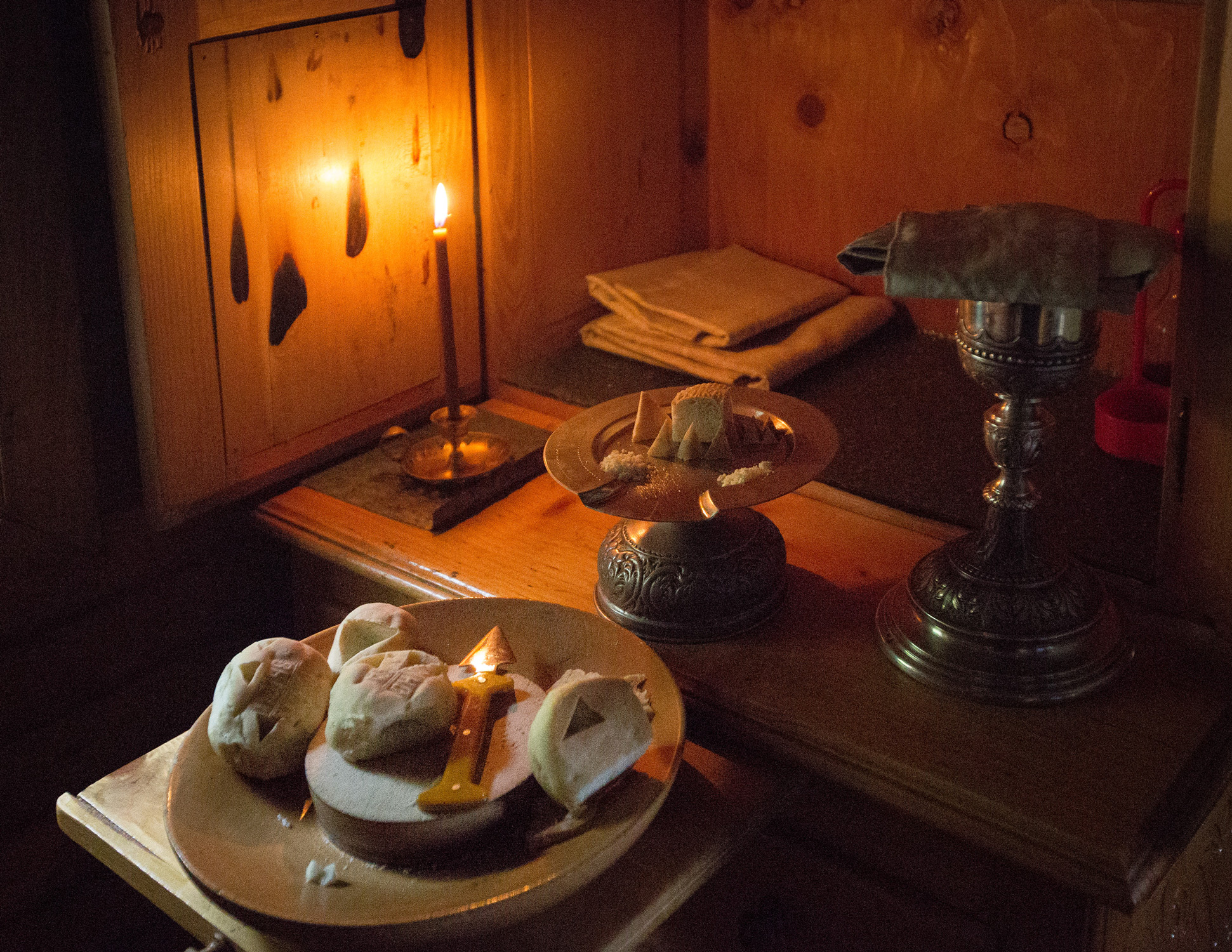
Oliver Mark spent nearly two weeks photographing at the Moldovița Monastery and the Mănăstirea Sfântul Ioan Iacob “Corlăţeni” in Bucovina. His striking photographs offer insights not only into the religious life of the monks and nuns but also into their daily existence. One of the most captivating images in this series is unique: it shows the view behind the iconostasis – the area that no one but the monks is allowed to enter. How did this extraordinary photo come about? Mark handed his pre-set camera to one of the monks, carefully explaining the composition he envisioned. The result is seen here. The exhibition is part of a cultural exchange with the Bukowina Museum in Suceava, where the Liechtenstein National Museum has been represented four times. More about this can be found on ZEIT ONLINE and in Monopol Magazine.

Fast 14 Tage verbrachte und fotografierte Oliver Mark im Frauenkloster Moldovița und im Mănăstirea Sfântul Ioan Iacob “Corlăţeni”. Seine eindrucksvollen Fotos gewähren Einblicke nicht nur in das religiöse, sondern auch in das alltägliche Leben der Mönche und Nonnen. Das wohl spannendste Bild dieser Reihe ist einzigartig: Es zeigt den Blick hinter die Ikonostase – jenen Bereich, den niemand außer den Mönchen betreten darf. Und wie entstand dieses außergewöhnliche Foto? Mark übergab einem der Mönche seine voreingestellte Kamera und erklärte ihm genau, welche Bildkomposition er sich wünschte. Das Ergebnis ist hier zu sehen. Die Ausstellung ist Teil des kulturellen Austauschs mit dem Bukowina-Museum in Suceava, in dem das Liechtensteinische Landesmuseum bereits viermal vertreten war. Mehr dazu auf: ZEIT ONLINE und im Monopol Magazin.
Jonathan Meese, Berlin 2017
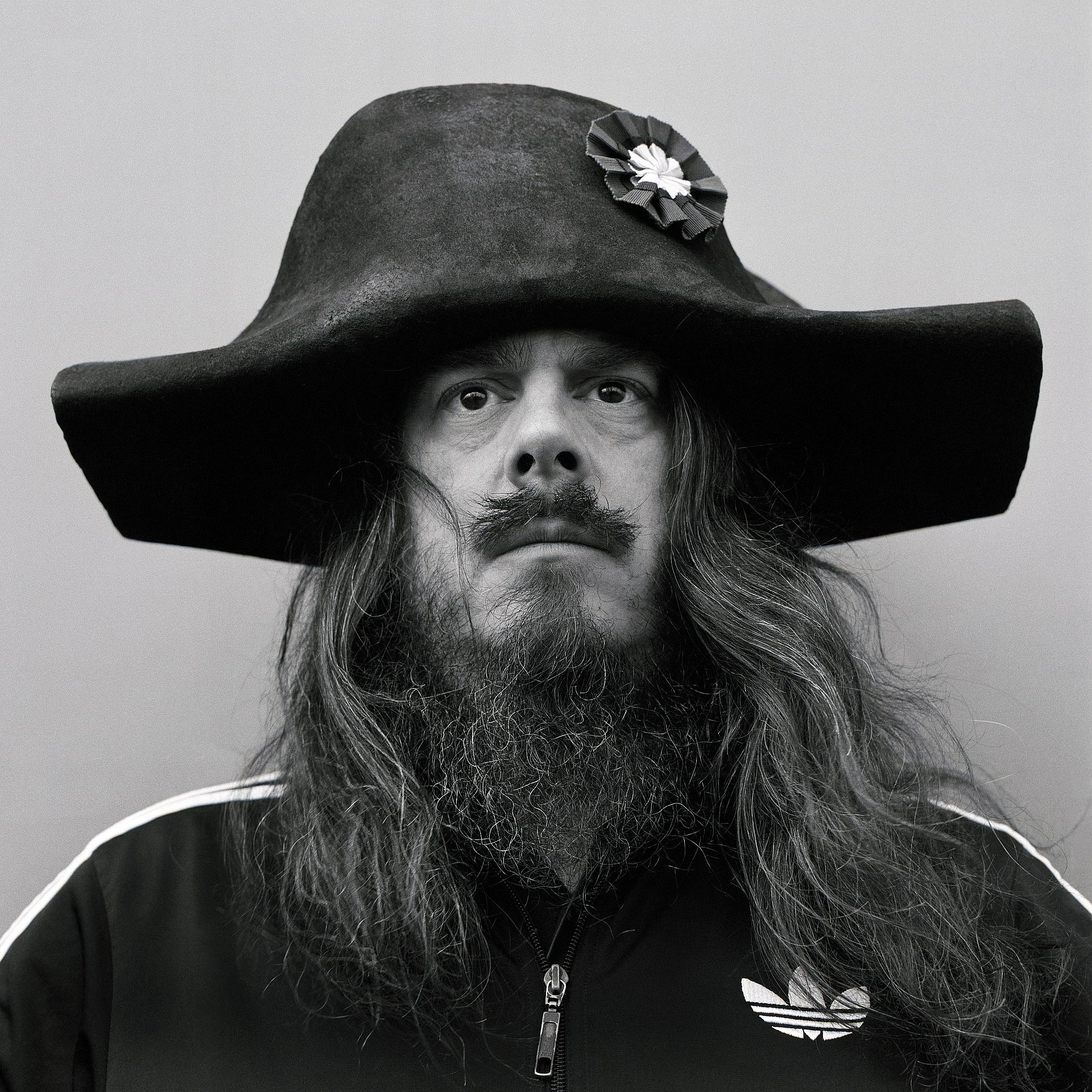
A hat – specifically, a tricorne – on Jonathan Meese’s head, which looks like a prop from the past. Together with Meese’s long beard, hair, and tracksuit, it creates a harmonious ensemble. Mark had this hat specially made for the portrait by Berlin milliner Fiona Bennett. Why? Because Mark had visited the Napoleon exhibition at the Bundeskunsthalle in Bonn in 2010, and Meese’s work Der Terminator, Napoleon (2006) served as the inspiration for the portrait.
Ein Hut, genauer ein Dreispitz, auf dem Kopf von Jonathan Meese, der wie eine Requisite aus der Vergangenheit wirkt. Zusammen mit Meeses langem Bart, den Haaren und der Trainingsjacke ergibt er ein harmonisches Ensemble. Mark ließ diesen Hut eigens für das Porträt von der Berliner Hutmacherin Fiona Bennett anfertigen. Warum? Weil Mark 2010 in der Bundeskunsthalle Bonn die Napoleon-Ausstellung besucht hatte und Meeses dort gezeigtes Werk Der Terminator, Napoleon (2006) als Inspiration für das Porträt diente.
Kristen Stewart, Hamburg 2017

Mark was commissioned by Stern magazine to create a portrait of Kristen Stewart. The result of this assignment is shown here.
The photo shows a person and a profile shadow – both depicting the same individual, but they do not match in perspective. This is because the two elements were shot separately and later combined into one composition. Both shots, however, were taken at the same location: the Elbphilharmonie in Hamburg, during a CHANEL fashion show by Karl Lagerfeld. While this may sound glamorous, the actual shooting location was much less spectacular. The images were taken at the only available wall in the crowded foyer, on the way to the restrooms. One of the editors had to temporarily hold the flash. However, the final result doesn’t reflect these circumstances.
Mark wurde vom Stern beauftragt, ein Porträt von Stewart zu erstellen. Das Ergebnis dieses Auftrags sehen Sie hier. Auf dem Foto sind eine Person und ein Profilschatten zu sehen – beide zeigen zwar dieselbe Person, passen jedoch perspektivisch nicht zueinander. Das liegt daran, dass die Bildelemente separat aufgenommen und später zu einer Komposition zusammengefügt wurden. Beide Aufnahmen entstanden jedoch am selben Ort: der Elbphilharmonie in Hamburg, anlässlich einer CHANEL-Modenschau von Karl Lagerfeld. Das klingt zunächst glamourös – der tatsächliche Aufnahmeort war jedoch eher unspektakulär. Die Bilder wurden an der einzigen freien Wand im vollen Foyer aufgenommen, auf dem Weg zu den Toiletten. Eine der Redakteur*innen musste provisorisch den Blitz halten. Doch dem Bild sieht man diese Umstände nicht an.
Madonna, Berlin 2017

The work you see here is a composition of two black-and-white images. A baby, partially visible in profile, is being held in someone’s hands, arching its back with body tension and posture – secure in the grasp of the holding hands. The baby’s head is also supported, presumably by the elbow of the person holding it. What’s particularly intriguing: The face of this person remains hidden. Instead, a triangular light pattern dominates the image, creating the effect of a fine mist of water vapor over a shot of treetops in backlight. The posture and subject of the photograph clearly reference the figure of the Madonna – yet it remains uncertain who is playing that role here. For me, the work raises the question of how a person positions themselves within the role of parent.
Die Arbeit, die Sie hier sehen, ist eine Komposition aus zwei Schwarz-Weiß-Bildern. Ein Säugling, im Halbprofil erkennbar, wird auf Händen gehalten und überstreckt sich mit Körperspannung und Haltung nach hinten – in der Sicherheit der haltenden Hände. Das Köpfchen wird ebenfalls gestützt, vermutlich vom Ellenbogen der Person, die das Kind hält. Besonders spannend: Das Gesicht dieser Person bleibt verborgen. Stattdessen dominiert ein dreieckiger Lichteinfall das Bild, der wirkt, als hätte sich ein feiner Wassernebel über die Aufnahme von Baumkronen im Gegenlicht gelegt. Haltung und Motiv der Fotografie verweisen eindeutig auf die Figur der Madonna – doch bleibt ungewiss, wer diese Rolle hier einnimmt. Die Arbeit stellt für mich die Frage, inwiefern sich eine Persönlichkeit in der Elternrolle selbst positioniert.
Ursina Lardi, Berlin 2018

Actress Ursina Lardi doesn’t let herself be confined to one theme. Mark had set up the lighting sideways for this portrait. Lardi noticed this and asked about it. When Mark explained that he wanted to address aging, she responded with, “Let’s rather not do that.” I think the result speaks for itself – sometimes, a little vanity isn’t such a bad thing.
Schauspielerin Ursina Lardi lässt sich nicht auf ein Thema festlegen. Mark hatte das Licht für dieses Porträt sehr seitlich aufgebaut. Lardi bemerkte dies und fragte nach. Auf Marks Antwort, er wolle das Alter thematisieren, konterte sie mit: „… das lassen wir mal lieber.“ Ich finde, das Ergebnis spricht für sich – manchmal ist eine gewisse Eitelkeit doch nicht verkehrt.
Georg Friedrich Prince of Prussia, Hohenzollern Castle, Bisingen 2018

Georg Friedrich Prince of Prussia stands, elegantly dressed in a suit and tie, between two large portraits, each displayed on an easel in front of a fireplace with an opening that reaches up to his shoulders. In this setting, he appears arranged, almost enveloped by tradition – no surprise, as he is posing here with his ancestors. To his left hangs the portrait of his great-great-grandfather Wilhelm II (*February 27, 1859, Berlin; † June 4, 1941, Doorn, Netherlands), and to his right, the portrait of Frederick the Great (*January 24, 1712, Berlin; † August 17, 1786, Potsdam) – one of the most famous representatives of the Hohenzollern family.
Georg Friedrich Prinz von Preußen steht, elegant gekleidet in Anzug und Krawatte, zwischen zwei großen Porträts, die jeweils auf einer Staffelei vor einem Kamin stehen, dessen Öffnung bis zu seinen Schultern reicht. In dieser Szenerie wirkt er aufgereiht, beinahe umfasst von Tradition – kein Wunder, denn er posiert hier mit seinen Ahnen. Zu seiner Linken hängt das Porträt seines Ururgroßvaters Wilhelm II. (27. Februar 1859, Berlin; † 4. Juni 1941, Doorn, Niederlande), zu seiner Rechten das von Friedrich dem Großen (24. Januar 1712, Berlin; † 17. August 1786, Potsdam) – einem der berühmtesten Vertreter des Hauses Hohenzollern.
Alicja Kwade, Berlin 2010, 2014 & 2019
Three portraits taken over a period of nine years show Alicja Kwade always in her respective studio, surrounded by her art. While in the first two images, she seems to almost merge with her works and environment – as the center, heart, and mind of her art – in the most recent image, standing at a table in front of a sculpture, she appears more dynamic and busy.
Drei Porträts, entstanden über einen Zeitraum von neun Jahren, zeigen Alicja Kwade stets in ihrem jeweiligen Studio, umgeben von ihrer Kunst. Während sie in den ersten beiden Aufnahmen sitzend beinahe mit ihren Werken und ihrer Umgebung zu verschmelzen scheint – als Mittelpunkt, Herz und Hirn ihrer Kunst –, wirkt sie auf dem jüngsten Bild, an einem Tisch stehend vor einer Skulptur, dynamischer und geschäftiger.
Alicja Kwade, 2010

This first portrait was created for the book Portraits published by Hatje Cantz Verlag (2009) and was later republished in No Show, Distanz Verlag, 2019. Kwade was photographed in her studio at Paul-Lincke-Ufer in Berlin-Kreuzberg. The shot was taken with a Mamiya RZ and a wide-angle lens (M 65mm F/4) on Kodak Portra 400, at aperture f/11 and a shutter speed of 1/15 second. The composition is deliberate, with Kwade “in concert” with her works.
Dieses erste Porträt entstand für das Buch Portraits im Hatje Cantz Verlag (2009) und wurde später erneut in No Show, Distanz Verlag, 2019, publiziert. Fotografiert wurde Kwade in ihrem Studio am Paul-Lincke-Ufer in Berlin-Kreuzberg. Die Aufnahme entstand mit einer Mamiya RZ und einem Weitwinkelobjektiv (M 65mm F/4) auf Kodak Portra 400, bei Blende 11 und einer Verschlusszeit von 1/15 Sekunde. Die Komposition ist durchdacht, Kwade „in concert“ mit ihren Arbeiten.
Alicja Kwade, 2014
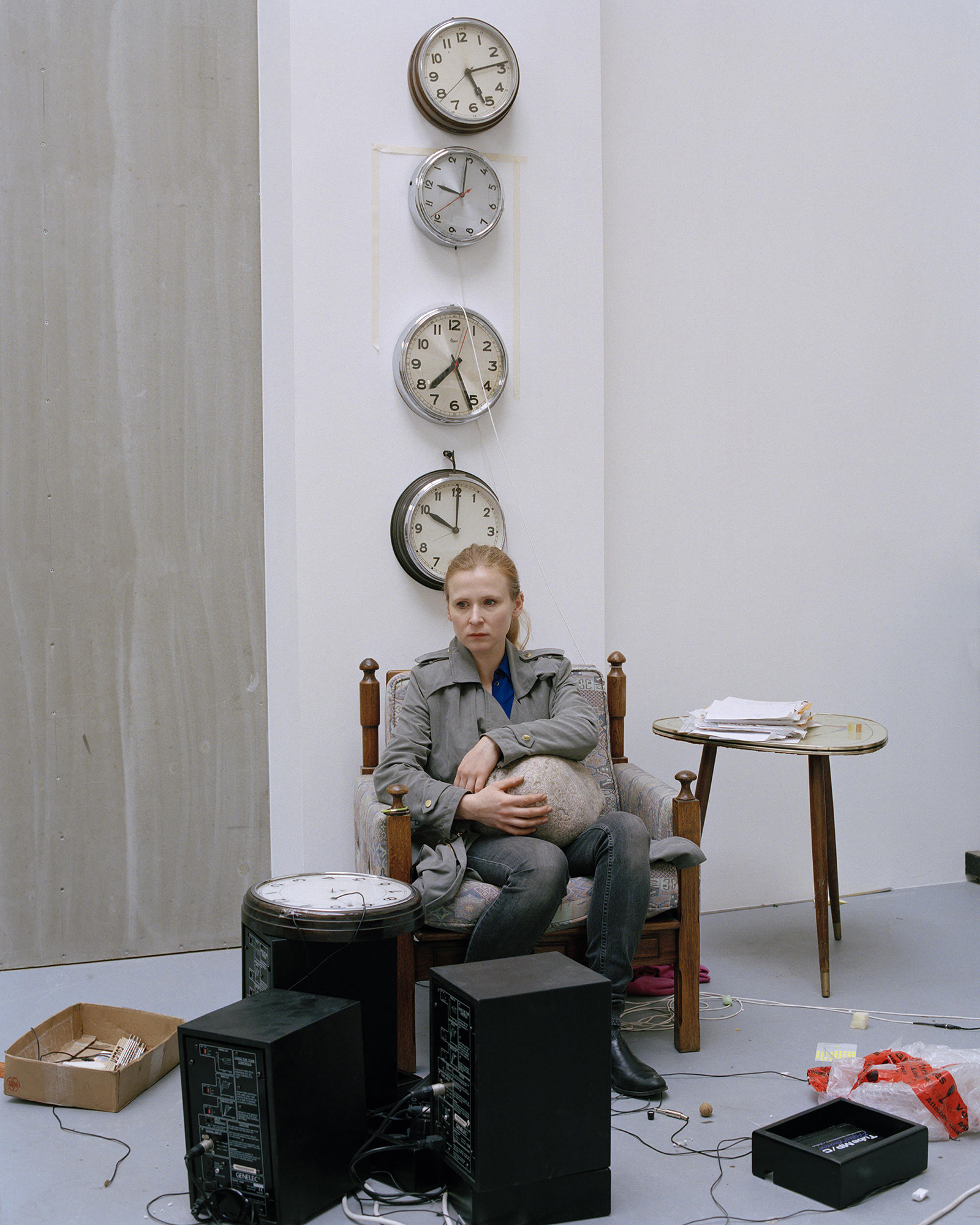
Four years later, Kwade’s portrait was taken for The Independent. This time, it was in her studio on Liebermannstraße in Berlin-Weißensee, again using the Mamiya RZ, but in portrait orientation. The client was the renowned art critic and columnist Karen Wright, whom Mark knew from previous collaborations with Phillips de Pury auction house. Wright, a prominent figure in the art world, had been portrayed by David Hockney in 2002. In this portrait, Kwade is again staged as an integral part of her works.
Vier Jahre später wurde Kwades Porträt für The Independent aufgenommen. Diesmal in ihrem Studio in der Liebermannstraße in Berlin-Weißensee, erneut mit der Mamiya RZ, jedoch im Hochformat. Auftraggeberin war die renommierte Kunstkritikerin und Kolumnistin Karen Wright, die Mark aus früherem Zusammenarbeiten für das Auktionshaus Phillips de Pury kannte. Wright, eine feste Größe im Kunstbetrieb, wurde 2002 selbst von David Hockney porträtiert. Auch in dieser Aufnahme ist Kwade als integraler Bestandteil ihrer Arbeiten inszeniert.
Alicja Kwade, 2019
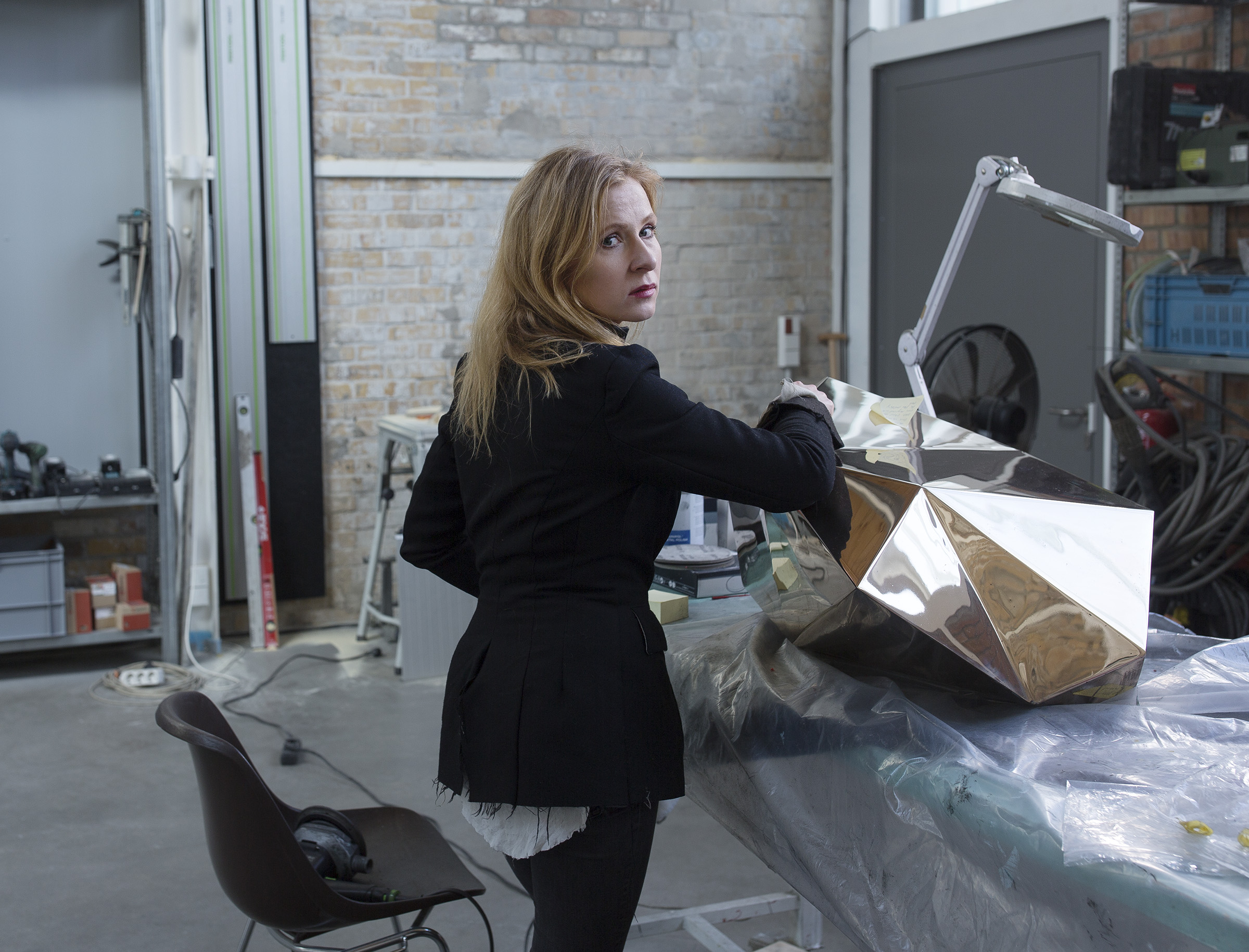
For her exhibition at the Metropolitan Museum of Art (April–October 2019), Kwade needed new portraits that could be used as versatile press images. She asked Oliver Mark to photograph her in her newly opened studio in Reinbeckstraße, Berlin-Oberschöneweide. This time, Mark used a Canon EOS 5D Mark III with a 50mm lens – a shift from tripod to handheld shooting. The crop is tighter, the background less composed, and the environment more minimal. The artist comes more to the forefront, and the studio appears more expansive than in the earlier shots.
These three portraits are not only a testament to Kwade’s growing success as an artist but also an intriguing contribution to the question of authorship and documentation. They highlight how the relationship between personality and artwork can be fluidly staged – the artist asserts herself through her own work and engages with it.
Für ihre Ausstellung im Metropolitan Museum of Art (Apr–Okt 2019) benötigte Kwade neue Porträts, die vielseitig als Pressebilder genutzt werden konnten. Sie bat Oliver Mark, sie in ihrem neu eröffneten Studio in der Reinbeckstraße in Berlin-Oberschöneweide zu fotografieren. Diesmal entschied sich Mark für eine Canon EOS 5D Mark III mit einem 50mm-Objektiv – ein Wechsel vom Stativ zur freihändigen Aufnahme. Der Bildausschnitt ist enger, der Hintergrund weniger komponiert, das Umfeld reduzierter. Die Künstlerin tritt stärker in den Vordergrund, das Studio erscheint weitläufiger als die der früheren Aufnahmen
Diese drei Porträts sind nicht nur Zeugnisse von Kwades wachsendem Erfolg als Künstlerin, sondern auch ein spannender Beitrag zur Frage der Autorschaft und Dokumentation. Sie verdeutlichen, wie sich das Verhältnis von Persönlichkeit und Kunstwerk als fließend inszenieren lassen kann – die Künstlerin weist sich durch ihr eigenes Werk aus und setzt sich mit ihm in Beziehung.
Christiane Paul, Berlin 2019

Mark and Hoischen, reunited… The theme: apocalypse. Mark found Hoischen’s works fitting – an apocalypse series with Paul in the lead role. The staging of these portraits for ICON Magazine involved several others: Mark was booked through the picture editor Julia Sörgel, assisted by Ingo Lawaczeck, with styling by Daniel Satore, and hair and makeup by Brigitte Brenner C/O Basic Berlin. And of course, the labels of the clothing: William Fan, Jil Sander, LaLa Berlin, Aeyde, and jewelry by No Editions and Helen Friesacher. Alongside all these names, there were also objects like an antique Heriz rug and the prototype of a sculpture – a polar bear with a pink head. And, of course, Hoischen’s works. This might sound very busy and chaotic, but in three of the five shots you can view here, the dust settles. What you see is a stylish, serene setting, in which the subject fully integrates into her environment, so much so that she hides her face. Art and the labels thus become the protagonists of the portraits.
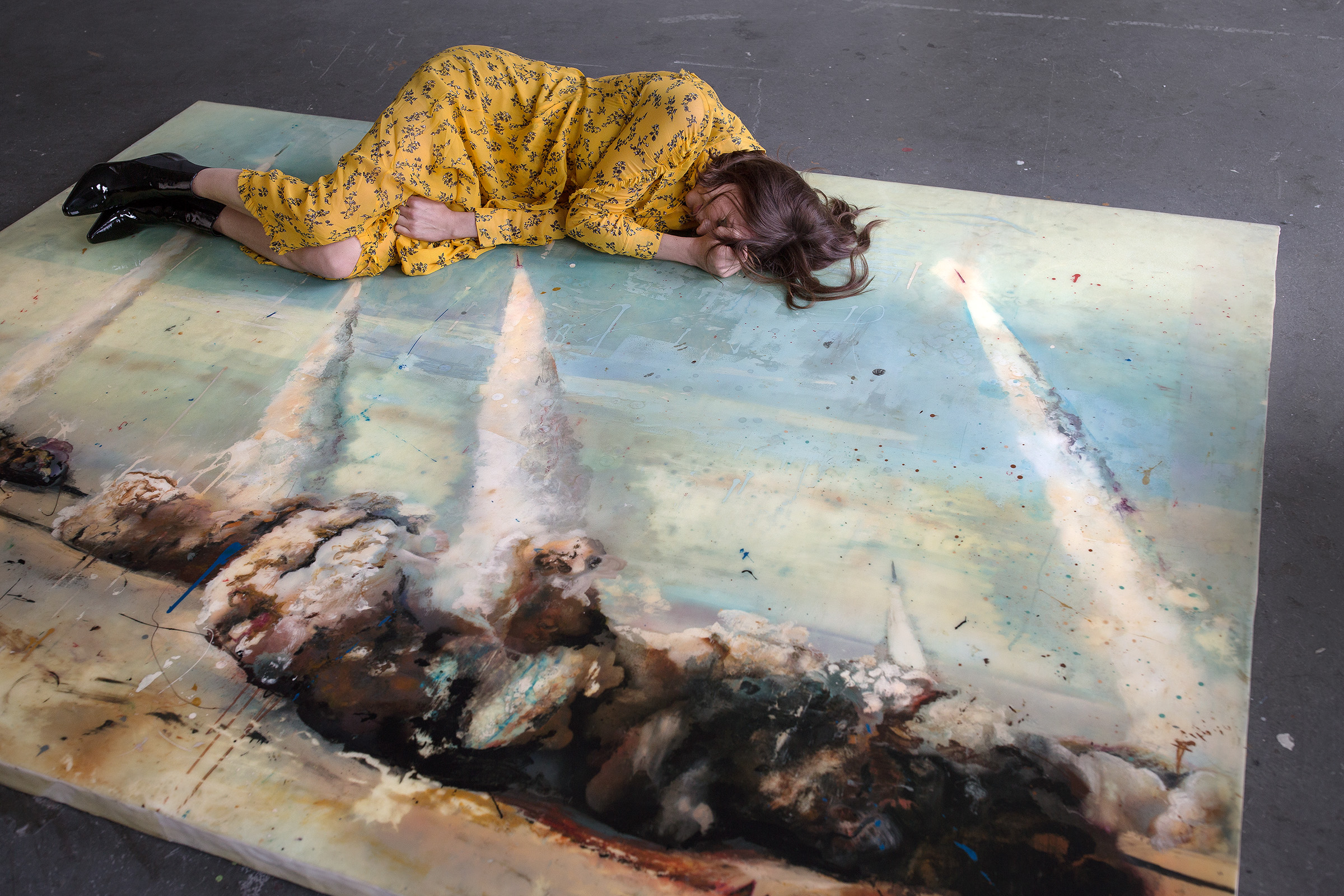
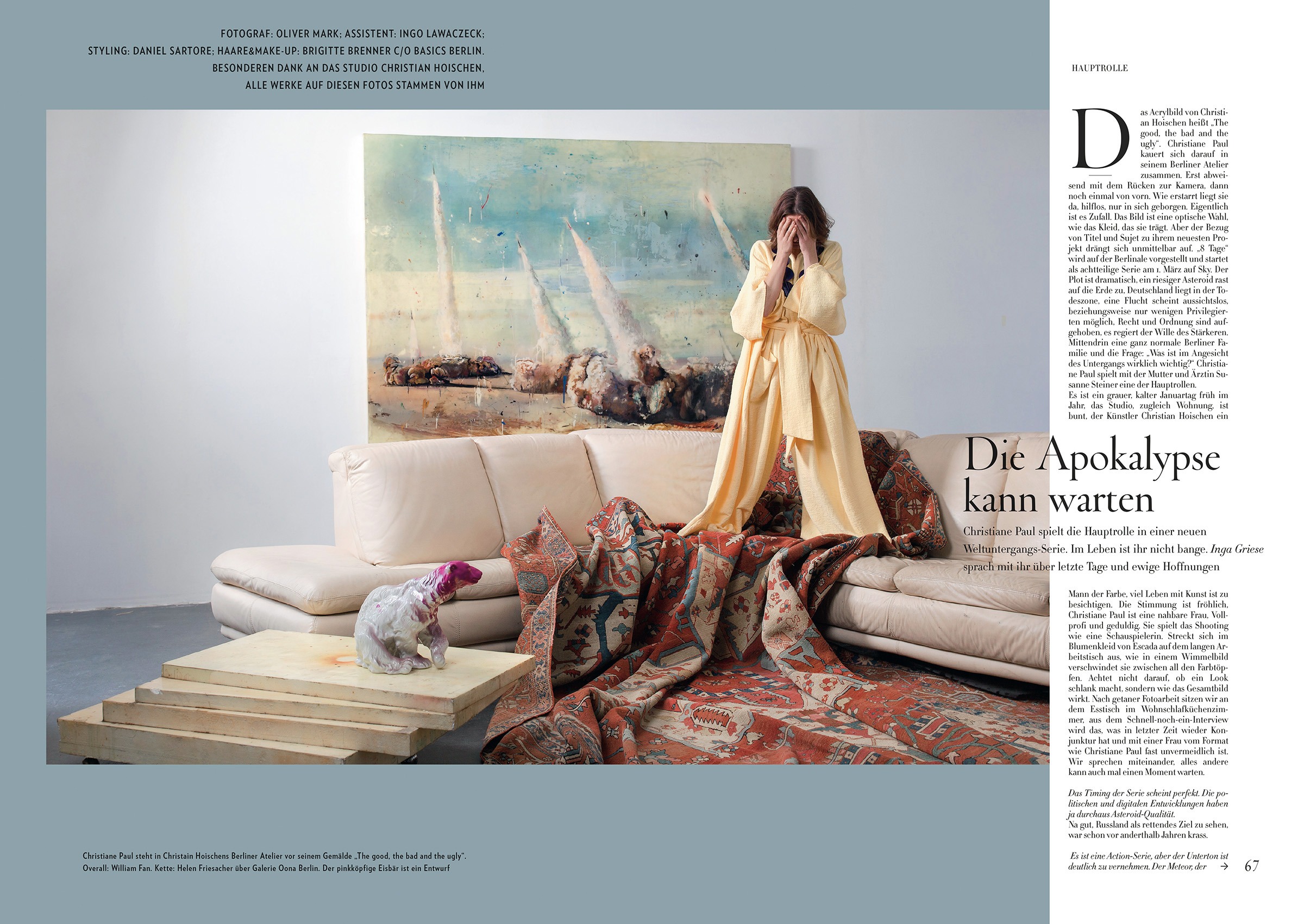
Mark und Hoischen, wieder vereint… Thema Weltuntergang. Da fand Mark die Arbeiten von Hoischen passend – eine Weltuntergangsserie, Paul in der Hauptrolle. Zur Inszenierung dieser Porträts für das ICON Magazin gehörten noch einige andere: Gebucht wurde Mark über die Bildredaktion Julia Sörgel, assistiert hat Ingo Lawaczeck, das Styling übernahm Daniel Satore, und Haare und Make-up kamen von Brigitte Brenner C/O Basic Berlin. Und natürlich noch die Labels der Kleidung: William Fan, Jil Sander, LaLa Berlin, Aeyde und Schmuck von No Editions und Helen Friesacher. Zu all diesen Namen kamen auch noch Gegenstände, wie ein antiker Heriz-Teppich und der Prototyp einer Skulptur – ein Eisbär mit pinkem Kopf. Und natürlich die Arbeiten von Hoischen. Das alles mag jetzt sehr wuselig und wirr klingen – in drei der fünf Aufnahmen, die sie hier ansehen können, lichtet sich das Dunkel. Sie sehen: eine stilvolle, ruhige Inszenierung, in der die Porträtierte sich ganz in ihrer Umgebung einfügt, sozusagen voll und ganz in ihre Rolle taucht. So sehr, dass sie ihr Gesicht verbirgt. Die Kunst und die Labels werden so die Protagonisten der Porträts.
Isa Melsheimer, Vaduz 2019

October 28, 2019: Hike in the Principality of Liechtenstein, 1:29 p.m., rising fog at 2000m. What are Melsheimer and Mark doing in this lunar landscape? Melsheimer is sitting on a stone wall, eating from the snack prepared on a small pink cloth. Mark is photographing – with a Canon EOS 5D Mark IV, EF 50mm f/1.8.
28.10.2019: Wanderung im Fürstentum Liechtenstein, 13:29 h, aufkommender Nebel auf 2000m. Was machen Melsheimer und Mark in dieser Mondlandschaft? Melsheimer sitzt auf einem Gesteinswall und isst von der Vesper, die auf einem kleinen rosa Tuch angerichtet ist. Mark fotografiert – mit einer Canon EOS 5D Mark IV, EF 50mm f/1.8.
Neue Nationalgalerie, Berlin 2020–2021
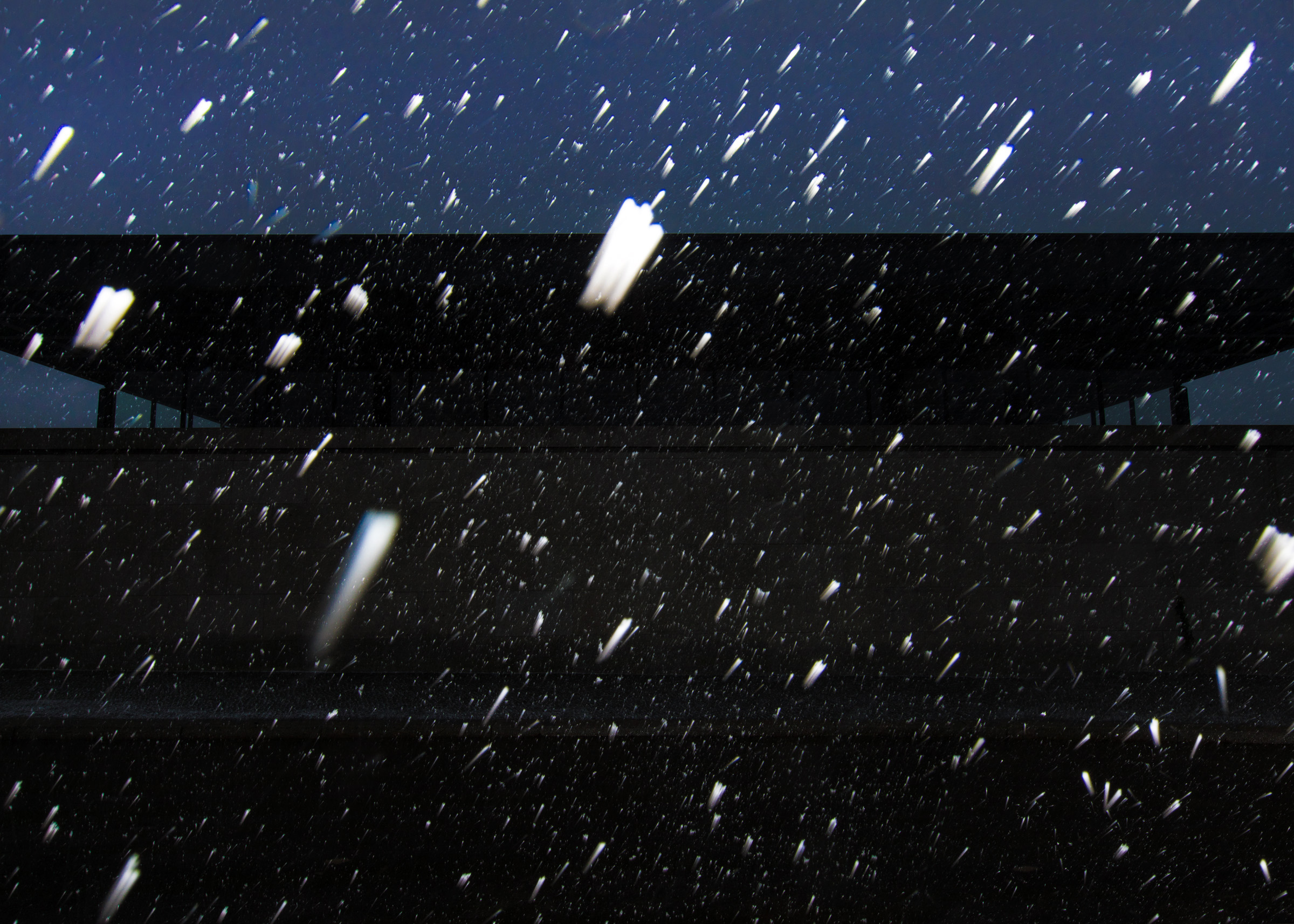
Oliver Mark’s photo series documenting the renovation of the Neue Nationalgalerie is more than a documentary view – it is an artistic exploration of forms, objects, colors, and light. Mark’s work oscillates between abstraction and contextualization, creating images that are compelling both on their own and as part of the larger narrative.While the setting of the renovation is predetermined, the staging comes through Mark’s unique perspective. His photography transforms the industrial nature of the construction site into an artistic space where lines and structures communicate. This results in an equal balance between form and content, documenting time while recontextualizing it.
Die Bildserie von Oliver Mark über den Umbau der Neuen Nationalgalerie ist mehr als eine dokumentarische Momentaufnahme – sie ist eine künstlerische Auseinandersetzung mit Formen, Objekten, Farben und Licht. Marks Arbeit bewegt sich zwischen Abstraktion und Kontextualisierung, wodurch die Bilder sowohl für sich allein als auch im Zusammenspiel eine beeindruckende narrative Kraft entfalten. Das Setting des Umbaus ist vorgegeben, doch die Inszenierung entsteht durch Marks Blick. Mit seinen Fotografien schafft er es, den industriellen Charakter der Baustelle in einen künstlerischen Raum zu verwandeln, in dem Linien und Strukturen miteinander kommunizieren. Es entsteht eine Gleichberechtigung von Form und Inhalt, die Zeit sowohl dokumentiert als auch neu kontextualisiert.
Isa Melsheimer, Berlin 2021
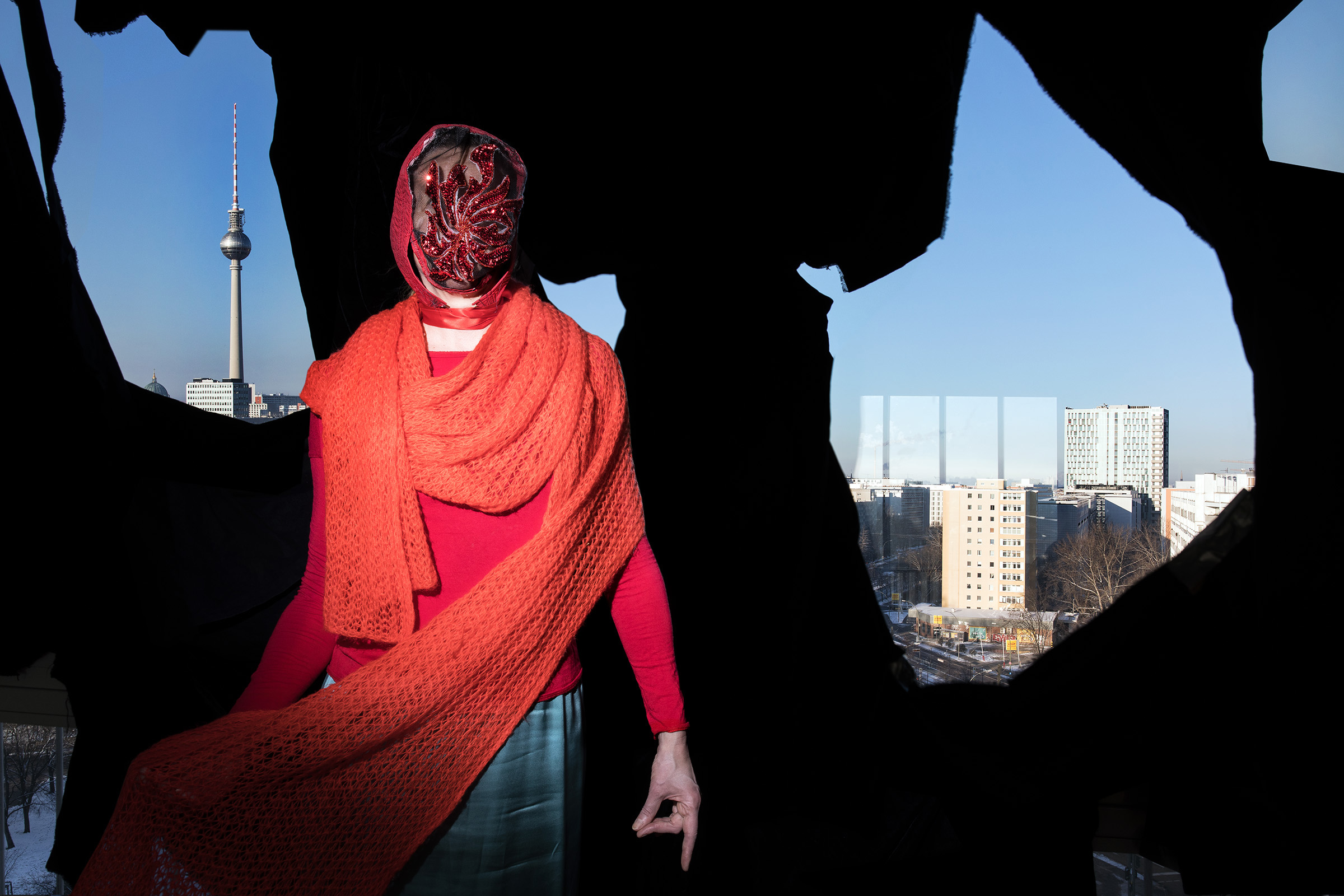
This portrait of the artist Isa Melsheimer was taken during the COVID-19 lockdown on January 31, 2021, in the “Studio in the Sky” on the 11th floor, with a panoramic view of Berlin. The composition of the image almost resembles a painting. Due to the lighting conditions – with the interior being just as bright as the outside – a unified visual plane is created. The colors are wintery and cold: black Molton fabric, pale skin, and a red mask. The semi-transparent mask, which is a work of the artist herself, is thematically extended by the slashed fabric in the background. This creates ambiguity about whose field of vision is restricted – that of the person in front of or behind the camera. At the same time, everything remains clearly visible: contrasting and precise. The image becomes a successful small commentary on the question of how and through what means a person may be restricted.
Das Porträt der Künstlerin Isa Melsheimer, während der Corona-Zeit am 31.01.2021 im Studio in the Sky im 11ten Stock vor dem Panorama Berlins aufgenommen, wirkt kompositorisch beinahe wie eine Malerei. Durch die Lichtverhältnisse – innen ist es genauso hell wie außen – entsteht eine einheitliche Bildebene. Die Farben sind winterlich kalt: schwarzer Molton-Stoff, helle Haut und eine rote Maske. Diese halbtransparente Maske, ein Werk der Künstlerin, wird thematisch durch den aufgeschnittenen Stoff im Hintergrund weitergeführt. Dadurch entsteht eine Unklarheit darüber, wessen Sichtfeld eingeschränkt wird – das der Person vor oder hinter der Kamera. Gleichzeitig bleibt dennoch alles klar erkennbar: kontrastreich und präzise. Das Bild wird so zu einem gelungenen kleinen Kommentar über die Frage, inwiefern und wodurch eine Person eingeschränkt wird.
Hoischen / Mark – “untitled”, 136,0 × 100,5 cm, Glossy C‑Print on wood, 2020

In this collaboration, Hoischen distresses the photo that Mark took of a bright green Lamborghini. Does it still fit – or perhaps all the more into the frame because of this? It certainly becomes an object, and both artists display their willingness to embrace self-criticism, change, and personal responsibility. Or, as Mark puts it: “It is important to manage your ride into the sunset.”
Hoischen ramponiert hier das Foto, das Mark von einem giftgrünen Lamborghini gemacht hat. Passt es dennoch – oder gerade deswegen – in den Rahmen? Auf jeden Fall wird es dadurch zum Objekt, und die beiden Künstler zeigen ihren Willen zur Selbstkritik, Veränderung und Eigenverantwortung. Oder, wie Mark es ausdrückt: „Es ist wichtig, dass man seinen Ritt in den Sonnenuntergang regelt.“
Oliver Mark Studio, Berlin 2010–2022
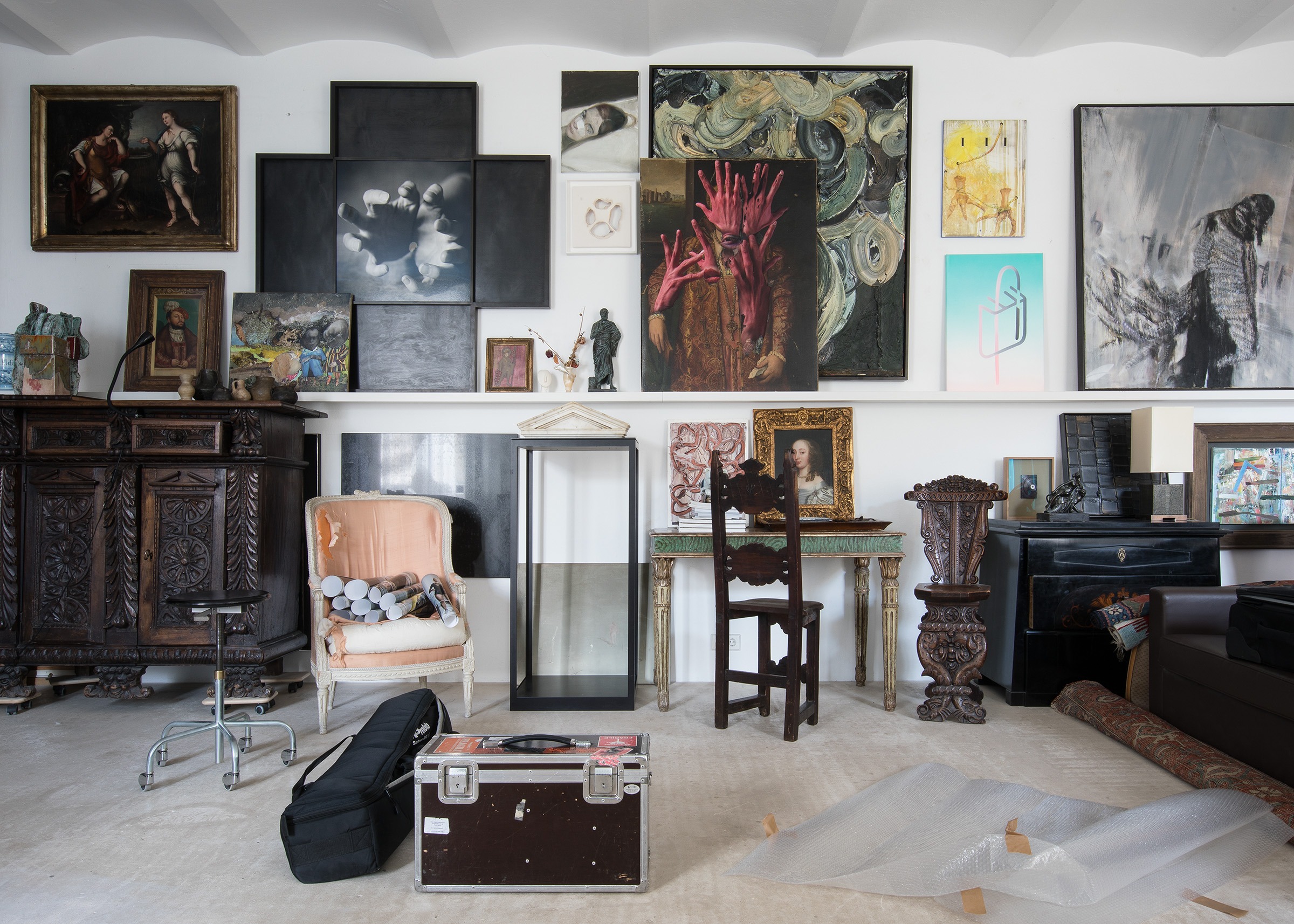
A glimpse into Oliver Mark’s studio on Tempelhofer Ufer reveals not only an impressive art collection, but also a living testimony to Mark’s work. Mark exchanges portraits he creates of artists for works by those very artists, fostering a productive dialogue that is evident in the diversity of the collection. But the studio reveals more than just art—it is an expression of the staging Mark brings into his work and living spaces. The antique furniture such as the black Pompeian chest of drawers from the 18th century or the Renaissance cabinet on rolling boards from 16th century Tuscany, doesn’t feel outdated or out of place; instead, it shifts between object and sculpture, creating a unique atmosphere. The space blends work and contemplation—a harmony of art, antique furnishings, and loft architecture with Prussian vaulted ceilings , radiating both abundance and tranquility.
Der Blick in Oliver Marks Studio am Tempelhofer Ufer offenbart nicht nur eine beeindruckende Kunstsammlung, sondern auch ein lebendiges Zeugnis von Marks Arbeit. Oft tauscht Mark die Porträts, die er von Künstlern anfertigt, gegen Werke dieser Künstler – ein produktiver Dialog, der sich in der Vielfalt der Sammlung widerspiegelt. Doch das Studio zeigt mehr als nur Kunst: Es ist ein Ausdruck der Inszenierung, die Mark in seinen Arbeits- und Lebensräumen verwirklicht. Die antiken Möbel wie z.B die schwarze pompejanische Kommode aus dem 18. Jahrhundert oder das Renaissance-Kabinett auf Rollbrettern aus der Toskana 16. Jahrhundert wirken dabei keineswegs alt oder deplatziert. Vielmehr changieren sie zwischen Objekt und Skulptur und schaffen so eine einzigartige Atmosphäre. Der Raum vereint Arbeit und Kontemplation – eine Harmonie aus Kunst, antikem Mobiliar und Loft-Architektur mit Preußische Kappendecken, die gleichzeitig Fülle und Ruhe ausstrahlt.
Isa Melsheimer / Oliver Mark – “Georg”, Berlin 2022

The work Georg (50 x 70 cm, glossy C‑Print on Aluminum Dibond, 2022) was created in the St. Canisius Church in Berlin, specifically in the Marian Chapel. The image depicts Father Georg Maria Roers SJ in a magnificent chasuble, his face hidden behind a mask by the artist Isa Melsheimer. This portrait is part of the exhibition Collaborations I, which Oliver Mark curated for the Guardini Gallery Berlin in 2022. Mark invited 60 artists to reinterpret his photographs. The design possibilities were completely open – from cutting and painting to complete transformation. The resulting works, including Georg, were documented in the Collaborations I magazine. The exhibition was made possible with the support of Father Georg Maria Roers SJ, the Archdiocese of Berlin, and the Guardini Foundation. It was opened on April 5, 2022, just three days after the mask mandate – one of the COVID-19 safety measures – was lifted, as part of the Gallery Weekend, with around 500 visitors attending.
Die Arbeit Georg (50 x 70 cm, glossy C‑Print auf Aluminium Dibond, 2022) entstand in der Kirche St. Canisius in Berlin, genauer gesagt in der Marienkapelle. Das Bild zeigt Pater Georg Maria Roers SJ in einem prächtigen Chormantel, sein Gesicht verborgen hinter einer Maske der Künstlerin Isa Melsheimer. Dieses Porträt ist Teil der Ausstellung Collaborations I, die Oliver Mark 2022 für die Guardini Galerie Berlin konzipierte. Mark lud 60 Künstlerinnen und Künstler dazu ein, seine Fotografien weiterzuverarbeiten. Die Gestaltungsmöglichkeiten waren vollkommen frei – von Zerschneiden und Bemalen bis zur vollständigen Verfremdung. Die entstandenen Werke, darunter Georg, wurden im Magazin Collaborations I dokumentiert. Die Ausstellung konnte dank der Unterstützung von Georg Maria Roers SJ, dem Erzbistum Berlin und der Guardini Stiftung realisiert werden. Am 5. April 2022, nur drei Tage nachdem die Maskenpflicht – eine der Corona-Schutzmaßnahmen – aufgehoben worden war, wurde sie im Rahmen des Gallery Weekends mit rund 500 Besuchern eröffnet.
Thomas Scheibitz / Oliver Mark, Umbertide I and II, Berlin 2022
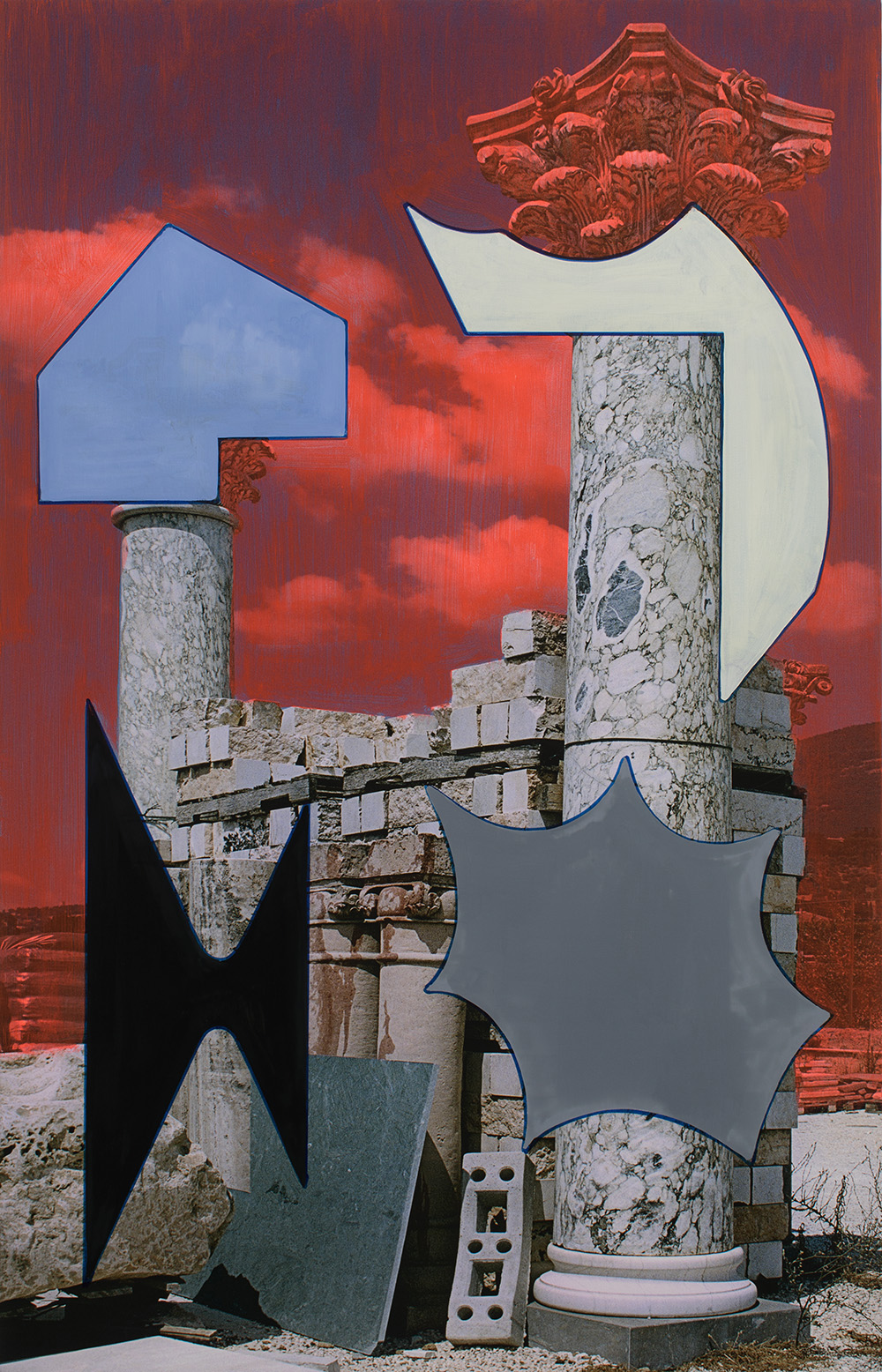
Another work from the Collaborations I series – the starting point here is a photograph taken in July 2020, created in Umbertide, a municipality in the Province of Perugia, Italy. Mark accompanied Isa Melsheimer there, who spent some time during the COVID-19 pandemic as an artist in residence at the Civitella Ranieri Foundation – a castle from the early Renaissance. Due to the precarious circumstances of the pandemic, the two of them had… a castle all to themselves.
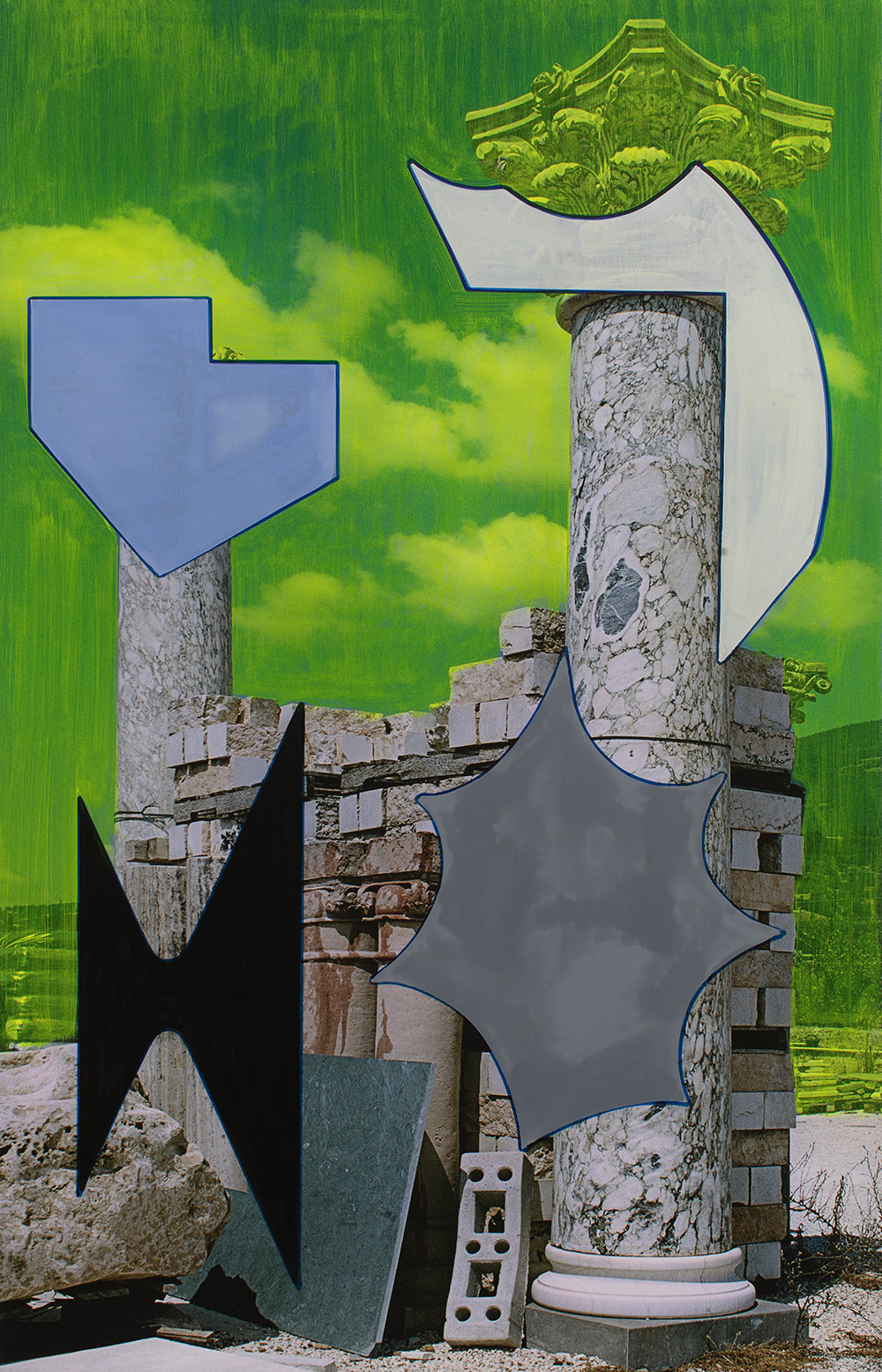
Eine weitere Arbeit aus der Serie Collaborations I – Ausgangspunkt hier eine Fotografie aus Juli 2020, entstanden in Umbertide, eine Gemeinde in der Provinz Perugia, Italien. Mark begleitete Isa Melsheimer dorthin, die während der COVID-19-Pandemie eine Zeit lang als Artist in Residence in der Civitella Ranieri Foundation lebte – eine Burg aus der Frührenaissance. Durch die prekären Umstände der Pandemie hatten die beiden …eine Burg für sich allein.
Sheikh Rashid bin Khalifa Al Khalifa, Bahrain 2022
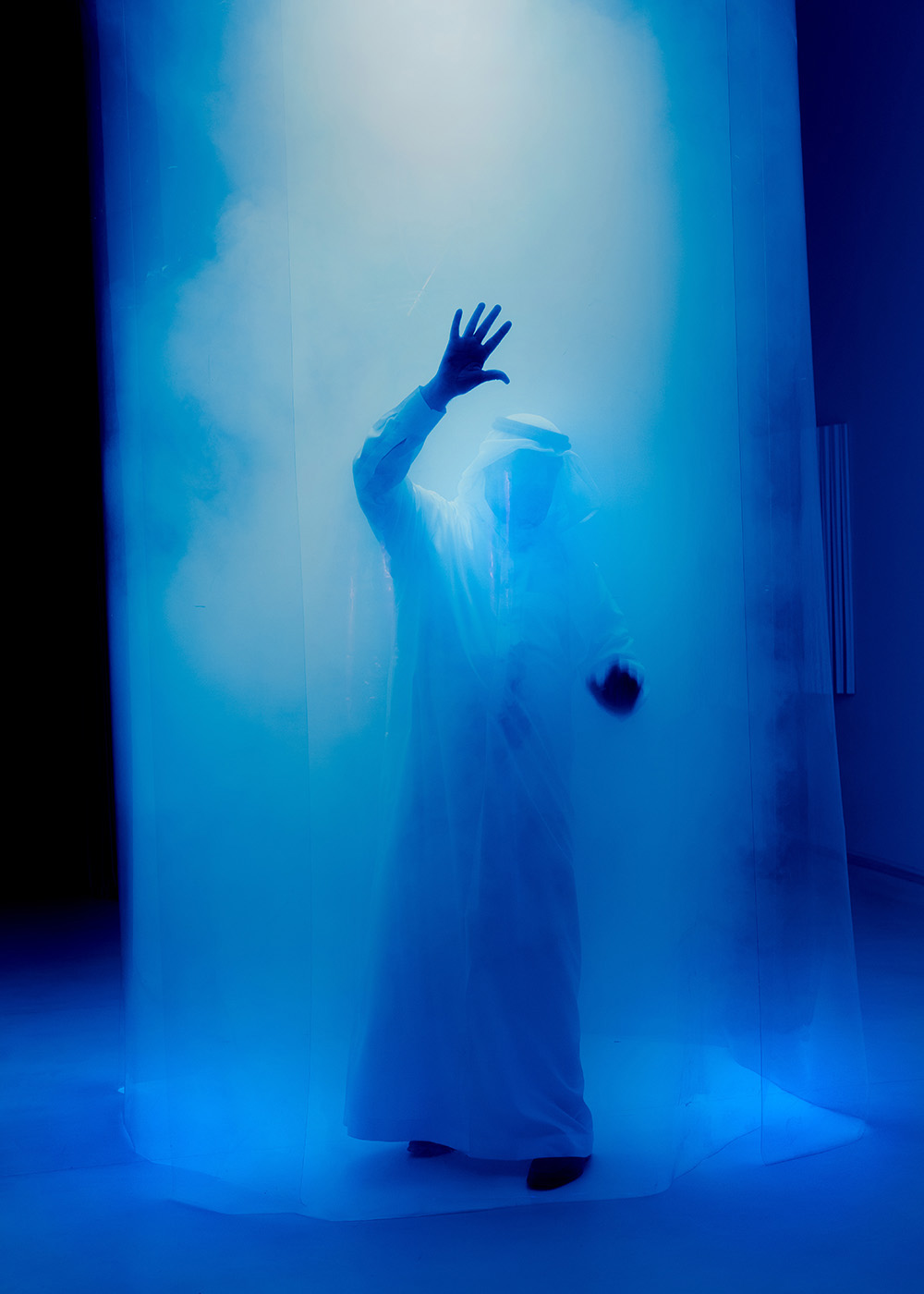
…dressed in a traditional, floor-length white robe with a headdress. Surrounded by: neon light, a fog machine, and the suggestion of a room. At times, the light fades like the shimmer of northern lights in the darkness; at others, it forms the background as it refracts through the fog, and sometimes the figure is directly illuminated: the Sheikh appears in the spectrum of colors. The figure, in a vertical, centered posture, arms and hands often gesturing, appears different in each image but always sculptural: simultaneously placeless and timeless, futuristic and contemplative. Mark was invited to photograph Rashid bin Khalifa Al Khalifa, an artist. He and his assistants were flown in and a chronicle of the moments was created.
…in traditionellem, bodenlangem weißen Gewand mit Kopfbedeckung. Um ihn herum: Neonlicht, eine Nebelmaschine und die Andeutung eines Raumes. Mal verliert sich das Licht wie der Schimmer von Nordlichtern in der Dunkelheit, mal bildet es den Hintergrund, indem es sich im Nebel bricht, und mal wird die Person gezielt angestrahlt: Der Scheich erscheint im Farbspektrum. Die Figur, in vertikaler, zentrierter Haltung, die Arme und Hände oft in Gesten, wirkt in den umgebenden Farbnebeln in jeder Aufnahme anders, aber stets skulptural: gleichzeitig ort- und zeitlos, futuristisch und innehaltend. Mark wurde eingeladen, Rashid bin Khalifa Al Khalifa, der als Künstler tätig ist, zu fotografieren. Dazu wurde er samt Assistenten eingeflogen und es entstand eine Chronik der Augenblicke.
Klaus Mertens SJ, Berlin 2023

This vertical portrait depicts a person in a white choir robe. The body is half turned, with hands extending from the wide sleeves, fingers lightly interlaced without crossing. The head tilts to the side, and the gaze drifts into the distance. Just behind the figure, a light blue cloth stretches over a railing, filling the lower half of the image to the waist. At head height, a dark, foreboding thundercloud looms. In the center of the image, a horizon is visible, with two buildings on the skyline, and rays of sunlight hint at light, casting a glow on the distant clouds. Who is this person, standing out so poignantly against this ominous yet fleeting backdrop of nature, city, and staging? Father Klaus Mertes, known as the first clergyman to publicly speak out about sexual abuse by priests.
Ein hochformatiges Porträt zeigt eine Person in einem weißen Chormantel. Der Körper ist halb gedreht, die Hände ragen aus den weiten Ärmeln, und die Finger sind leicht ineinander verschränkt, ohne sich zu verkreuzen. Der Kopf ist zur Seite geneigt, der Blick schweift in die Ferne. Unmittelbar dahinter spannt sich ein hellblaues Tuch über eine Brüstung, die die untere Bildhälfte bis zur Taille der Figur füllt. Auf der Höhe des Kopfes breitet sich eine graue, düstere Gewitterwolke aus. In der Mitte des Bildes zeichnet sich ein Horizont ab, auf dem zwei Gebäude sichtbar sind, während Sonnenstrahlen eine Ahnung von Licht auf die Wolken in der Ferne werfen. Wer ist diese Person, die vor diesem unheilvollen, aber vergänglichen Hintergrund aus Natur, Stadt und Inszenierung so eindringlich hervorsticht? Pater Klaus Mertes, bekannt als der erste geistliche, der sexuellen Missbrauch durch Priester öffentlich machte.
Richard Roberts, Berlin 2023

The photo captures Richard Roberts wearing dark jeans and a white ribbed shirt, with small figurative tattoos visible on his arms, chest, and neck. His hand rests on the zipper of his pants, the belt undone. His gaze is turned away from the camera, and his reflection can be seen in the background. Around him, artworks hang on the walls. Is he coming, or is he going? We don’t know. What is certain, though, is that he is an artist. In Oliver’s words: “Now, New, and Next.”
Farbe an der dunklen Jeans und dem weißen Feinripp-Shirt, kleine figurative Tattoos an Armen, Brust und Hals. Seine Hand ruht am Reißverschluss der Hose, der Gürtel ist geöffnet. Der Blick ist von der Kamera abgewandt, sein Gesicht spiegelt sich im Hintergrund. Um ihn herum hängen Arbeiten an den Wänden. Kommt er, oder geht er? Wir wissen es nicht. Eines ist sicher: Er ist ein Künstler. Mit Olivers Worten: „Now, New and Next.“
Joachim Lenz, Ventotene 2024

In the summer of 2024, Mark participated in IN/SU/LA, a residency program and exhibition platform for European artists, on the island of Ventotene in the Tyrrhenian Sea. This small island is located behind Ischia, about two hours by ferry from Naples. The bust-like profile portrait of artist Joachim Lenz was taken in front of the ruins of Villa Giulia, which was built by Augustus as an imperial summer residence in the 2nd century BC. Since then, the place has been associated with exile: Augustus sent his daughter Julia here because she refused to comply with his morals. Later emperors used the island to exile female family members. Well beyond this era, until the 1940s, Ventotene served as a place of isolation for those considered undesirable. Today, the island is a tourist destination, though it remains largely unknown and retains a harsh, unappealing character.
Zusammen mit elf weiteren Künstlern nahm Mark im Sommer 2024 an IN/SU/LA, einem RESIDENCY PROGRAM AND EXHIBITION PLATFORM FOR EUROPEAN ARTISTS auf Ventotene im Tyrrhenischen Meer teil. Die kleine Insel liegt hinter Ischia, etwa zwei Stunden mit der Fähre von Neapel entfernt. Die büstenhafte Profilaufnahme des Künstlers Joachim Lenz entstand vor den Ruinen der Villa Giulia, die im 2. Jhd. v. Chr. von Augustus als kaiserliche Sommerresidenz erbaut wurde. Seit dieser Zeit ist der Ort mit Verbannung verbunden: Augustus schickte seine Tochter Julia hierher, da sie sich seinen Sitten nicht unterwerfen wollte. Auch folgende Kaiser nutzten die Insel als Exil für weibliche Familienangehörige. Weit über diese Zeit hinaus, bis in die 1940er Jahre, diente Ventotene der Isolation von Menschen, die als unliebsam galten. Heute ist die Insel touristisch erschlossen, jedoch eher unbekannt und besitzt einen rauen, nicht besonders gefälligen Charakter.
Michael Kunze, Ventotene 2024
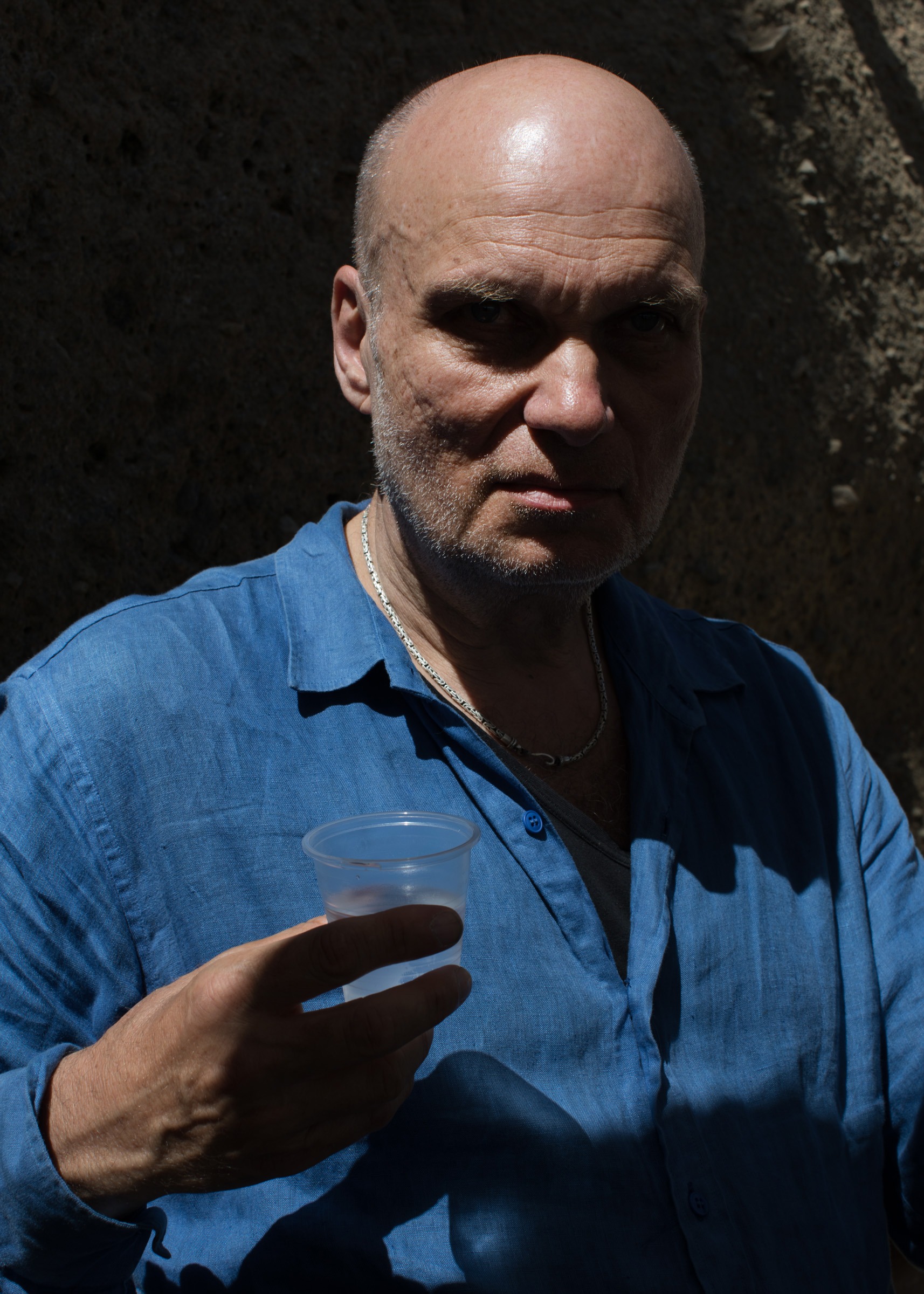
What does the portrait of Michael Kunze have in common with the photos of Monica Bellucci that Helmut Newton took for Vogue Italia in 2001? The use of harsh, direct midday sunlight – a testament to the craftsmanship of the photographers.
Was hat das Porträt von Michael Kunze mit den Aufnahmen von Monica Bellucci, die Helmut Newton 2001 für Vogue Italia gemacht hat, gemeinsam? Der Umgang mit dem grellen, direkten Licht der Mittagssonne – ein Testament für das handwerkliche Können der Fotografen.
Sean Scully, London 2024

The photograph of Sean Scully was taken on June 17, 2024, in Hampstead Heath Park, London. It is a precise shot of the renowned artist in a moment marked by naturalness. His soft gaze contrasts with his brutal posture and appearance, creating an intriguing duality that makes his essence and artistic aura tangible. His painted oeuvre is referenced in this portrait through the tonality and physical presence, as well as the vastness and complexity of the scene. It seems as if one of his own works surrounds him. The photo was taken in daylight under a cloudy sky, providing a soft, even light source. This natural environment—consistent and unforced—reflects Scully’s connection to nature, which is also visible in his works. The artist is not idealized here but portrayed truthfully, in all his physiology. This precision in capturing reality was central to Mark’s approach: to create an image that not only shows Scully but makes him palpable. The image has already been featured in well-known publications such as The New York Times and Vogue Polska.
Die Fotografie von Sean Scully entstand am 17. Juni 2024 im Hampstead Heath Park in London. Es ist eine präzise Aufnahme des renommierten Künstlers in einem Moment, der von Natürlichkeit geprägt ist. Sein sanfter Blick kontrastiert mit seiner brutalen Haltung und Erscheinung, wodurch eine spannende Dualität entsteht, die sein Wesen und seine künstlerische Ausstrahlung greifbar macht. Auf sein malerisches Œuvre wird in diesem Porträt durch die Tonalität und physische Präsenz sowie durch die Weite und Vielschichtigkeit der Szenerie hervorragend referenziert. Es scheint, als würde ihn eines seiner eigenen Werke umgeben. Das Foto wurde bei Tageslicht unter bewölktem Himmel aufgenommen, was eine weiche, gleichmäßige Lichtquelle bietet. Diese natürliche Umgebung – konsequent und selbstverständlich – reflektiert Scullys Verbindung zu Natur, die auch in seinen Werken sichtbar ist. Der Künstler wird hier nicht idealisiert, sondern wahrheitsgetreu und in seiner ganzen Physiologie dargestellt. Genau diese Präzision in der Erfassung von Wirklichkeit war für Mark von zentraler Bedeutung: ein Abbild zu schaffen, das Scully nicht nur zeigt, sondern spürbar macht. Das Bild wurde bereits in bekannten Publikationen wie der New York Times und der Vogue Polska gezeigt.
Julie Delpy, Berlin 2005/2025
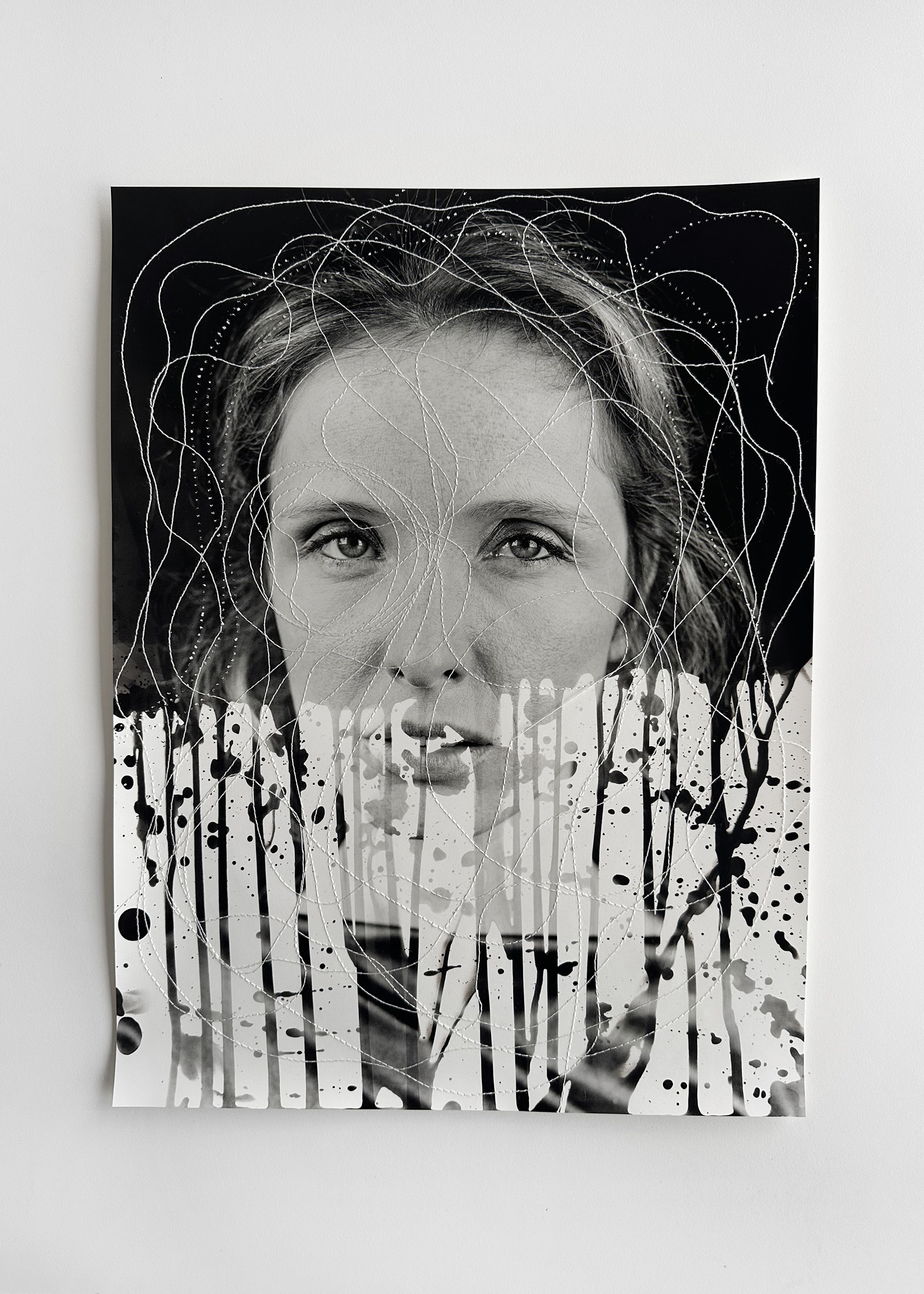
What you see here is the image of an image, not a photograph in the digital sense, but the depiction of an analog, manually developed, and edited photograph on thick, cardboard-like baryta paper. The edges of the paper gently curl upward, while the black in the background appears particularly deep. The upper half was dipped into a developer bath. After removing it, the paper was rotated, creating the characteristic runners in the lower half of the image. Small, random splashes were added by hand, giving the work a spontaneous dynamism and depth. Through the center of the image run intertwined seams and perforated lines created with a sewing machine. Since they show neither a beginning nor an end, they seem to stretch infinitely, visually connecting the upper and lower halves of the image as well as the foreground and background. For me, this work addresses the question of the meaning of time. The span of time becomes visible here—in the duration of the editing process but also in the gap between the original photograph taken in 2005 and the editing done in 2025. This is how I interpret the endlessly swirling lines, which don’t disturb the face but rather open up new layers of observation. As Mark crafts his way back to his roots, he simultaneously opens a new chapter in his artistic work and his exploration of portraits, following the spirit of his Collaborations series. By the way, this is Julie Delpy, known for her starring role and co-authorship in the Before Sunrise trilogy. The film series explores a romantic couple and three of their encounters over 18 years: Before Sunrise (1995), Before Sunset (2004), and Before Midnight (2013).
Sie sehen hier das Bild eines Bildes, nicht eine Fotografie im digitalen Sinne, sondern die Abbildung einer analogen, manuell entwickelten und bearbeiteten Fotografie auf dickem, kartonartigem Barytpapier. Die Kanten des Papiers wölben sich leicht nach oben, während das Schwarz im Hintergrund besonders satt erscheint. Die obere Hälfte wurde in ein Entwickler-Bad getaucht. Nach dem Herausnehmen wurde das Papier gedreht, wodurch die charakteristischen Läufer in der unteren Bildhälfte entstanden. Die kleinen, zufälligen Spritzer wurden per Hand hinzugefügt und verleihen der Arbeit eine spontane Dynamik und Tiefe. Durch das Zentrum des Bildes ziehen sich verschlungene Nähte und mit einer Nähmaschine gelochte Linien. Da sie keinen Anfang oder kein Ende zeigen, scheinen sie unendlich fortzulaufen und verbinden optisch die obere und untere Bildhälfte sowie Vorder- und Hintergrund miteinander. Dieses Werk thematisiert für mich die Frage nach der Bedeutung von Zeit. Die Zeitspanne wird hier sichtbar – in der Dauer der Bearbeitung, aber auch im Abstand zwischen der ursprünglichen Aufnahme im Jahr 2005 und der Bearbeitung im Jahr 2025. So interpretiere ich die endlos wirbelnden Linien, die das Gesicht nicht stören, sondern neue Ebenen der Betrachtung eröffnen. Während sich Mark handwerklich zurück zu seinen Anfängen bewegt, schlägt er, in Anlehnung an die Collaborations-Serien, gleichzeitig ein neues Kapitel in seiner künstlerischen Arbeit und seiner Auseinandersetzung mit Porträts auf. Zu sehen ist hier übrigens Julie Delpy, bekannt durch ihre Hauptrolle und Ko-Autorenschaft in der „Before Sunrise“-Trilogie. Diese Filmreihe beschäftigt sich inhaltlich und zeitlich mit einem Liebespaar und drei ihrer Begegnungen über einen Zeitraum von 18 Jahren: Before Sunrise (1995), Before Sunset (2004) und Before Midnight (2013).
Isa Melsheimer, Basque Country 2025
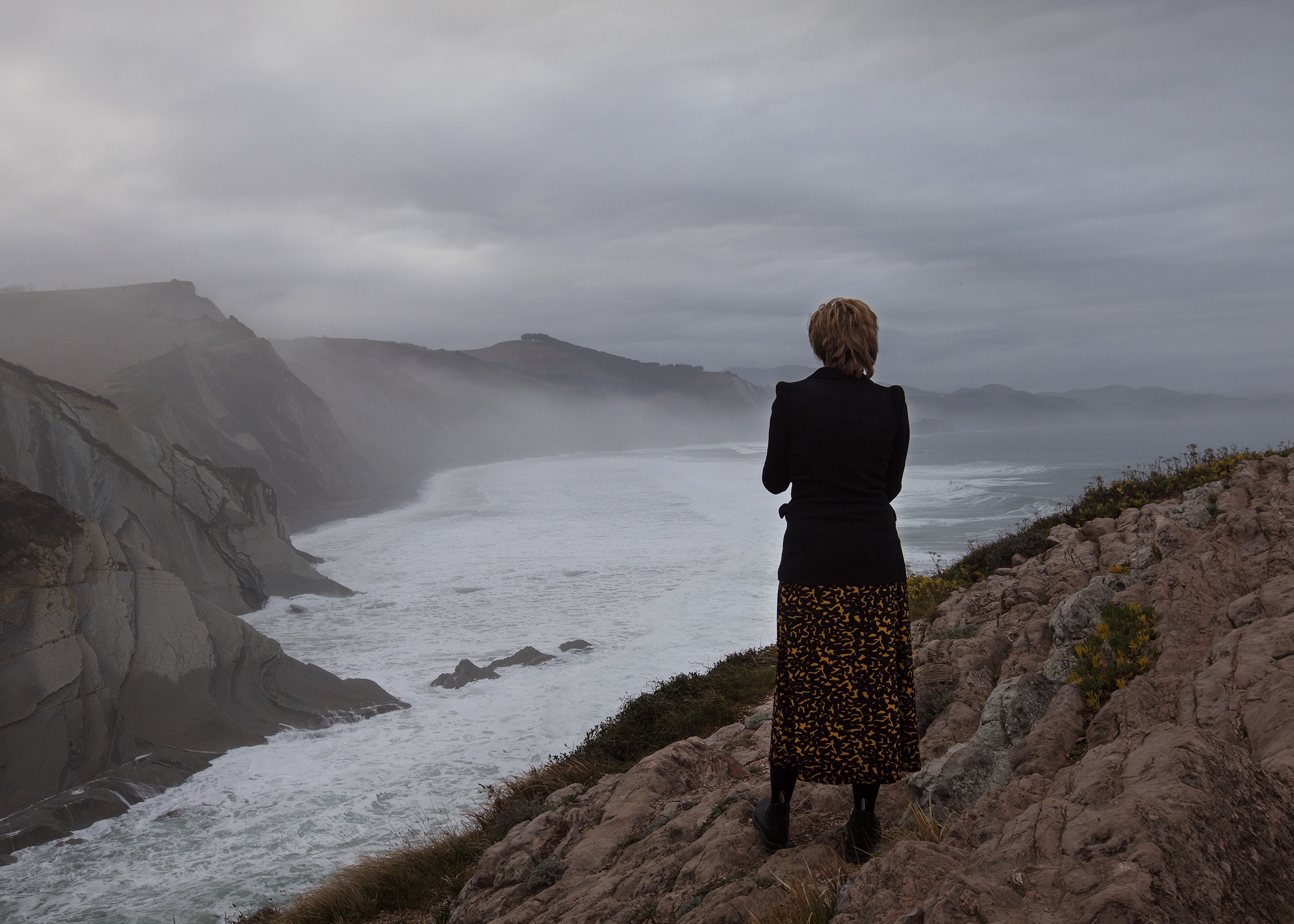
A woman is seen from behind as she stands at the edge of a cliff. The reference to Caspar David Friedrich is both immediate and subtly altered.
In December 2025, Mark accompanied the artist Isa Melsheimer to the Basque Country, where her group exhibition, Arts of the Earth, opened at the Guggenheim Museum Bilbao. The portrait was taken against the flysch formations of the Cantabrian cliffs: sedimentary rock layers running downward like the pages of an open book. Melsheimer stands on the right side of the image on a rocky outcropping. She wears a black jacket and a black-and-yellow skirt with an organic, mottled pattern. Below her, the sea crashes white against the rocks. To the left, the cliffs drop steeply, and in the background, other headlands disappear into the fog. The sky is gray and diffuse, and the air is damp.
The image can be interpreted in two ways. Those familiar with Melsheimer’s series, Continuous Process of Improvement I–IV (2023), recognize in this portrait the bridge between geological memory and artistic practice. In this series, Melsheimer explores lamellar-like stratifications in glazed ceramics, surfaces reminiscent of oxidized stones, layers of earth, and organic fossils. The artist does not merely stand before the material of her thought; she stands in the midst of what her sculptures convey.
Others see something different: a female figure seen from behind by the sea and the question of how the image of thought, vision, and independence shifts when Friedrich’s Wanderer is no longer male. They also consider whether we have evolved since the Romantic era and, if so, to what extent.
Eine Frau in Rückansicht, am Rand einer Steilküste. Die Referenz zu Caspar David Friedrich ist unmittelbar und zugleich verschoben.
Im Dezember 2025 begleitete Mark die Künstlerin Isa Melsheimer ins Baskenland, wo sie ihre Gruppenausstellung Arts of the Earth im Guggenheim Museum Bilbao eröffnet hatte. Das Porträt entstand an den Flysch-Formationen der kantabrischen Steilküste: sedimentäre Gesteinsschichten, die wie Lamellen, wie Seiten eines aufgeschlagenen Buches in die Tiefe verlaufen. Melsheimer steht rechts im Bild, auf einem Felsvorsprung, in schwarzer Jacke und einem schwarz-gelben Rock mit organisch-fleckigem Muster. Unter ihr bricht sich das Meer weiß an den Felsen. Links fallen die Klippen steil ab, im Hintergrund versinken weitere Landzungen im Nebel. Der Himmel ist grau, diffus, die Luft feucht.
Das Bild lässt sich in zwei Richtungen lesen: Wer weiß, dass Melsheimer in ihrer Werkgruppe Fortlaufender Prozess der Verbesserung I bis IV (2023) genau diese lamellenartigen Schichtungen in glasierter Keramik aufgreift – Oberflächen, die an oxidierte Steine, Erdschichten und organische Versteinerungen erinnern , erkennt in diesem Porträt die Brücke zwischen geologischem Gedächtnis und künstlerischer Praxis. Die Künstlerin steht nicht nur vor dem Material ihres Denknes, sie steht inmitten dessen, was ihre Skulpturen übersetzen.
Wer diese Information nicht hat, sieht etwas anderes: eine weiblich konnotierte Rückenfigur am Meer, die Frage, wie sich das Bild des Denkens, Sehens und der Unabhängigkeit verschiebt, wenn Friedrichs Wanderer nicht mehr männlich ist. Und ob, und wenn ja, wie weit, wir uns seit der Romantik weiterentwickelt haben.
Alicja Kwade, Vatican City 2026
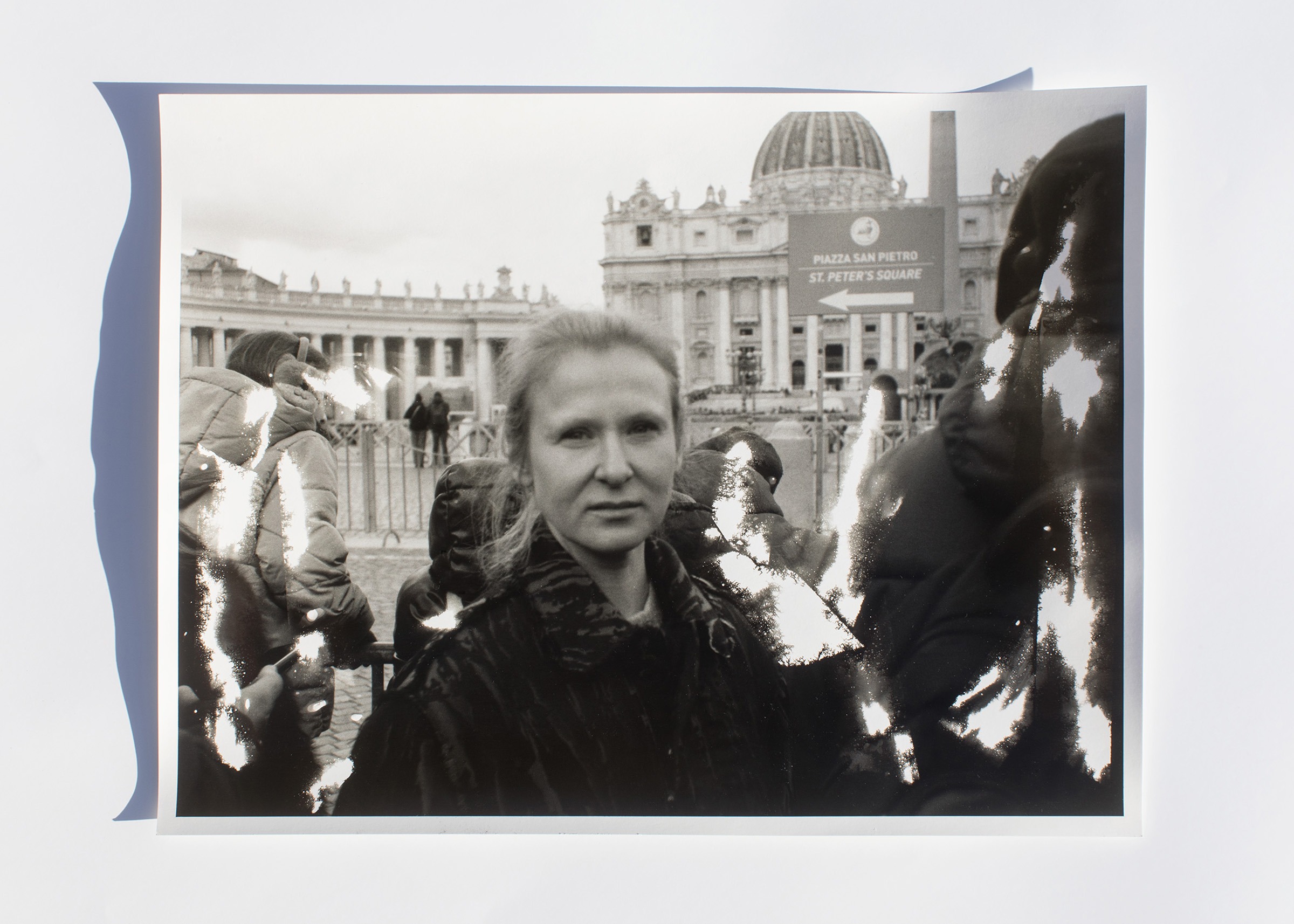
It’s a photograph that feels like a memory, even at the moment it’s taken.
Over the years, Mark has repeatedly photographed Alicja Kwade, primarily in her studio surrounded by her artwork. This portrait, however, was taken in a different context, simultaneously private and public.
New Year’s Eve 2025/26 in Rome: Mark is spending eight days at Villa Massimo with Kwade, Gregor Hildebrandt, and other artists, where Kwade is currently in residence. A must for Mark was a visit to St. Peter’s Baslicia, a place he returns to time and again, drawn by its architecture, history, and unique atmosphere.
In the center of the image, Kwade looks directly into the camera. Behind her, other visitors are visible only as dark silhouettes in hoods and down jackets. In the middle ground is a sign: “Piazza San Pietro / St. Peter’s Square,” with an arrow below. Behind the sign is the colossal façade of St. Peter’s Basilica, with its colonnades and partially visible dome. The waist-high metal fences allow the line of people waiting to flow in an orderly fashion toward the entrance. The normal length of this line indicates that, contrary to the group’s assumption, the Pope will not be holding an official audience that day.
The image was edited by Mark during the development process using physical interventions. The figures in the foreground, immediately behind Kwade, appear to have dissolved into white in some places, as if they were sprayed or erased. What remains is Kwade’s clear gaze surrounded by elements that are already dissolving within the material itself.It was photographed on 35mm black-and-white film with an Olympus Mju‑1 and printed by Mark himself. It is a silver gelatin print on baryta paper that has been selenium-toned and is a unique print. 30.0 x 39.5 cm.
Ein Bild, das sich schon im Moment der Aufnahme anfühlt wie eine Erinnerung. Mark hat Alicja Kwade über die Jahre immer wieder fotografiert, meist in ihrem Studio, umgeben von ihren Arbeiten. Dieses Porträt entsteht in einem anderen Kontext: privat und öffentlich zugleich.
Silvester 2025/26 in Rom: Mark verbringt mit Kwade, Gregor Hildebrandt und weiteren Künstler*innen acht Tage in der Villa Massimo, wo Kwade derzeit eine Residenz hat. Für Mark obligatorisch: der Besuch des Petersdoms, ein Ort, zu dem er immer wieder zurückkehrt, angezogen von Architektur, Geschichte und der besonderen Atmosphäre des Monuments.
Im Zentrum des Bildes blickt Kwade direkt in die Kamera. Hinter ihr, zu beiden Seiten, sind andere Besucher*innen nur noch als dunkle Silhouetten erkennbar: Kapuzen, Daunenjacken, angedeutete Körper. Im Mittelgrund ein Schild: „Piazza San Pietro / St. Peter’s Square”, darunter ein Pfeil. Dahinter die kolossale Fassade des Petersdoms mit ihren Kolonnaden, die Kuppel angeschnitten. Die halbhohen Metallzäune lassen die Schlange der Wartenden geordnet in Richtung Eingang fließen. An der normalen Länge dieser Schlange ist abzulesen, dass der Papst, entgegen der Annahme der Gruppe, an diesem Tag keine offizielle Audienz geben wird.
Das Bild wurde während der Entwicklung von Mark durch physische Eingriffe bearbeitet. Die Figuren im Vordergrund, unmittelbar hinter Kwade, erscheinen stellenweise weiß aufgelöst, wie gesprüht oder abradiert. Was bleibt, ist Kwades klarer Blick, umgeben von dem, was sich im Material selbst bereits in Auflösung befindet.
Fotografiert auf Kleinbild-Schwarzweißfilm mit einer Olympus Mju‑1, von Mark selbst abgezogen. Silver Gelatin Print auf Baryta Paper, seleniumgetont, Unikat. 30,0 x 39,5 cm.