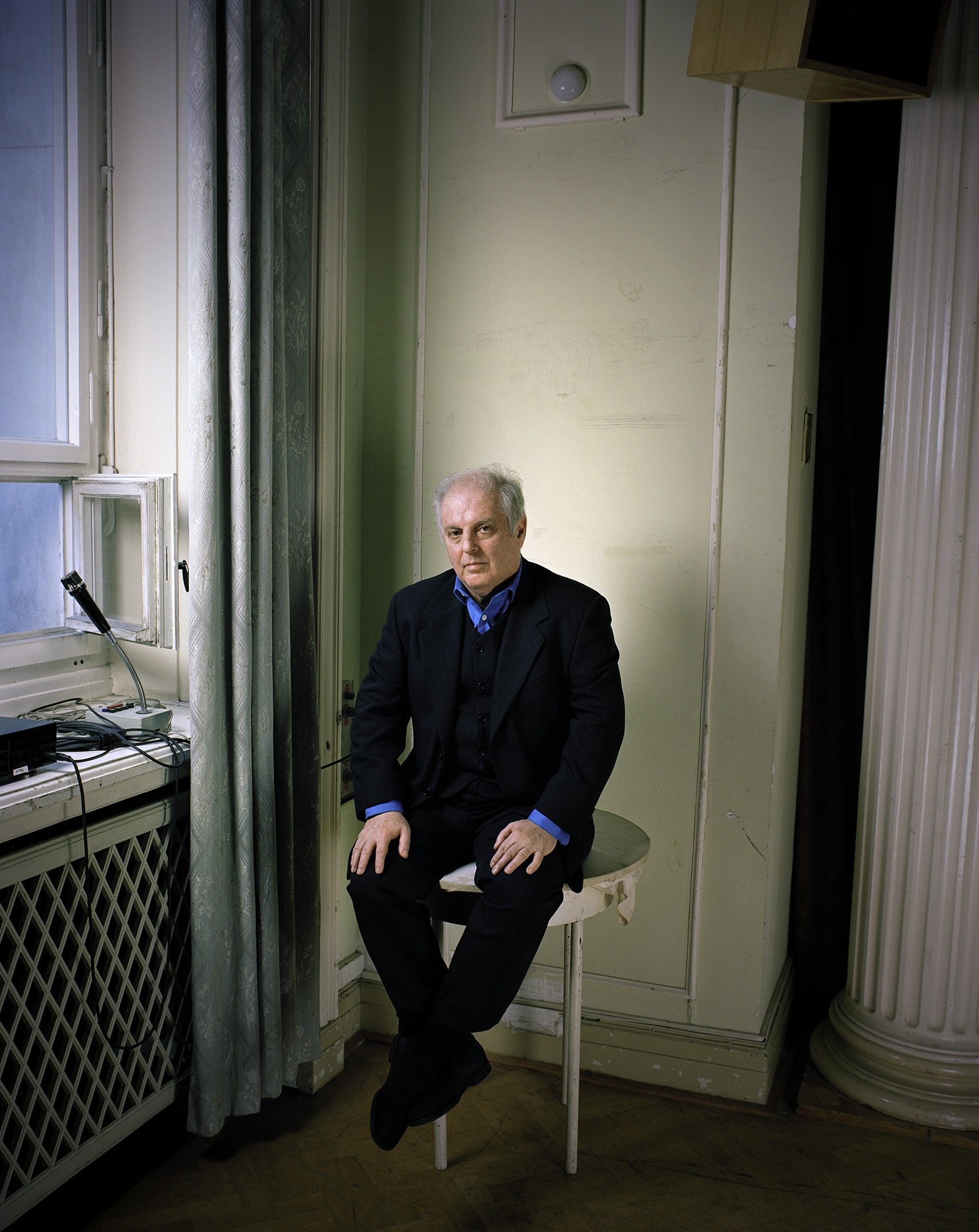
Berlin, May 2008. The former magazine building of the Staatsoper Unter den Linden still breathed the spirit of the provisional when I prepared the room for a portrait originally commissioned by the American TIME Magazine. For an hour, I arranged the setting, checked the light, and searched for an unseen perspective away from the usual maestro iconography, a perpetual search that drives my photographic work. The actual shoot ultimately lasted barely fifteen minutes. My goal was to break radically with the conventions of the classical cult of genius: Daniel Barenboim, one of the most monumental figures in contemporary music history, was to defy any traditional gesture of dominance in my image.
He does not throne. He hovers.
I asked the General Music Director to take a seat on an inconspicuous, three-legged white side table. His legs did not reach the floor; they dangled freely in space. It was a precise visual punchline meant to shape my image concept: Barenboim physically measures barely 1.68 meters, yet in this conscious detachment from the foundation, his small stature transformed into an almost weightless grandeur. Not a man made large, because he does not even need the ground beneath his feet to dominate the space intellectually and artistically.
The Dialectics of the Prussian Backdrop
I constructed the composition in a strict symmetry that frames Barenboim within the fractures of Berlin’s history. On the right side, I framed the image with a classicist-looking column, a citation of Prussian representation. On the left, on the windowsill, I allowed the interior to correspond with the history of the location: historical recording equipment from the 1980s and a wooden loudspeaker reference the GDR past of the Paulick building, which before the fall of the Berlin Wall had served, among other things, as a refuge for the State Security (Stasi).
Barenboim himself reflected publicly during those May days of 2008 on the irony of establishing his Daniel Barenboim Foundation precisely here, vis-à-vis the dome of St. Hedwig’s Cathedral. With my camera, I wanted to capture exactly this historical interim space: the transformation from bureaucratic confinement to a humanistic utopia, which years later would culminate in the founding of the Barenboim-Said Akademie and the construction of the Pierre Boulez Saal.
The Luminescence of Humanism
Amidst this historically charged environment, Barenboim seemed curiously timeless to me. He was dressed in a deep black suit with a vest, but his bright blue shirt broke the melancholy of the room. I enhanced the natural daylight falling through the window only very subtly with a flash from the same direction. This allowed me to guide the viewer’s gaze over the open collar directly into the artist’s face. The technical details of the photograph, exposed on analog Kodak film with my Mamiya medium-format camera and wide-angle lens, faded entirely into the background for me; they merely served as tools to generate the optical stretching of the space.
His hands rested relaxed on his thighs. No conductor’s baton, no expressive gesture, no stern gaze. Instead, he gave me a slight, almost knowing smile. It is the smile of a man who has seen through the scores of both power and music. My intention with this portrait was not to stage the great humanist of our time as an unapproachable myth, but as an artist firmly anchored within himself, precisely because he left the grounding of the everyday behind on that white side table.